
On February 10th, B3, the gaming-focused L3 on Base, launched its token on Bybit and Aerodrome at a market cap of just over $100M. In the hours/days following, the token saw a spot listing on Coinbase and perps listing on Binance, spiking the marketcap to a peak of $350M.
Now that the dust has settled and the market cap is sitting at a respectable ~$220M, it is the perfect time to provide some more color, see how the project is doing, and speculate on where it goes from here.
A Bit of Background
B3 (by NPC Labs) was founded with one key value proposition in mind – fill a hole in the current Base L2 ecosystem by creating a scalable L3 designed specifically for Web3 games. The three founders all left their previous positions at Coinbase only 10 months ago to start building B3 and promptly raised $18M from VCs (Pantera led the round) and $3M from some high-profile Angels from entities such as Coinbase, Base, Optimism, Bybit, Parallel, Proof of Play, and Delphi Digital.
B3 separated itself from other gaming-focused blockchain networks with a number of novel features, many of which leverage partnerships with third-party providers, such as Optimism’s Superchain, and have yet to go live. Gamechains, Sprinter, and a concept the team refers to as L3 Density stand out as features that could provide meaningful value to game studios.
Without going into the weeds (read more about it in their whitepaper), the crux of many of these features is to address challenges caused by the increasingly fragmented Web3 gaming landscape. They plan to do this by aggregating liquidity, games, and gamers across multiple app-chains, as well as other external blockchain ecosystems, without sacrificing scale or speed.
The Token
The B3 token has two core stakeholders:
Players:
• Stake $B3 to Gain Exposure to GameChains – Stakers receive a basket of tokens from participating studios, offering passive exposure to the growth of multiple GameChains.
• Crowdfund & Publish Games – Use B3 to support and publish games, earning rewards based on game performance.
• Early Access to Games & Features – Holders get priority access to new games, content, and premium experiences within the ecosystem.
• Governance & Ecosystem Influence – Vote on ecosystem upgrades, GameChain funding allocations, and community proposals.
Developers:
• GameChain Licensing & Revenue Sharing – Studios launching on B3 can license GameChains, benefiting from optimized infrastructure while paying fees in B3.
• Access Grants & Development Incentives – Apply for funding to develop and scale games within the B3 ecosystem.
• Referral Rewards – Developers earn B3 whenever new players join their GameChain through referrals.
• Airdrops from Infrastructure Partners – Studios on B3 benefit from cross-chain collaborations and ecosystem-wide rewards.
As I briefly mentioned in the intro, B3 had a relatively strong TGE, especially compared to similar launches. For example, Sonic SVM launched its token one month prior at an impressive $400M market cap but has since fallen by over 70% and is currently sitting at a $117M market cap. G7 from G7 DAO launched two days after B3 at a $16M market cap and is currently sitting at only $10M.
It should be noted, however, that of the three, B3 had by far the best listings on launch day – further illustrating the importance of strong CEX listings for gaming tokens.
Basement Gamers
Basement.fun is B3’s game distribution platform where users can engage with all first and third-party titles, including games that are live on other chains. In addition to the dozens of casual B3 exclusive titles live on the platform, B3 has also announced partnerships with prominent Web3 games such as Pirate Nation, Off The Grid, and Parallel TCG.
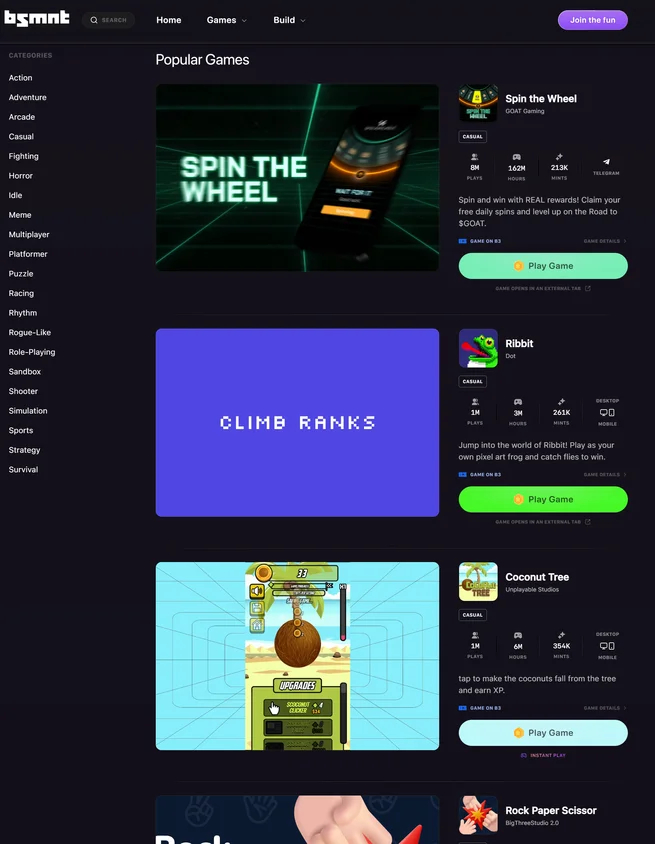
The core incentive mechanisms on the platform are Experience (XP) and Builder Points (BP). XP is earned by playing any and all games and can be used to “unlock various rewards within basement.fun” however exact details are scarce. BP is the platform’s core on-chain points system and is integrated into games or apps built directly on B3.
B3 is allocated BP to developers based on a set of parameters (designed to align incentives between devs and the platform) and used to reward user engagement.
It has been noted that both XP and BP can be converted into B3 tokens but exact exchange rates are yet to be determined and will likely not be fixed. Incentive systems like these are great at boosting user engagement, especially pre-TGE when the speculative upside is at its peak. However, we have yet to see an implementation in Web3 that is sustainable, distributed to only real users, or one that drives monetization.
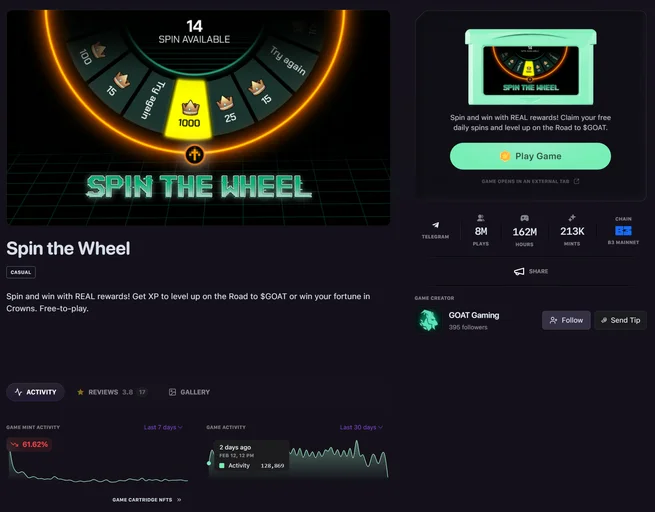
The platform conveniently displays recent player activity but unfortunately, there is a bug that means all metrics, regardless of when the game went live, only show up until the day after the token launch…
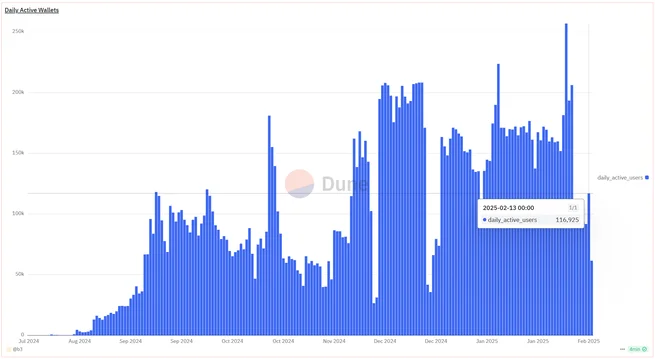
Depending on the source, B3 has anywhere between ~2M and ~6.5M total registered on-chain accounts (although note that one source states only ~850k accounts). DAU is currently between 14k and 90k, with the total number of transactions at between ~200M and ~230M, depending on the source.
Looking at the user metrics on basement.fun, although the irregularities make me question the legitimacy of this data, you can see that the number of daily players per title ranges from between <100 for titles with a collective <700k plays and >100k hours played to <1.5k players for a game that has a collective 1M total plays and >6M total hours played. The number one game on the platform has >40k players and a collective 8M total plays and 162M hours played (hint, it’s a click-to-play roulette wheel).
Summary
The B3 token launch has arguably been the most successful Web3 gaming token launch of 2025. Chances are the mix of a low initial float and favorable CEX listings played a bigger part in the success than the actual product at the time of writing. That said, fragmentation is a non-trivial issue for many consumer applications in Web3 and it is worth tracking how well B3 addresses these issues as more ecosystem features launch over time.
Ultimately, this sector has proven time and again that superior tech alone is not enough to grow market share. Good games > all else and B3 will need to continue to secure top-tier partnerships, such as Parallel Studio’s upcoming shooter.
In the short term, B3’s token price performance will likely be a leading factor in the platform’s popularity with Web3 users. My hope is that they can leverage their current momentum to maintain mindshare and secure further partnerships that cement their place as a leading Web3 gaming ecosystem.