
Before we dive in, here’s a quick intro to liquidations on lending protocols.
Liquidations on a lending protocol happen when a borrower’s collateral value drops too low, causing the protocol to sell the collateral to repay the loan. This ensures that lenders get their money back even if the collateral loses value. Third parties, such as searchers/bots, are incentivized to perform liquidations. Searchers compete with each other and bribe block builders to be successful by having their liquidation bundle accepted by a block builder to be added to a block.
On Jan 23rd this year, a position worth $4.18M was liquidated on Aave, and a searcher was rewarded with a liquidation incentive of $141,477. The searcher then had to bribe a block builder with $141,416 to successfully include the liquidation bundle in a block.
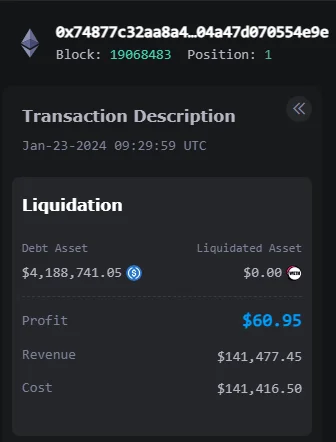
Why did the searcher have to pay 99% of their reward as a bribe? An estimate of $180Mn has been paid out as liquidation incentives on Ethereum mainnet. Why do lending protocols have to let go of all of this value? Let’s dive in further.

Lending Protocol Auctions Are Inefficient
Of the Lending protocols that use auctions for liquidations, Dutch auctions are often used to liquidate collateral. They start with a high price that decreases over time, avoiding capital lock-up for bidders. However, these auctions are inefficient during high market volatility, potentially delaying liquidations and not preventing OEV extraction. Protocols like MakerDAO use a reset function to address delays and significant price changes, but overall, Dutch auctions struggle with timely liquidations.
Searchers Compete In Block Space Auctions
Block space auctions on Ethereum lead to builders and validators capturing more value by creating competitive bidding environments. Searchers bid to order their transactions within a block, with the highest bidders winning but paying significant portions of their profits to validators. Block builders aggregate and bid on these blocks in PBS auctions, further driving up costs. This intense competition results in searchers often paying up to 99% of their profits to validators, highlighting a unidirectional flow of value toward validators and block builders, who ultimately capture the majority of the value in the transaction supply chain.
With Block builder centralization increasing and builders playing the role of an auctioneer and accumulating private order flow has led to costly bribes and inefficiencies in MEV/OEV capturing. An alternative is to move auctions to the oracle level, where price updates and the right to capture liquidations can be sold to a single bidder. However, this shift introduces new centralization risks as oracles gain more control over liquidations. Effective decentralization and incentive structures are crucial for mitigating these risks in oracle-based auction mechanisms like API3’s OEV Network, UMA’s Oval, and Pyth’s Express Relay.
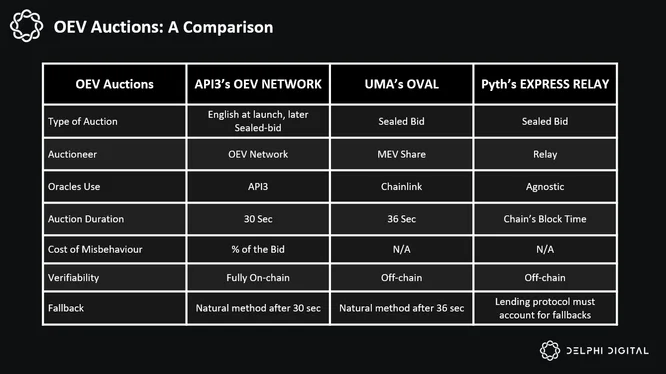
We dive into the inner workings of these OEV auction mechanisms in our report here