The post below has also been posted on Twitter by the Head of Delphi Labs Jose Macedo. You can read the thread on Twitter here: https://x.com/zemariamacedo/status/1839691280768696422?s=46
Tbh Initia is one of the rare teams I’d back without seeing a deck It helps I’m also bullish af on what they’re building. As @SmokeyTheBera put it: “Betting on these dudes to facilitate the appchain future that Cosmos fumbled”.
Thread on Cosmos, what it got right and wrong, and how Initia fixes this
https://x.com/initiaFDN/status/1838929323954200974
Cosmos had the right core idea: sovereignty and customisability matter. Developers want to control the ground they build on, and I continue to believe that most successful dApps will end up migrating to their own chains/L2s.
We’ve already seen this happen many times with the likes of Ronin, Flow, and Stepn last cycle, dYdX, Hyperliquid and Blast this cycle, and others like Ethena, Maker, and Synthetix launching their own chains/L2s soon.
We’re even seeing this happen on so-called “monolithic” chains like Solana with the rise of L2s/network extensions like Zeta, Code, Magicblock and many others.
See our “Solana the Modular” report for the best coverage on this.
So if Cosmos was right about sovereignty, why hasn’t it succeeded? I believe there are two main reasons:
a) it was conceived ~10 years ago before anyone knew what an L2 was. Many design decisions were made optimising for sovereign chains rather than roll-ups.
b) the Cosmos hub failed miserably in its role, because it misunderstood the role of a hub as merely providing a validator set In reality, this is only a small minority of what sovereign chains want/need from a hub in order to succeed.
Simple stuff like wallet integrations, block explorers, canonical bridged assets w/ liquidity, and even intangibles like BD/ecosystem development are actually far important and were left entirely up to the chains.
The result? Higher costs to building app-chains, fragmented UX as each app-chain does its own custom thing, and no ecosystem/community alignment to speak of (hence why @Neutron_org has stepped up to fill this role).
How does Initia fix this? Put simply. Initia is an L1 built from the ground up to enable a new-generation of sovereign yet interwoven roll-ups. It fixes the problems of Cosmos by asking the simple question: what do users (i.e. roll-up builders) actually want from a hub?
I believe this can be reduced to three main things: flexibility, connectivity, and alignment. Flexibility – Builders want to be able to use whatever VM/language they want, and to easily customise their execution environment.
Initia launches with MoveVM, Cosmwasm, and EVM options – the widest array available anywhere. It will also leverage the Cosmos SDK and allow builders to plug in any Cosmos SDK module (e.g. AuthZ, Bank, etc), inheriting best. https://docs.initia.xyz/deploy-minitia/customizing-minitia
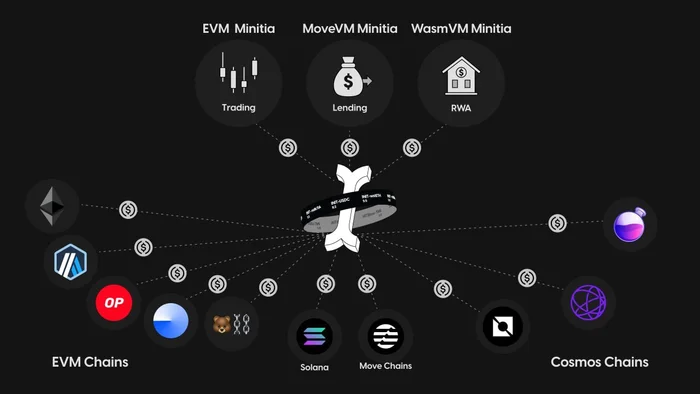
Connectivity – Builders want their users to be able to easily bridge all major assets to their roll-up from any other roll-up, and from all major L1s. “Easily” here means without switching wallets, figuring out which bridge to use, or incurring massive slippage.
Initia L1 will have a custom Layer Zero bridge module, creating a canonical bridge which is inherited by all Minitias (Initia roll-ups). There will also be a canonical L1 dex (Minitswap) leveraging a novel “Enshrined Liquidity” mechanism.
This is similar in spirit to Berachain’s Proof of Liquidity – enabling individual or paired INIT tokens to be staked with validators and incentivising deep on-chain liquidity for whitelisted pairs at the L1 level.
In addition to enhancing L1 security, when combined with IBC (initially permissioned) this mechanism also enables inter roll-up transactions, allowing seamless bridging/swapping between roll-ups.
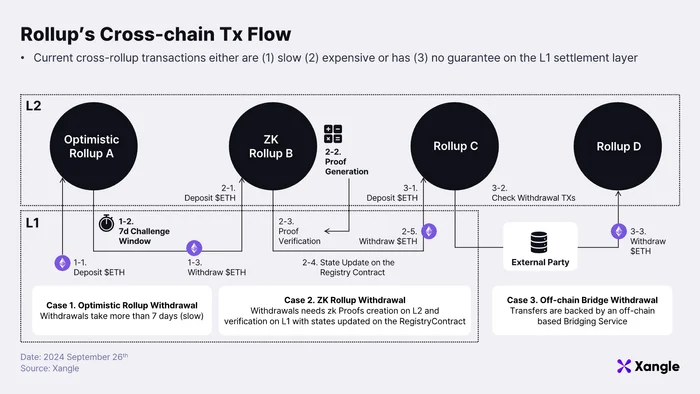
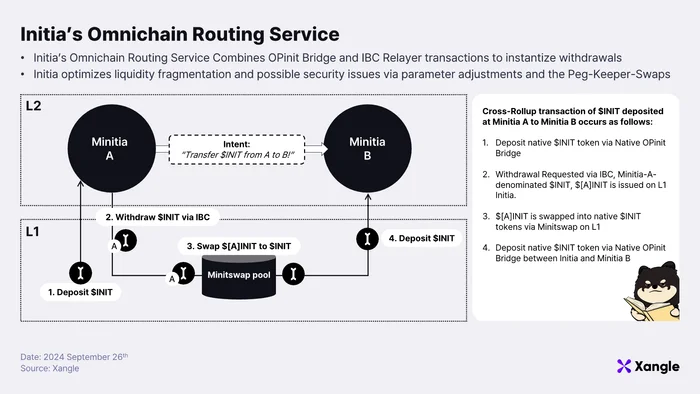
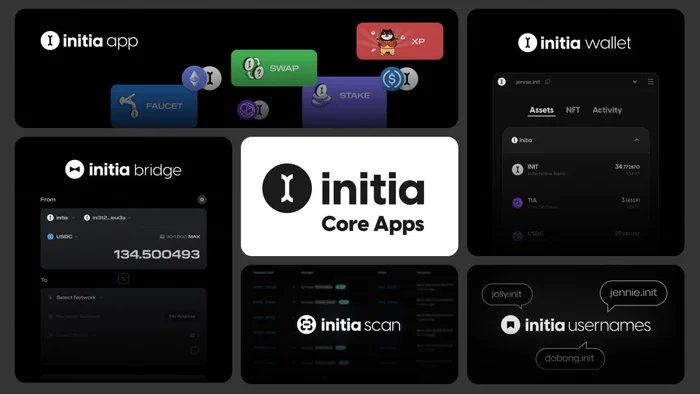
Alignment – Builders want sovereignty without sacrificing the benefits of having an aligned ecosystem behind them. You can think of “alignment” as the benefits you get from launching as a hyped Solana app in the current meta, or as an ETH-aligned app in the previous meta.
These benefits include tooling (e.g. Solana blinks), captive base of existing users/shillers, investor interest, cross-promotion, but perhaps most importantly:
alignment around a schelling point asset which reflects the value of the broader ecosystem.
Initia achieves this in several ways. In addition to “Enshrined Liquidity” which naturally makes $INIT the most liquid pair in the Initia ecosystem, perhaps the most interesting innovation is the Initia Vested Interest (VIP) program.
This can be seen as a programmatic grants program: automatically distributing $INIT to the highest performing Minitias based on objective metrics. It serves to ingrain $INIT within apps and allows them to use it as a retention mechanism to attract more users. It also creates positive-sum, in-built alignment between Initia, Minitias and their users.
As you can see, every part of Initia’s tech stack was custom-designed to empower Minitia builders with everything they need to succeed. It’s no wonder they’ve already developed arguably the deepest ecosystem among alt L1s with stud teams like @controrg , @blackwing_fi, @milky_way_zone, and many others.
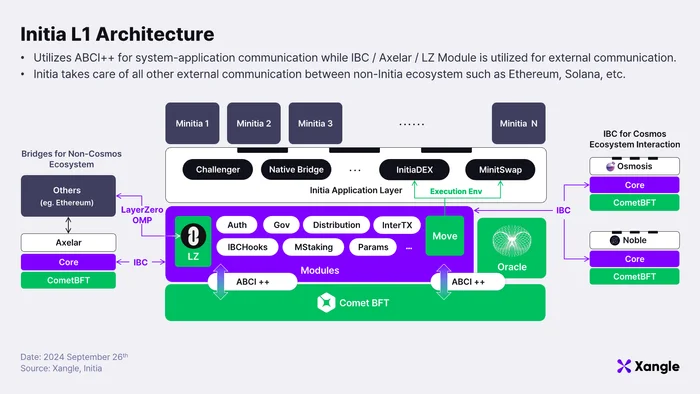
To my knowledge, Initia is also the only alt L1 whose ecosystem projects have raised more than the L1 itself – a very encouraging stat since ultimately an L1’s value should come from the ecosystem of projects built on top of it. For a good deep dive on the ecosystem, check out the report below: https://xangle.io/en/research/detail/2108#h-3—-Interwoven-Applications
Finally, I’m incredibly proud of this team for going against the grain and choosing to do things the right way. In a market where they could’ve raised 9 fig rounds and followed the low-float high FDV playbook, Initia chose a harder but imo long-term better path.
They raised the minimum they needed from VCs to ship, selling only 15% cumulatively. They then offered up 1% of the supply to community investors via @echodotxyz, enabling everyday ppl to get in at a better valuation and terms than VCs. The rest of the tokens (excluding team) will be distributed to the community via the treasury and VIP program, ensuring Initia is majority community owned.
While going against the grain is always risky, I believe they will ultimately be rewarded and pave the way for other high-quality projects to follow this route.
On our side, @delphi_ventures couldn’t be more excited to be along for the journey!