
While Solana has been the breakout success story of recent years, its DeFi ecosystem has trailed Ethereum in product diversity. However, with faster blocks and cheaper transactions, Solana is perfectly suited for DeFi innovation and growth. The success of yield trading and points farming on Ethereum, exemplified by Pendle’s remarkable journey from $0.05 to over $7 (140x rise), sets an interesting precedent for Solana’s ecosystem.
Solana now boasts a rich universe of yield-bearing assets that are suited for the growth of a yield trading ecosystem:
-
Staking (LSTs): mSOL, JitoSOL, bSOL
-
Restaking (VRTs): ezSOL, kySOL, kyJTO
-
Perps LP tokens: JLP, DLP (Drift), FLP (Flash Trade)
-
Stableswap LP tokens: Meteora, Saber, Perena
-
Yield-bearing stablecoins: USDH, YBX, SUSD
-
Staking yield: RAY, JUP
-
Bribing yield: veMNDE, veBLZE, veLFNTY
-
Lending protocol receipt tokens: On Kamino, Solend, marginfi
Three major players have emerged in Solana’s yield trading space, each incorporating Pendle-like components such as liquid yield token standards, yield stripping mechanisms, and Time Decaying AMMs. These protocols also generate fee income for providing the infrastructure:
-
Trading Fees: Trading fees on every trade facilitated by the AMM is split between the LPs and the protocol.
-
Yield Fees: A small portion of the yield accrued from the yield bearing asset is collected as a management fee, while the majority is streamed to the LPs and YT holders.
Rate-X
(TVL: $36.7M)
Leading the pack with the broadest market coverage, Rate-X’s key differentiator from other products is through its leveraged yield trading (offering up to 10x leverage on YTs) for certain assets. It makes it a better avenue for traders and users looking to hedge their yield from yield bearing assets with lesser capital requirements.
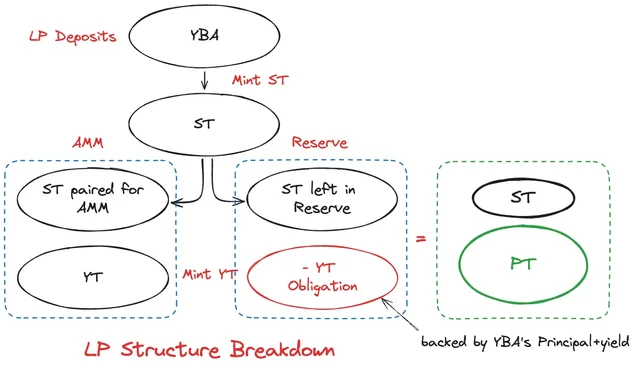
Their AMM differs from Pendle’s design and pairs both the YT and ST together. It manages YT value decay through a time-decay mechanism, adjusting ST and YT pool quantities in the AMM based on confirmed APY after settlement periods. This is done by moving ST tokens from the LP pool to a reserve vault to account for the decrease in value of YTs in each settlement period. LPs can choose between standard or custom yield ranges for LP positions like any other concentrated liquidity AMM. It requires manual rebalancing from users if they wish to concentrate liquidity as pools move closer to maturity.
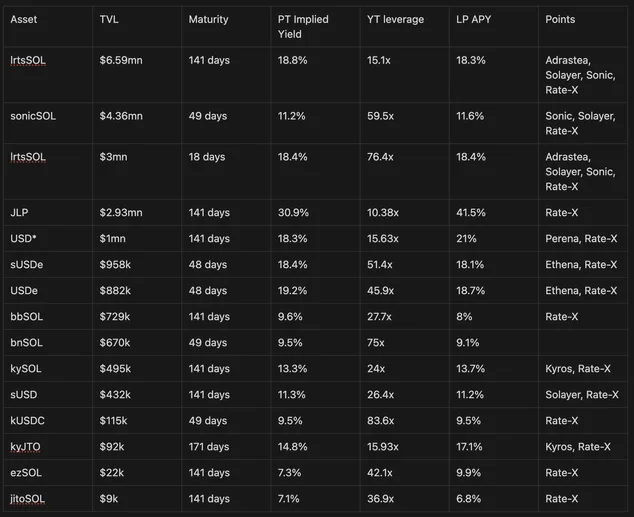
Key farming opportunities I’m looking at: lrtsSOL (18d maturity), JLP pool LPing, sUSDe (48d maturity), USD*, kySOL and kyJTO.
Exponent
(TVL: $8M)
Exponent pools are focused on points farming for upcoming token launches and follow on airdrops (Perena, Kyros, marginfi, kamino).
Exponent’s Time-Dynamic AMM uses a Pendle like approach to liquidity management through automated concentration that adapts based on time to maturity. At its core, the pool pairs Income Tokens (PTs) with their underlying yield-bearing assets (YBA) to minimize impermanent loss through natural price correlation. The system’s Flash Swap mechanism enables LPs to provide liquidity for both yield shares and fixed yield markets through single asset exposure in a unified market.
This AMM’s design handles yield share (YT) purchases and sales more efficiently as compared to the Rate-X AMM. When users buy YTs, the system automatically deposits their funds to mint both yield shares and Income Tokens (PT), with the latter being sold back to the pool for the underlying asset. When users sell YTs, the system automatically borrows equivalent Income Tokens (PT) from the pool, combines them with the YTs to redeem the underlying asset (LYT), then sells a portion of the LYT back to the pool to repay the borrowed PTs, with this process affecting PT prices in response to the YT sale.
As these tokens progress toward maturity, the AMM dynamically adjusts liquidity – starting with high sensitivity when significant yield is available early in the market, then gradually decreasing to zero price impact at maturity when yield distribution ends.
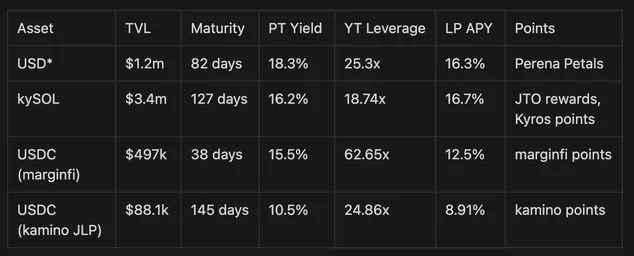
Key farming opportunities I’m looking at: kySOL (higher implied yield vs Rate-X) and marginfi USDC pool (higher yields compared to Sandglass pools).
Sandglass
(TVL: $10.1M)
Built by the Lifinity team, Sandglass offers a straightforward Pendle like experience, focusing on LST tokens, stablecoin vaults, and JLP markets. While their implementation is more conventional, it provides a familiar experience for DeFi users. Sandglass has extended their product onto the SVM validium: Eclipse with a single yield market.
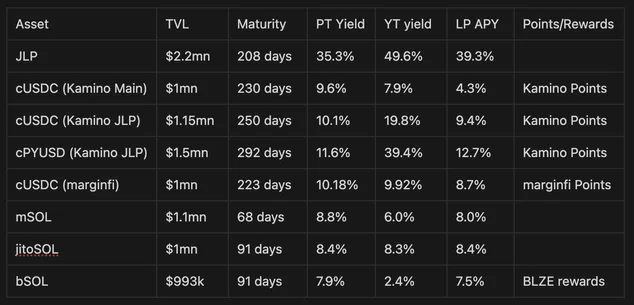
The yield trading opportunity on Solana is just getting started as evident by the low TVL deposited in these protocols. The combined value locked between these protocols is below $60mn currently – far below some of the individual markets on Pendle’s instance deployed on Ethereum. This low TVL, interest also presents a cheap farming opportunity for tokens of DeFi products with proven PMF being built on Solana.
Both Rate-X and Exponent have design features that I would want to see combined into a single product – Rate-X’s leveraged yield trading and support for cross chain yield tokens and Exponent’s AMM design. Solana’s yield trading products so far lag behind their Ethereum counterparts in features such as orderbook liquidity (Pendle), support for synthetic asset (Pendle V3) and permisionless market creation (Napier). I don’t expect to see these teams to build out these features anytime soon until a proven demand for yield trading on Solana has been established. Regardless these are good DeFi farming opportunities to look at especially for holders of yield bearing SOL.
Disclaimer: I am farming points and tokens on Rate-X, Exponent and Sandglass across a few asset pools.