
You know the old saying, “Another day, another central bank has been repatriating its gold reserves as insurance against a deglobalizing and increasingly volatile world.” At least, it will probably become an old saying soon enough.
India, a key player in the global financial landscape, has recently made a significant move. The Reserve Bank of India [RBI], which had been storing half its 822 tons of gold reserves overseas at the Bank of England, has brought 100 tons of their gold (~$750M) back to India. This decision, the first of its kind since 1991, marks a significant shift in India’s approach to its gold reserves, underscoring the evolving dynamics of global finance.
Unsurprisingly, I have thoughts
The process of repatriating gold on such a scale is a monumental task. One hundred tons of gold is an enormous amount, and the logistics involved in moving it are undoubtedly a nightmare. The fact that a nation would undertake such a task is a stark reflection of the perceived risks in the current financial system. In a world where geopolitical tensions and sanctions are on the rise, holding gold overseas is a significant gamble. This move signals a growing trend of nations seeking to maintain control over their assets, despite the challenges and risks involved.
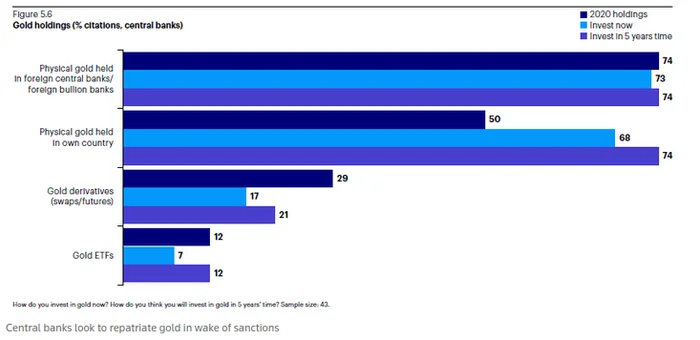
Reuters published an article in mid-2023 highlighting that 68% of sovereign wealth funds and central banks were unwilling to hold assets overseas—precisely because of sanctions and seizures. The survey also highlighted the trend of seeing gold derivatives as much less attractive. I expect these trends to continue for a decade.
The Bitcoin Question
The other thing to consider is how Bitcoin and other blockchains fit into this increased sanctions and distrust paradigm. On the surface, Bitcoin seems tailor-made for these types of situations. Bitcoin and other chains are trustless and verifiable. Custodying and transferring crypto assets are easier, with fewer trust assumptions than other reserve assets. Crypto and Bitcoin can be highly secure. But, I am less sure that these advantages will mean much in the new world.
Banks are signaling that they trust the traditional financial system less and less. Sanctions and seizures become much more common during times of conflict and will probably become more frequent. But, realistically, crypto has little insulation against national sanctions. Exchanges and fiat off/on-ramps are easy targets for sanctions—and we have already seen it happen. For nations involved in the adversarial shifts of international relations, crypto probably offers little utility for its citizens and institutions.
However, Bitcoin and maybe Ethereum could find some utility in unaligned nations. El Salvador paved the way years ago by adding BTC as a national reserve asset. As unaligned nations attempt to navigate the world, some could adopt crypto assets to hedge against conflict and unfriendly nations. Bitcoin especially is a promising third or fourth options for nations. Fiat and national debt is beholden to their issuing nations, meanwhile, metals and commodities are large, heavy, hard to store, and extremely risky to ship around – Zeihan has been predicting a return to convoys due to the oceans becoming less safe. Crypto, meanwhile, is controlled by no one and could theoretically offer a way for nations to diversify their reserve assets and give them greater sovereignty over their assets. If I had to guess, Central and South American nations would probably be the ones that experiment further with crypto reserve assets.
Brave New World
I have been beating this drum for a while, but the world is becoming more volatile, and there is little evidence of that trend slowing down. At the very least, I recommend crypto investors consider what a world of increased sanctions and conflict means for their crypto investments. Central banks are sending strong signals that trust between nations is declining, and we have not considered what that means for crypto.