
Intro
History has demonstrated that almost every time we approach a new paradigm in gaming (e.g., arcades → home consoles, or PC/console → mobile), it often takes some time before infrastructure advancements meaningfully impact the application layer. More often than not, genesis content tends to mirror previous generations, with some added incremental improvements on top. It can sometimes take years before future waves of content fully utilize the new technology to create new experiences. Broadly speaking, the first generation of blockchain games all belong to existing genres and have integrated blockchain elements to varying degrees of success. We have yet to see any standout examples of gameplay that is uniquely enabled by blockchain.
If you believe blockchain’s role in gaming is to evolve beyond an incremental value add, then a natural path of progression for many projects will be towards an end-state that is fully on-chain. This transition of state will subsequently lead to a meaningful expansion of the surface area for experimentation. Many of the most attractive properties of a blockchain-based architecture (permissionless composability, immutable, persistent, etc.) are only unlocked under this framework.
The TLDR is that we are witnessing a renaissance in blockchain gaming and expect to see innovative ideas and credible products make it to market over the next 12-24 months. That said, the current technical limitations mean that in the short term, we are unlikely to see product-market-fit or scalable games with a legitimate chance to carve out a slice of the ~$184.4B global gaming revenue pie.
This report will look to define what a fully on-chain game is, where they lie on the spectrum of blockchain games, highlight some of the leading projects, outline the key considerations, and speculate on how things will develop in the future.
On-Chain Gaming
On-chain games are not simply defined by the extent to which they leverage blockchain technology throughout their various assets, systems, mechanics, etc. To this effect, not all “Web3 games” are created equal. Gubsheep (Brian – 0xPARC/Dark Forest) presented the most widely accepted definition of the sub-sector in July 2021 when he outlined five main principles:
- “The source of truth for game data is the blockchain.”
- “The game logic and rules are implemented via smart contracts.”
- “The game is developed in accordance with open ecosystem principles.”
- “The game is client-agnostic.”
- “The game embraces the financialization of digital assets.”
In a sentence, a fully on-chain game is defined as using a blockchain to store all its data and smart contracts to enact the game logic and rules in a client-agnostic manner. Under these prerequisites, on-chain games unlock a number of defining features, such as interoperable/composable assets and systems, permissionless design philosophy, trustless persistence, and immutability. Additionally, the use of a blockchain-based architecture results in the end product embracing the financialization of game assets and the adoption of open-source building practices by default.
Notably, one should understand that the end goal for fully on-chain games is not for the blockchain to be just an infrastructure layer that mirrors data also stored in a proprietary server or for it to be a place where only a fraction of game systems will live. Ultimately, it should be used to replace all traditional alternatives to fully take advantage of the perceived benefits. The execution of game logic should be permissionless, and the community should be able to interact independently with the core smart contracts. The ultimate test for a client-agnostic game is if the original client was shut down today, would the game still be playable tomorrow?
Timeline
As previously stated, not all blockchain games are created equal, and to better understand the current landscape and the potential future for on-chain games, it is important to understand the history of the sub-sector. One of the first fully on-chain games was Huntercoin, a gamified mining loop launched in 2014, where the blockchain was the game. From 2015 onwards, we saw several game-focused on-chain experiments, such as Tug Of War and Galleass. These were followed by more hybrid design models, such as CryptoKitties in 2017, the NFT breeding game that took over Ethereum, and later Axie Infinity, which went on to popularize the term play-to-earn and onboarded millions into Web3.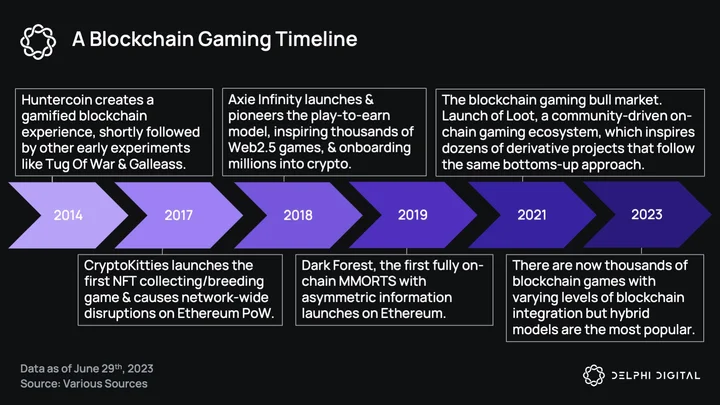
Ultimately, hybrid models facilitated (relatively) better scaling and ultimately captured more widespread attention, allowing them to spearhead the blockchain gaming bull market in late 2021. However, there were two standout projects that found moderate levels of success and brought significantly more attention to fully on-chain games.
In 2019, Dark Forest (DF), an Ethereum-based MMORTS, was launched by a small team from the 0xPARC Foundation (more about that later). DF has attracted more than 10k unique players since launch, and the most popular game mode sees players, AIs, and smart contracts compete over a week to collect resources, conquer planets, and dominate an infinite universe. The big unlock made by DF was the use of zkSNARK proofs to bring fog-of-war (AKA information asymmetry) to fully on-chain games. This allowed for a more engaging core loop and introduced social dynamics on a level not seen before in fully on-chain games.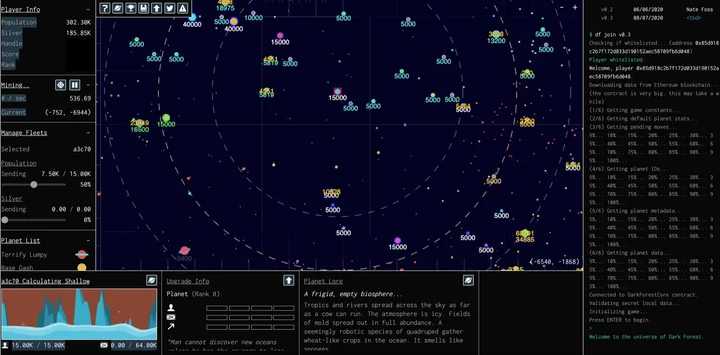
Many of the first wave of on-chain projects lacked information asymmetry becau
Read the full report
This report is part of Delphi Pro.
- 800+ Pro reports across every major sector
- Talk directly with our analysts
- Private community of funds and builders
Already a Pro member? Log in
0 Comments