Introduction to Edge
Big shout out to @therobotjames as the main inspiration of this report and thought framework. The lessons learned from @therobotjames deserved to be shared and experience by more people. Further detailed sources, lessons and resources on the following topics can be found at the end of this report.
Edge is a repeatable process in which a trader can expect to make money over time, net of costs and fees. In other words, edge can be thought of as a trading process with positive expected value. Expectation is integral when defining edge.
What is expected value (I’m not Sam Tabasco, I promise…)? Expected value is a statistical measure that represents the projected average outcome of a particular trade over time. Let’s use a simple coin flip example to illustrate how this works.
Scenario 1: Suppose you flip a coin and if it lands on heads, you get $15. If it lands on tails, you lose $5.
Scenario 2: Now, suppose you don’t flip the coin, but instead are guaranteed $5.
Which scenario should we choose, assuming rational actors are playing our game? This is where expected value helps us make informed decisions.
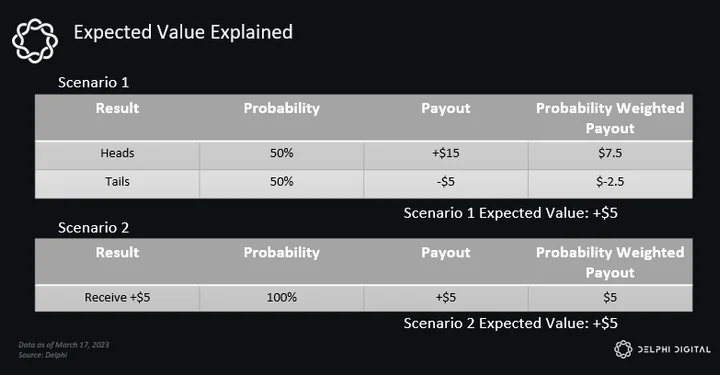 Expected value is calculated as follows:
EV = (probability of heads x amount won) + (probability of tails x amount lost)
In scenario 1, the expected value = (0.5 x $15) + (0.5 x -$5) = $7.5 – $2 = $5.
In scenario 2, the expected value is simply $5 because you will always receive $5.
Scenarios 1 and 2 have the same expected value of $5, albeit with different risk profiles. We can see that we are taking unnecessary risk in scenario 1 with the same expected payout as scenario 2, making scenario 2 the much more attractive option. We are not being compensated for the extra risks associated with scenario 1.
However, if we make scenario 1 a bit more enticing, will this change our choice?
Scenario 1: Suppose you flip a coin and if it lands on heads, you get $15, but if it lands on tails, you lose $3 (instead of $5 originally).
Scenario 2: Now, suppose you don’t flip the coin, but instead are guaranteed $5.
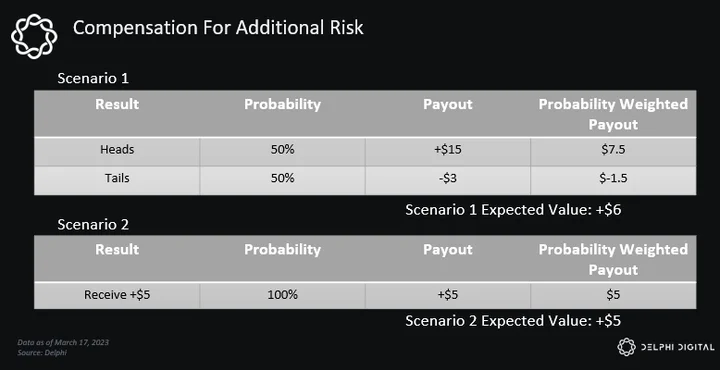 The answer is, well, it depends on if we are finally being compensated for the additional risk!
We can calculate scenario 1’s new expected value to be $6. Scenario 2’s expected value is unchanged at $5. We can see that we are now being compensated more than we previously were for the difference in risk profiles between scenarios. Whether or not this additional compensation is adequate is another question entirely.
What might this example look like for financial assets?
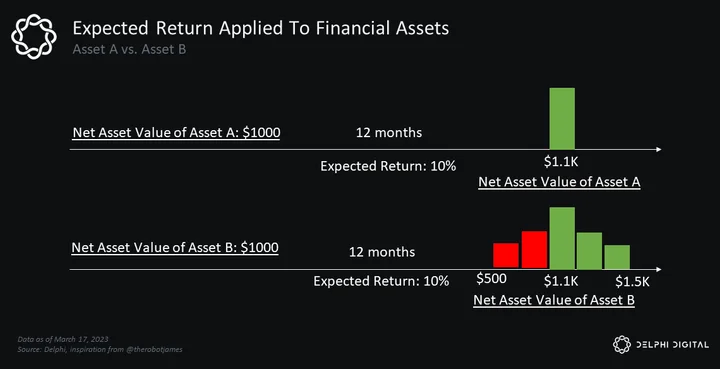 Asset A and Asset B are both priced equally at $1,000. Asset A has a guaranteed return (thus expected return) of 10%, yielding an NAV of $1,100 after a period of 12 months. Asset B has an expected return of 10%, with an actual NAV varying from $500 to $1,500. Asset A is priced like a fixed income asset, while Asset B resembles a return profile more akin to that of a stock.
In the above scenario, given the same pricing, it would make no sense for market participants to purchase Asset B, assuming more risk for no additional expected return. Market participants would likely begin to sell Asset B until the price fell more inline with the risk profile.
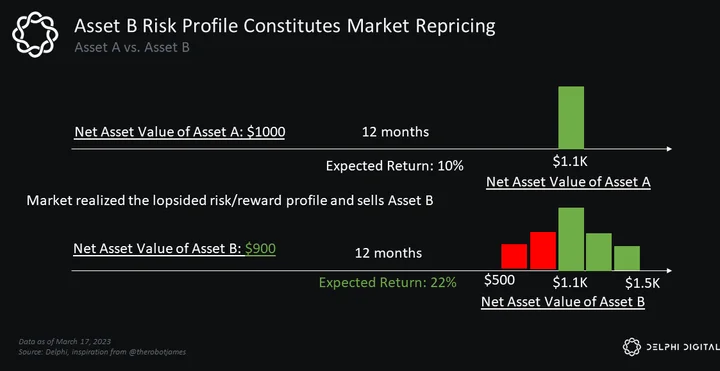 After some time, the market will have determined a new fair value for Asset B relative to Asset A. In this simple example, we can see that the market has sold Asset B down to a price of $900 while Asset A remains at $1,000. With this shift in asset pricing, the expected return of Asset B has now increased considerably, making it a much more attractive option.
How to Go About Locating and Extracting Edge
First and foremost, it is important to realize that trading is a job, not a hobby. Take it seriously and always have a plan. Trading is one of the hardest jobs due to the highly competitive nature of it, so treat it as such. With that out of the way, we can focus on some things to avoid first.
Stop Doing Dumb Stuff
Beginner traders need to avoid the following mistakes at all costs in order to survive, before they should even start thinking about being consistently profitable:
-
Trading too often — incurs excess spreads, fees, etc. This is known as death by a thousand cuts.
-
Trading too big — leverage o
Read the full report
This report is part of Delphi Pro.
- 800+ Pro reports across every major sector
- Talk directly with our analysts
- Private community of funds and builders
Already a Pro member? Log in


0 Comments