
Introduction
The second half of the most recent bull market, colloquially named the “double bubble,” was dominated by the “L1 Wars” narrative. The initial spark was Avalanche’s announcement of “Avalanche Rush,” a $180M liquidity mining incentive program. The day of the Avalanche Rush announcement led to a 28% gain for the AVAX token, followed by a nearly sixfold surge in price over the subsequent three months.
This success didn’t go unnoticed, prompting other L1 platforms to launch similar programs in an attempt to replicate Avalanche’s success. Commonly referred to as development, ecosystem, or incentivization funds, these initiatives invariably led to token price appreciation, increases in total value locked (TVL), and a proliferation of decentralized applications (dApps) with growing user bases.
But not all announcements are created equal. The way in which an announcement plays out in the short term is mostly dictated by the timing of the announcement, i.e., the broader market conditions at that point in time. Favorable market conditions pave the way for a pronounced impact on token price, user activity, dApp growth, and TVL. Conversely, less favorable conditions result in a more muted impact. Over a longer time frame, however, the effects of market conditions even out, and sustained user engagement, dApps, and TVL emerge as indicators of success. Before we get into the market analysis, we will first explore the impact of these programs using the above as our lens.
Exhibit A
Avalanche’s announcement came at a very opportune time: roughly two weeks after BTC had bottomed in late July 2021. Avalanche introduced “Avalanche Rush,” a liquidity mining program that helped attract two major DeFi protocols (Aave and Curve) to its blockchain.
In order to encourage activity and usage, Avalanche offered token incentives to users of certain dApps. This approach served a dual purpose: firstly, it attracted a significant influx of capital, and secondly, it motivated developers to create and launch more dApps on the Avalanche L1.
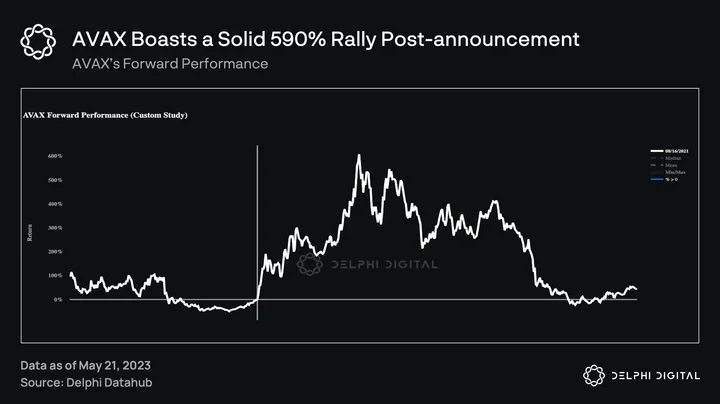
In the above chart, we can see that AVAX was trending up ever so slightly prior to the announcement (mostly trending in line with BTC price action) but saw a parabolic advance of 590% following the announcement. AVAX reached an ATH around 100 days after the announcement and has been in a downtrend ever since. The downtrend began on November 21st, 2021, correlating with the overall shift in risk markets. Currently, AVAX is down 38% from its pre-announcement levels. The ATH was formed closely following BTC’s $69k ATH, a correlation that hardly comes as a surprise.
A close relationship between AVAX’s price and TVL can be observed, with the latter displaying an even more stunning 48-fold increase. The rise in TVL was parabolic, reaching its peak within 107 days, but has been in a downtrend ever since. This is expected as the majority of the TVL consists of digital assets that have significantly dropped in price. Despite this decrease, it’s worth mentioning that the current TVL is still roughly three times greater ($758M) c
Read the full report
This report is part of Delphi Pro.
- 800+ Pro reports across every major sector
- Talk directly with our analysts
- Private community of funds and builders
Already a Pro member? Log in
0 Comments