The Income Statement Hierarchy
There’s a misunderstanding in crypto when people talk about “revenues.”
Revenue sits at the top of the income statement and not at the bottom. This matters because there are two types of revenue:
- Gross Revenue – Total fees collected
- Net Revenue – Gross revenue minus cost of revenue
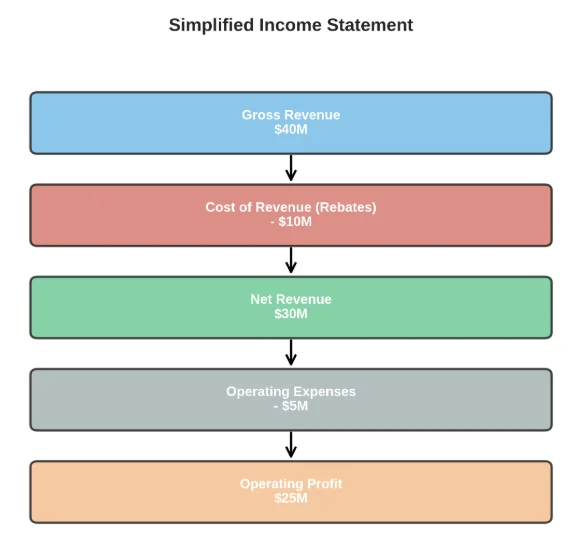
Cost of revenue (also called COGS – Cost of Goods Sold) represents the direct costs of generating that revenue. In traditional businesses, this might be raw materials or manufacturing costs. In perp DEXs, for some, the primary cost of revenue is rebates paid to market makers. This is a direct deduction from the topline that happens before you get to net revenue or operating profit.
Why does this matter in the context of perp DEX revenue?
Think about your taxes for a second. Even though we might flex our salary, you don’t measure your income by your gross salary. You measure it by what hits your bank account after taxes, 401k, and health insurance. Making $100k but keeping $65k is very different from making $80k and keeping $70k. Some of you might have read Rich Dad Poor Dad and know Robert Kiyosaki’s quote: “It’s not how much money you make, but how much money you keep.”
Similar logic can be applied to revenues. The goal isn’t to just generate (make/earn) the most revenue. It’s to keep the most revenue.
When CT tweets that “x” perp dex has $40M in annualized “revenue,” one of the first questions should be: how much of that is being rebated back to market makers? Or even more simply put: how much of that revenue does the protocol get to keep? If you’re paying out 25% in rebates, your actual net revenue is $30M, not $40M. Those cash flows never accrue to the protocol, therefore, they cannot be used for future growth or buybacks.
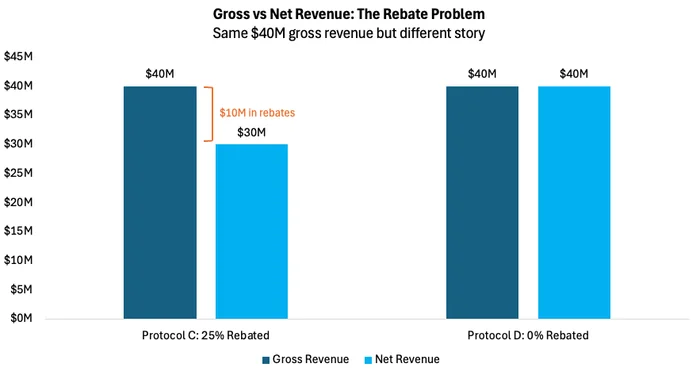
Protocol value ultimately derives from cash flows available to the protocol. These flows can be used for buybacks, protocol expansion (options, stablecoin, borrow/lend, etc.), or acquire strategic assets and/or businesses
Rebates fail this test. That capital is being extended (pun intended) to the market but provides zero value capture for token holders.
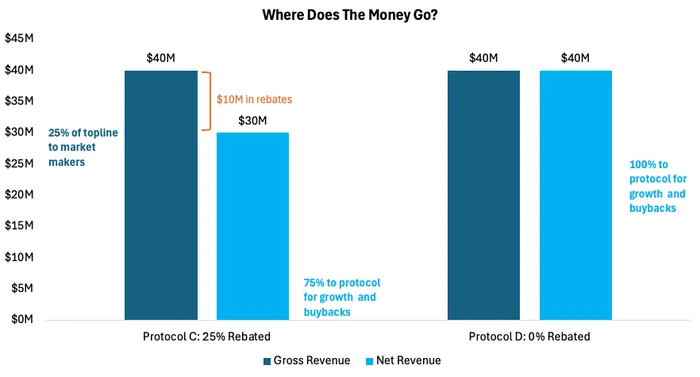
Some protocols give zero rebates. Every dollar of gross revenue = net revenue. This holds true for both Lighter and Paradex. The entire fee flows to the protocol for capital allocation decisions after operating expenses.
Should a protocol with $40M in revenue and zero rebates be valued the same as one with $40M in revenue but 25% rebates? Probably not.
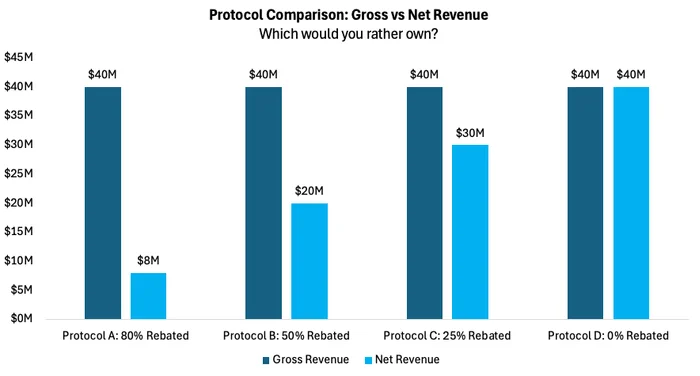
Going back to my tax analogy, we all pay attention to taxes and most of us optimize to keep more of what we earn. Revenues and businesses work the same way. The ones that keep more of their topline are in a fundamentally better position because they have higher margins, more optionality, and better unit economics. This is why it is important to understand the difference between gross and net revenues and which businesses have rebates and those that do not.