
Stripe just launched Link balance for AI agents. Its first integration is Instinct, an iMessage-native AI agent.
Link is Stripe’s digital wallet, which lets consumers pay with saved payment methods quickly and securely.
Link Agent Wallet allows popular agents like Muse, Grok Bot, and Instinct to spend on the user’s behalf with Link credentials. But you approve every purchase by hand. It launched April 29. Agentic purchases on Link grew 38x in September (volume 20x, ~$100 average ticket), with no base disclosed.
Link balance, released Oct 26, sits on top of the agent wallet. You pre-fund a dollar balance, set a per-purchase cap, and the agent spends autonomously within the cap.
Stripe Crypto brings together everything needed to enable agentic commerce.
From stablecoins on @tempo to secure non-custodial wallets powered by @privy_io, here’s what’s powering Link balance for AI agents, starting with @instinct. https://t.co/yn07R9uE1F
— Stripe Crypto (@StripeCrypto) October 27, 2026
Link balance runs on Stripe’s stack:
-
Onramp: Stripe Crypto Onramp converts the card load to USDC and keeps the spread.
-
Asset: USDC on Tempo
-
Wallet: a Privy self-custody wallet
-
Controls: Link Agent Wallet handles spend requests and per-purchase cap.
-
Card: a Visa prepaid virtual card issued by Lead Bank, with Stripe Issuing as program manager.
-
Settlement: Bridge pulls the exact amount at authorization, Stripe sells the USDC, and the dollars hit the card account, which sits at $0 otherwise.
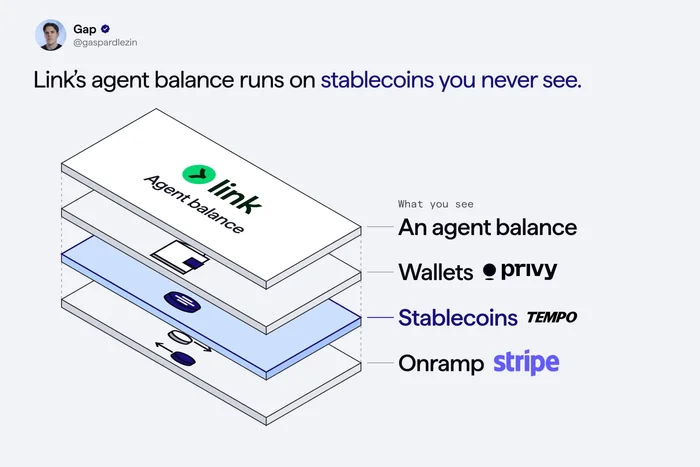
The user loads $150 by card. Stripe buys USDC on Tempo and stores it in a Privy wallet. When the agent makes a purchase, Lead Bank checks the balance, Bridge pulls the exact amount from the wallet, Stripe sells it, and fiat passes through the virtual card.
Stablecoins are fully abstracted away from the user and the merchant. The USDC only exists between load and spend. It is essentially a just-in-time card wrapped stablecoin payment.
Notably, Link balance does not utilize MPP. This is not true stablecoin payments adoption, but stablecoins as payment over MPP and x402 remains the endgame. For now, the card-wrapped stablecoin model helps navigate rules and regulations such as Visa’s card-fronting ban.
This is likely the first time a post-PMF consumer agent can spend autonomously. Instinct doesn’t disclose users, but its founder claims annual spend is approaching $1B, half of it travel. AI agents are already strong at discovery, now they have the capability to act on behalf of users in familiar settings like iMessage. The crypto-AI narrative is ready to rip, and Tempo is extremely well-positioned.
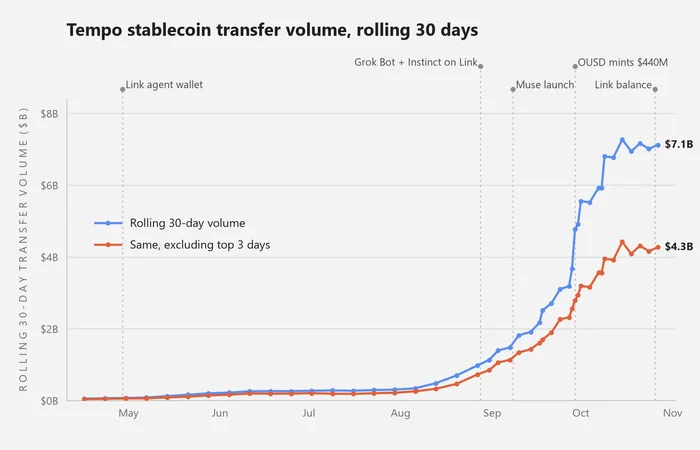
Tempo’s 30D stablecoin transfer volume has reached $7B. Much of this is due to OUSD launch and minting. Link Agent Wallet was launched in April, and the 38x growth figure cited by Stripe has no absolute number, so adoption to date is building from zero and could be low.
If Stripe can push OUSD adoption and swap it in for USDC, it would earn OUSD rewards on idle balances, and interchange on spend.
Instinct represents a turning point in consumer AI agents, and Link balance gives agents real payment capability for the first time.
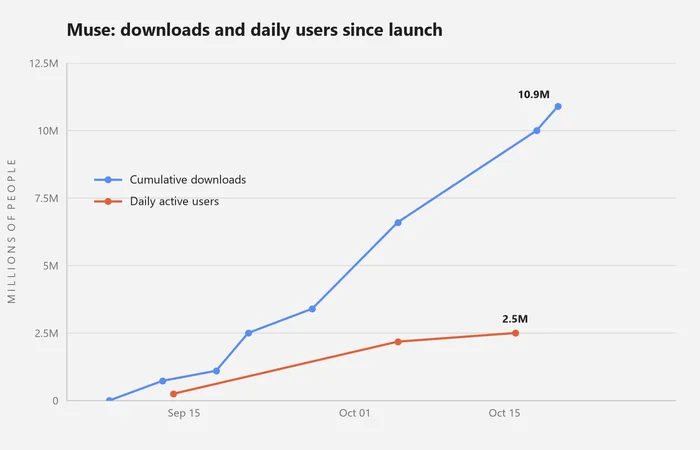
The balance belongs to the Link account, not the agent, so it can likely be shared across supported agents. Instinct is the first integration. The bigger unlock is Muse (10.9M downloads and 2.5M DAU in six weeks), Grok Bot (800K paid weekly users in early October) and future agents plugging into a universal balance. That is the UX agentic commerce needs for such a drastic shift in consumer behavior.