At Google Cloud Next conference last week, Jai Haridas, a VP at Google Cloud Platform, told the conference audience there are two terms coming up in every customer conversation right now. AI was one. The other term was sovereignty.
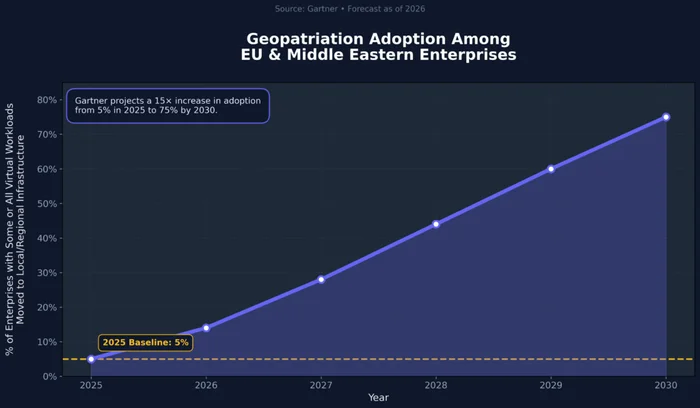
Gartner named geopatriation one of its top strategic technology trend for 2026. The term describes something companies are quietly doing more of, that of pulling cloud workloads away from US-based hyperscalers and depositing them into local, jurisdictionally controlled environments. A Kyndryl survey of 3,700 IT leaders across 21 countries released this week found 83% saying data sovereignty has become more important in the past year, and 65% saying they had already changed their cloud strategies because of geopolitical pressure. Gartner is projecting 20% of global sovereign cloud infrastructure as a service (IaaS) workloads will have shifted from global to local providers by 2027. By 2030, they think more than 75% of European and Middle Eastern enterprises will have moved some or all of their virtual workloads to regionally controlled infrastructure. This would be up from less than 5% in 2025.
The underlying reason is a legal incompatibility problem. The US CLOUD Act, the EU’s NIS2 directive, and China’s Data Security Law create three mutually exclusive legal regimes. A company operating across all three cannot simultaneously comply using a single hyperscaler. It’s not a hypothetical risk. Export controls can reclassify a workload overnight. Data residency rules can change faster than procurement cycles. What was a defensible cloud configuration in one quarter can become a legal exposure in the next.
The problem with the “local sovereign cloud” response is that it’s expensive and hardware-constrained. Geopatriated workloads cost 20-30% more than global public cloud equivalents. Nvidia historically prioritizes its largest hyperscaler customers when allocating its newest GPUs, which means smaller national sovereign clouds are often working with compute that’s a generation behind. What you get is an infrastructure setup that costs more, runs slower, and is operationally rigid.
Crypto networks like Akash, Aethir, and Render aggregate spare GPU capacity across providers distributed across 90 or more countries. The compute is routed dynamically via on-chain mechanics, priced by competitive market rather than hyperscaler list rates. It isn’t hosted in any one jurisdiction.
Building sovereign national AI infrastructure from scratch is one answer to geopatriation. A token-coordinated global compute layer that doesn’t care about jurisdictional exposure is another. Both solve the same problem. One costs 20-30% more and requires years of capital expenditure. The other already exists.