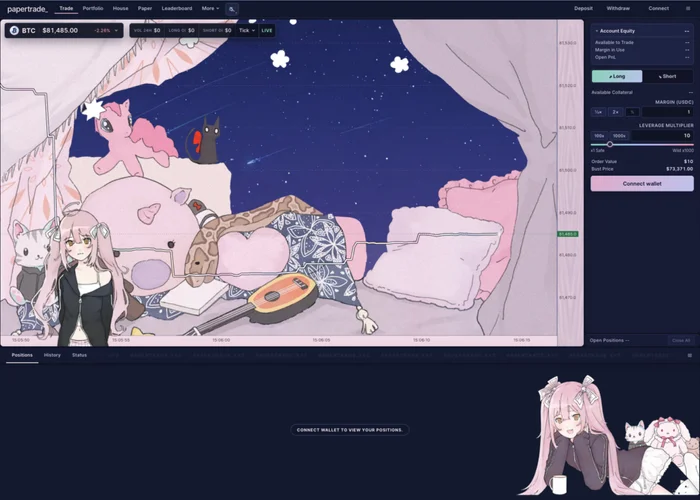
PaperTrade is making the rounds with pre-deposits opening today ahead of its much-anticipated launch, one of the more exciting onchain game-theory experiments we’ve seen in a while for perp enjoyooors and gamblooors. The basic TLDR is onchain Rollbit-style synthetic crypto perps with up to 1000x on BTC & ETH, no traditional maker/taker trading fees, no slippage, no funding fees, with an LP fee-claim token ($PAPER) that you earn via losses and stake to receive a share of protocol profits – built atop the HyperEVM.
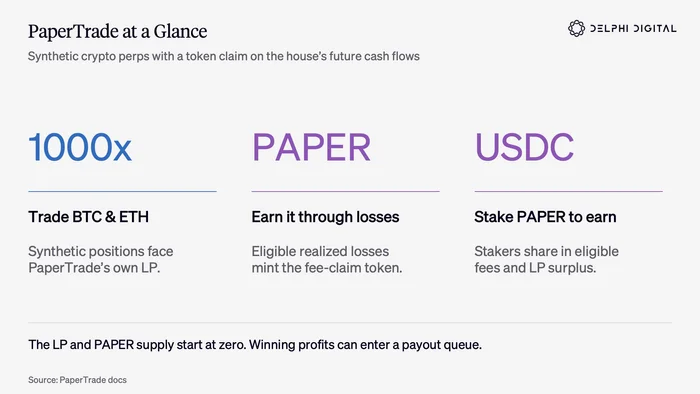
While the trading UX/casino aspect is pretty interesting on its own, I’ve seen alot more discourse on CT about farming PAPER, what the most efficient strats could be, even some new side projects spun up to accumulate as much PAPER as possible. Of course, the performance and benefits of farming PAPER ultimately depend on the protocol’s success and how many people actually trade on it.
Rollbit can give us a pretty clear precedent for this sort of synthetic product with 1000x lev. According to Rollshare.io, Rollbit has had about $608M in total futures wager volume (not notional) in the last 180D, generating nearly $9M in revenue for the casino. The broader crypto casino audience is incredibly broad as well, Stake advertises over 60M registered customers and $30B in monthly wagers across its platform.
To me, PaperTrade’s appeal is bringing that experience onchain, where the bankroll, payout queue, and oracle are verifiable and deterministic. PAPER also gives users a direct claim on fees and LP surplus, which could give traders a reason to stick around after a losing session.
How the house works
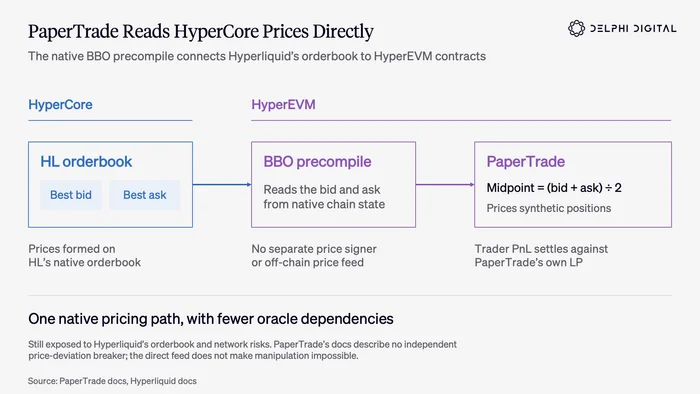
PaperTrade prices BTC & ETH trades directly from Hyperliquid’s mid-price, and settles each position against the LP. That is why there is no slippage or funding fees regardless of size, the house/LP just takes the other side of your position 1:1.
Since this is built on the HyperEVM, this price feed also comes directly from Hypercore via precompiles, making for one of the most bulletproof and decentralized oracles you can have, with no other infra needed between PaperTrade and HL’s orderbook – critical for a protocol like this so that it cannot be easily manipulated.
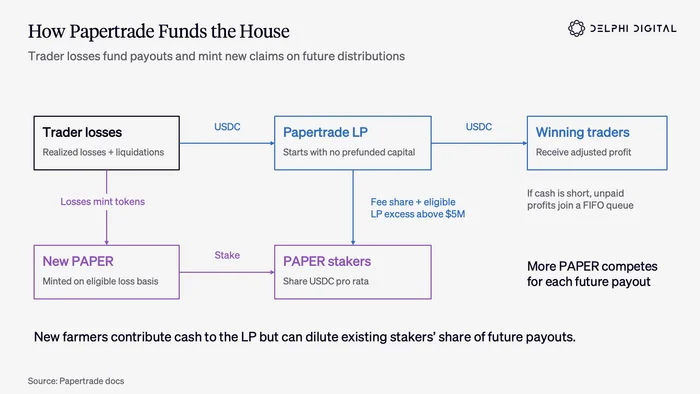
The PaperTrade LP will start at zero at launch, intended to bootstrap itself from traders’ losses (who will be incentivized to lose money for PAPER). Users’ losses then build the bankroll, while any winners take money out of the pool.
If, for some reason, there isn’t enough cash to pay a winner, the unpaid profit goes into a first-in, first-out queue, and later losses go towards those claims. Your initial cash-funded margin would be returned on close, but a winning trade could, in theory, leave you waiting for profit.
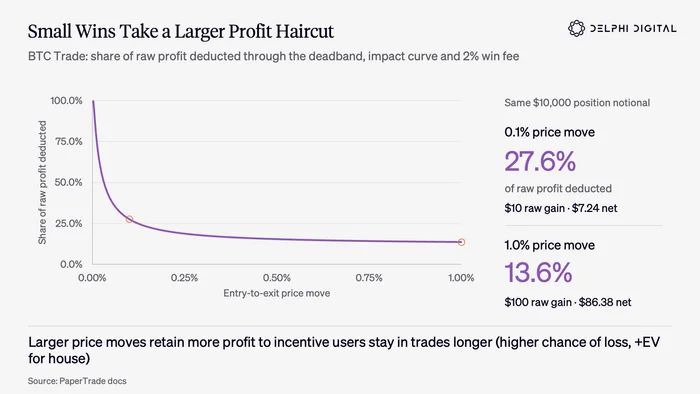
The “house” gets its edge from taking a cut on any winning trades. PaperTrade trims any profit through an asymmetric impact curve, with small price moves taking a larger percentage haircut. This likely incentivizes traders to stay in winning positions longer, which also then increases the odds of liquidation or closing at a loss. There’s another 2% fee on the profit left after that haircut as well.
As we know, PAPER is the LP fee-claim token that allows you to own the house. “Owning the house” means staking your PAPER to get your share of fees and traders’ losses. Half of the 2% profit fees go to stakers and the other half to the developer. Stakers also receive LP surplus payouts above the current $5M balance threshold, so you want to see trader losses pile up into the pool.
Launch phases
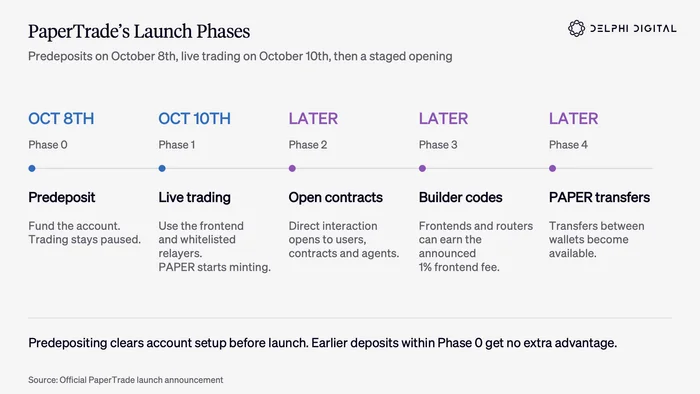
The PaperTrade launch is taking place in stages. Predeposits opened today, followed by frontend-only trading to go live in Phase 1 on October 10. Phase 2 opens direct contract access, allowing for automated strats, followed by builder codes in Phase 3 and PAPER transfers in Phase 4. The later phases don’t have any announced dates yet.
Farming PAPER
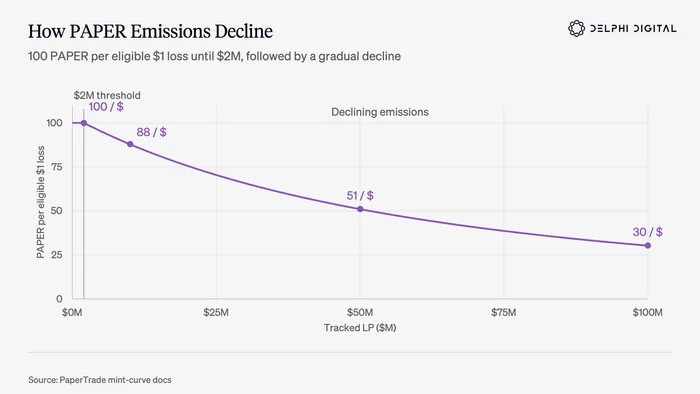
The farming side is pretty straightforward at first glance. PAPER starts with zero supply and only mints through realized losses. Below the $2M LP balance threshold, the rate is 100 PAPER per eligible $1 lost, maximizing incentives for losses that add capital to the trading pool. Above that, emissions gradually decay as the protocol records more LP gains beyond the threshold. Under the current curve, another $3M of progress brings the rate to about 95 PAPER/$, and $8M brings it to about 88 PAPER/$.
I think the instinct to get liqd early makes sense if the goal is to get some PAPER staked before everyone else starts trading into the pool. But I wouldn’t assume it’s the best way to farm your whole desired allocation. At the flat rate before $2M in the pool, losing $100 outright buys 10,000 PAPER, or roughly 1c per token before any staking income.
To lower the cost, you could pair a long with an equally sized short on PaperTrade. The losing leg mints PAPER, while the winner recovers some of the cash you lost. This is where the leverage you choose matters. At 1000x, a move of roughly 0.052% can wipe the loser’s entire margin, while the winner only earns PnL on that small move, then takes the larger impact haircut and 2% settlement fee.
On a lower leverage pair, the winning leg will take a much smaller percentage haircut off a larger price move. Recovering more through your winner could make a huge difference to the actual cost of PAPER farming.
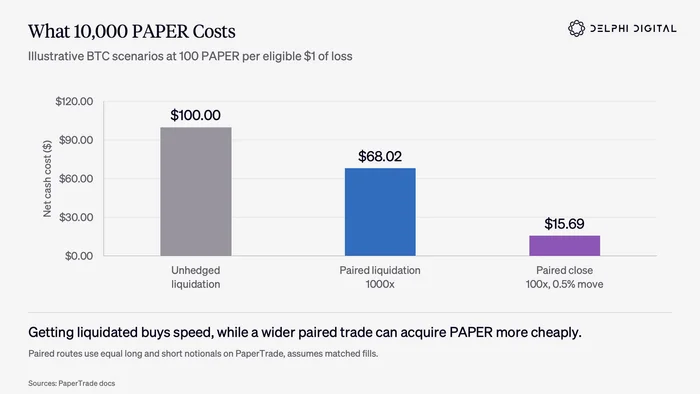
To put more context behind this chart, $100 of margin on each side at 100x gives you a $10k long and a $10k short. Close both after a 0.5% BTC move, and the loser drops $50, while the winner returns about $42.31 in profit after the haircut and fee. You’ve spent roughly $7.69 to mint 4,900 PAPER, or about $16 per 10,000 PAPER, rather than the full $100 unhedged, or $68 at 1000x lev.
The trade-off here is how long you could wait to acquire the PAPER. This example needs a larger price move to work, still only 50bps, but you could miss out early on in the PAPER emissions curve after it’s already passed the $2M threshold. Yet crossing $2M doesn’t suddenly kill this farm either, another $3M of tail progress only cuts the mint rate by about 4.8%. So I’d focus more on whether you’ll miss meaningful USDC payouts than on rushing to beat that threshold.
For a small allocation, I’d lean toward trying to acquire a small PAPER position early with quick liquidations. For the rest, I’d care more about what I’m paying per PAPER, how quickly my share of the staked supply is shrinking, and how much USDC it actually earns. Deliberately losing money only pays if the rewards and eventual value of the PAPER cover what you spent acquiring it.
There’s also an opportunity cost here. If you think you can trade profitably on PaperTrade after the haircut and fees, deliberately farming losses means giving up some of that potential PnL. You’d still earn PAPER on the losing trades you make along the way. So I’d compare how much extra PAPER a farming strat produces with the cash return you give up to get it. The paired approach gives us a useful acquisition-cost benchmark, but someone with a trading edge may do better trading their book and treating PAPER as a rebate on any losses.
Crowd behavior is what I think matters most here, though. In the paired 100x example, farmers mint about 6.4x as much PAPER per dollar of net cash lost as someone taking an unhedged liquidation. If everyone reaches this conclusion, PAPER supply can grow much faster than an early farmer expects. For the same 100,000 PAPER minted, an outright liquidation adds about $980 to LP cash, versus only about $119 through that paired route. The paired route also creates some settlement fees, so this isn’t a complete return comparison, but it can show why LP size alone tells you very little about PAPER dilution.
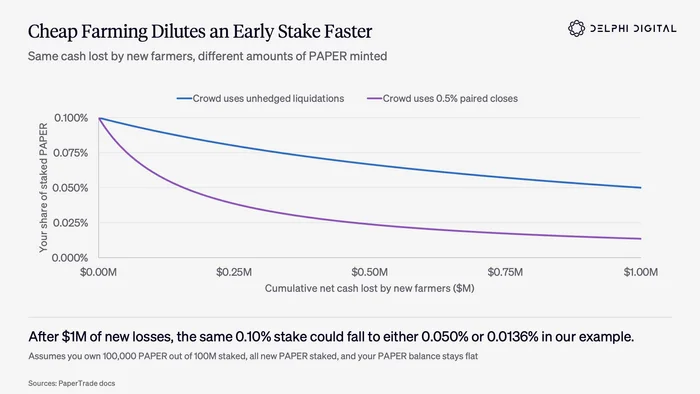
Another counter to this could be to farm a small stake early and keep the rest of your cash for when PAPER eventually becomes transferable. If everyone figures out how to farm cheaply, that supply may eventually become cheap sell pressure as well. There’s no reason to keep deliberately losing money if someone else will sell you the same exposure for less. The drawback is that transfers come later at an unknown time, and waiting could mean missing distributions or potentially paying more.
Ready for launch
We won’t know how any of these strats work until launch when people are actually playing around with the protocol. The paired trades look cheaper in a model, but those costs depend on filling both legs at the right price, relayer delays or queued payouts could slow capital recycling and make the early staking window harder to capture, etc. The cheapest approach could also change as contract access opens and more farmers automate the same trades.
Afterwards, the key is seeing how many people come for PAPER and end up staying for the trading app. Someone coming back for another 500x BTC punt is a much different user than someone punting matched positions to mint tokens. If that audience keeps growing as farming gets more competitive, it’s much more interesting to hold a share of the house.
Ps: you def need to be trading in UwU mode for max alpha