
On the news of increased chatter that the SEC is flipping their opinion about approval of the spot ETF, the Bloomberg boys raised their odds of an approval on the May 23rd, 2024, deadline to 75% from 25%.

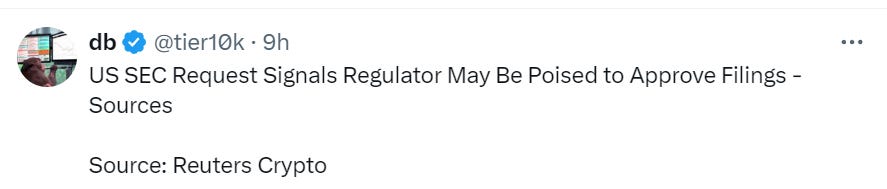
Later that day ( confirming increased chatter), the SEC asked for 19B-4 filings to be updated on an accelerated basis.

This is important because, in the prior months, there had been effectively zero communication between issuers, exchanges, and the SEC.
The next day, SEC staff alerted exchanges that they were likely to approve the spot Ether ETF by the May 23rd deadline.
An important clarification here is that the May 23rd deadline is for 19B-4s. For the ETFs to be actually traded, S-1s need to be approved, which, according to the Bloomberg brothers, could take weeks to months.
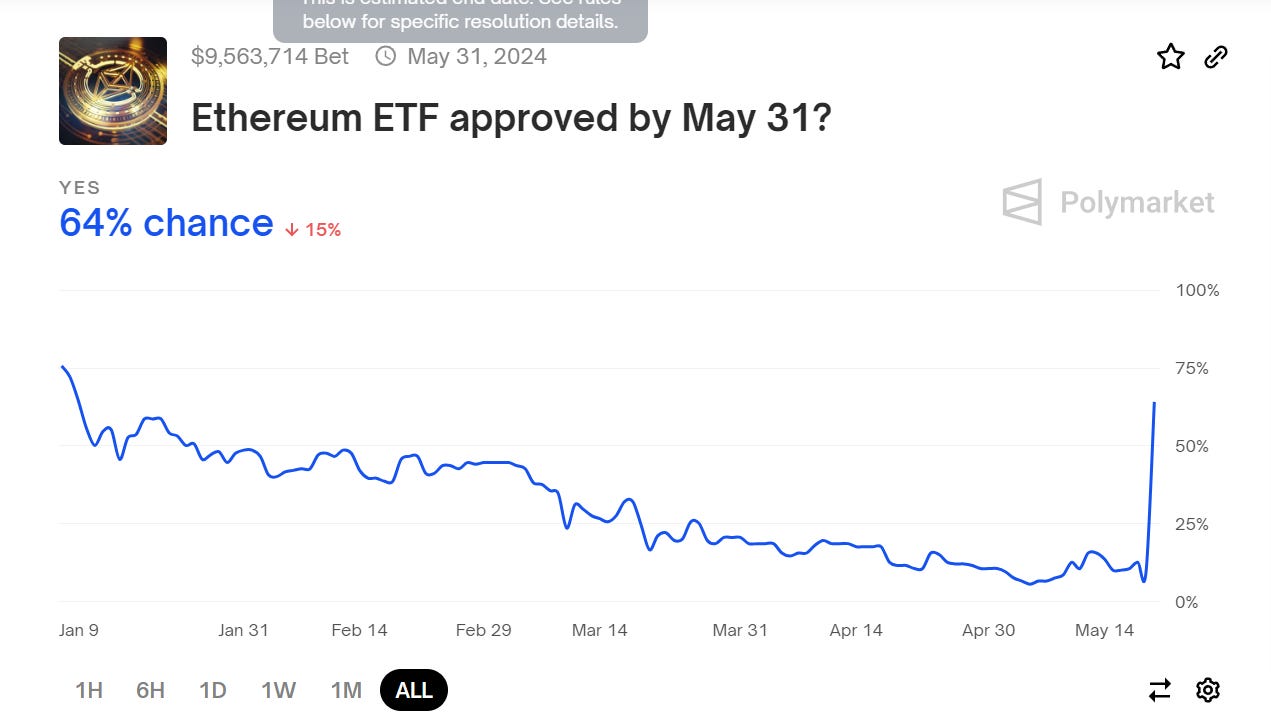
Polymarket odds have been surging in response to the news, up from 13% to 64%. There is an interesting caveat here (and arguably the reason odds are not higher) that the approval of the 19B-4s does not fulfill the claim of the ETF being “approved” and that S1s would also need to be approved by the very unlikely deadline.
In the case of a conflict, UMA governance acts as the “Supreme Court,” so it should be very interesting to see what happens, assuming the 19B-4s are approved by the deadline.
Politics
ETF approval is far more important than most people understand. By approving these ETFs, the SEC effectively relinquishes its ability to label Ethereum (and many similar altcoins) a security.
So why is the SEC doing this? Crypto has become political. With an estimated 50M+ Americans holding cryptocurrencies and continually growing, crypto has become a policy debate.
In the past few weeks, Donald Trump has become vocal about crypto, saying he is not against it. Today, he launched a fundraising page with the ability for crypto donations. It is common amongst voters that Republicans are neutral with crypto, whereas most democratic leaders have a negative stance.
Five days ago, a bill was put in front of the Senate to undo a rule passed by the SEC (SAB 121) that digital assets would need to be referenced as liabilities on their balance sheets, amongst many other rules that would make it difficult for crypto companies to operate in the United States.
The white house said if this bill were passed to repeal the SEC rules, Biden would veto it.
However, perhaps understanding the importance to voters, 11 democrats voted in favor of the bill, allowing it to pass 60 – 38.
The bill to repeal SAB 121 then passed in the House of Representatives (228-182), with 21 Democrats voting in favor of it.
This is incredible news for the entire industry, and it shows that the community’s efforts to promote new crypto-friendly legislation are working!
I wanted to take a moment to highlight that this type of news is not random. Many individuals are “fighting the good fight” with crypto legislation. I am confident that without their efforts, we would not be standing here awaiting the probabilistic approval of a spot at Ether ETF.
Speculation
Many believe approval of the 19B-4s and weeks/months until the S1s are approved (and trading subsequently goes live) is bullish. I tend to agree in the sense that it allows for rampant speculation (which tends to be optimistic) on inflows and allows anticipation to build.
Another kicker is that, similar to GBTC outflows, there is a similar supply overhang, with ETHE holding roughly $9B of Ether. If we expect similar outflows, we could see $5B of ETHE sold in the first four months of trading.
However, the Grayscale CEO did resign, so there’s the possibility Grayscale will lower its fees to match other providers, which should mitigate outflows.
In the long-term, defining Ether as a non-security and allowing institutions to acquire positions easily is very healthy and a sign of good things to come.