
FWA Catch-up
FWA is a gacha machine for NFTs. LPs deposit NFTs, spinners pay a fixed price to pull one at random.
LPs deposit ETH attached to their NFT, called its backing. The backing is essentially a standing bid on the NFT. When someone draws the NFT, they can keep the NFT or sell it back to the LP for 90% of the backing (or 92.5% in FWA). The other 10% (7.5%) is kept as a protocol fee.

If the NFT is kept, the LP receives their backing minus 1%. If the NFT is sold back, the entire backing is consumed. When drawn, LPs lose ~50% of their position one way or another.
A pull costs the average backing of all assets in the pool, plus a 2.5% surcharge (plus a variable Chainlink VRF fee and gas). ~0.05 ETH right now. Pull odds are inverse backing (1/backing), so a 1 ETH milady is 100x more common than a 100 ETH punk.
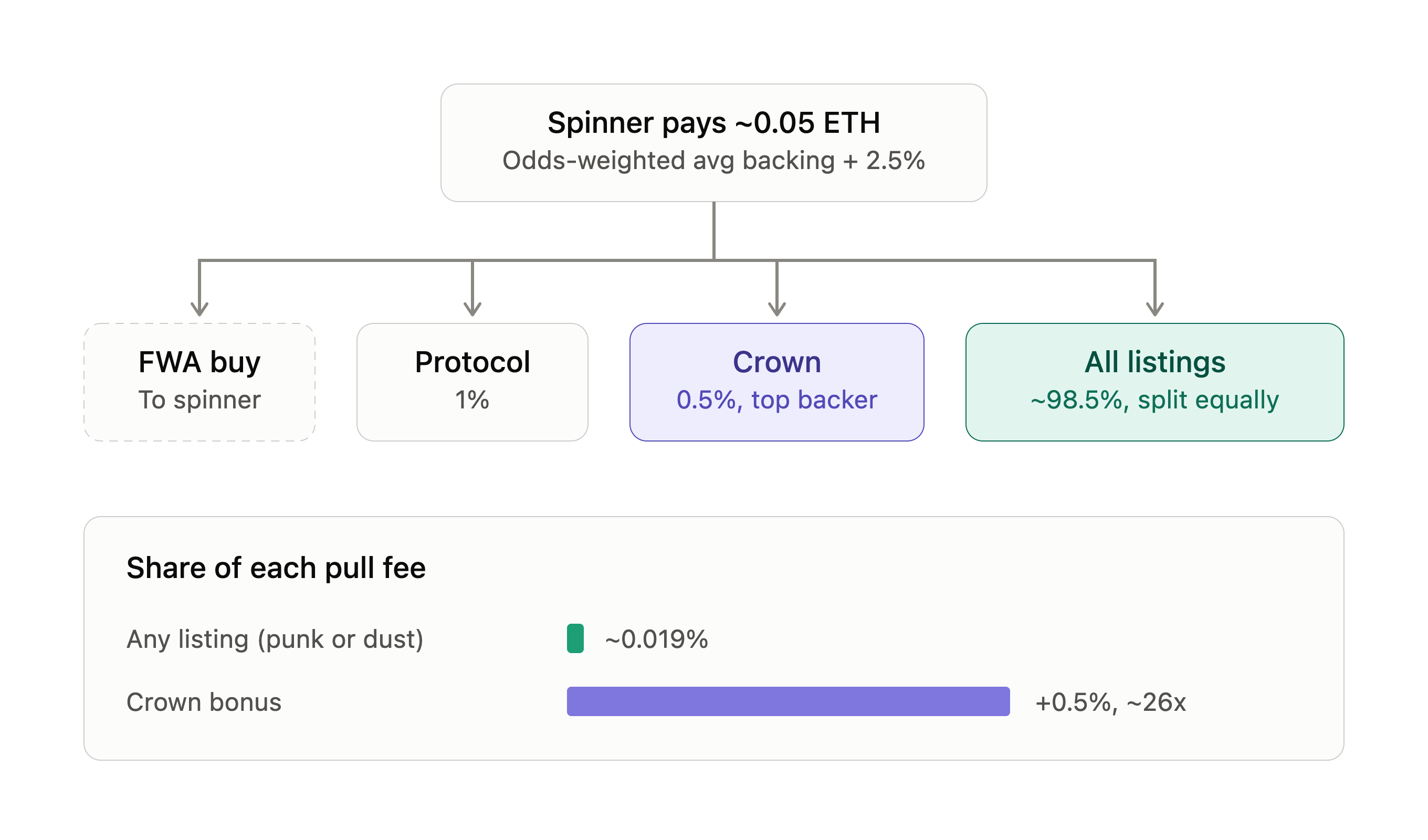
Pull fees: a slice buys FWA for the buyer, 1% to the protocol, 0.5% to the crown, leaving about 98.5% split equally across every active listing.
LPs’ only income is this fee share. The inverse odds and 2.5% surcharge make each LP’s expected return 1.01x their backing in the long run, regardless of value or pool composition. LP-ing is shorting the probability your NFT is pulled in exchange for an equal share of the proceeds.
Equal fee share means a 100 ETH punk earns the same ETH per pull as a 0.03 ETH friendship bracelet. Yield is inversely proportional to value deposited. The crown is the only exception. It is the pool’s top-backed position, earning an extra 0.5% of every pull fee on top of its equal share. The crown is earned by out-backing the current holder by 10%.

There are roughly 5,200 active listings, ~665 pulls/day, quote around 0.05 ETH. All of this scales with volume, which is down ~99% from July.
FWAIR launches
FWAIR is FWA’s launchpad. Supporters pre-fund
...