
The following is a skeleton incentive structure design protocols can adopt, using Starknet as an example.
A well-designed token incentive program needs to achieve two core components: staked capital and user activity.
The current DeFi Spring program achieves staked capital by requiring liquidity provision across DEXs and lending markets.
However, this does not achieve user activity because rewards are earned passively. Users simply need to deposit (occasionally rebalance if providing liquidity on DEXs) and claim their rewards. While programs like this are necessary to achieve a liquid ecosystem, the reality is that the majority of the capital is mercenary and will flee once the incentive program ends.
Additionally, this program revolves around a limited subset of financial products. The financial incentives attract the capital, but there should be other mechanisms in place to show users that Starknet’s technology stack and user experience is superior to other networks.
Incentivizing staked capital + user activity
To achieve the core components, a program needs to financially incentivize people to stake their capital in Starknet applications while still using the network.
This can be accomplished with a custom, gamified quest system that rewards people for staking their capital and using the network.
The more quests a user completes, the more STRK $1 of provided capital receives with each weekly distribution.
Quest Design Concept
The amount of quests a user completes directly influences the multiplier they receive on their rewards:
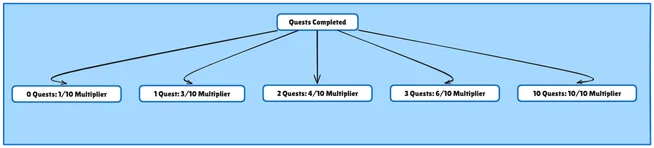
In any given week, there are four different quests, with an example week highlighted below:
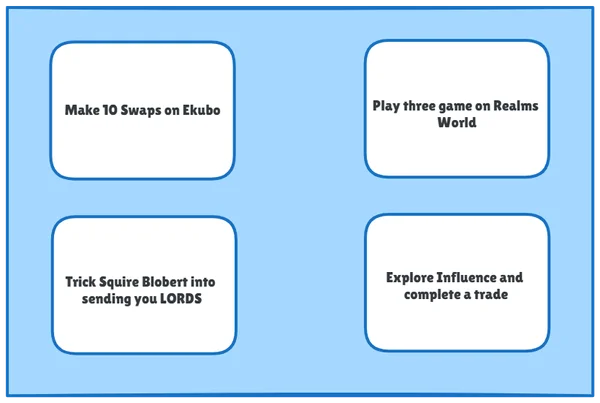
While the above example quests are relatively quick, in practice, the quests must ensure users are truly exploring the network and not gaming the system through low-effort quest completion. This can be achieved by increasing the number of quests or making them more in-depth.
For simplicity purposes, the rewards are not per-protocol, but cumulative. This means that the cumulative figure of liquidity provided across eligible pools on DEXs/money-markets is summed up. After it is summed up, multipliers are applied to each address, and the number of STRK per address is quantified.
The below formula quantifies this figure:
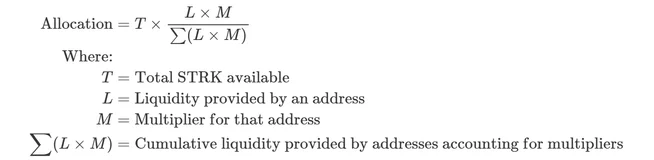
Using the cumulative figure of liquidity, regardless of which protocol the liquidity is supplied to, is integral to ensuring no application is favored over another.
This also fosters healthy competition and mitigates the cold-start problem that new applications often face.
Simple Example
There are 10M STRK allocated in the month of January to the incentive program that is paid out weekly to users who provide liquidity on DEXs or money-markets.
Let’s assume for this example that there is $100M supplied across eligible pools, and that the average address has completed two quests.
Eli, Uri, and Shubhangi each have $100,000 of ETH they have bridged to Starknet and lent on Vesu.
During the first week Eli completed 0 quests, Uri completed three, and Shubhangi completed all four.
The following table is a breakdown of the rewards earned by all three users and how they differ:

As the data shows, these quests completely alter the dynamics of the incentive program, with active users earning up to 10x more than users who simply stake their capital without using the network.
Conclusion
Starknet is the leading ZK rollup and pioneering the space through their research with STARKs and OP_CAT.
That said, the best technology does not always win. Financial incentives attract capital, but Starknet must also showcase its superior technology and user experience.
This can be achieved by creating a quest system that forces users to use their capital while also exploring the network.