
TLDR
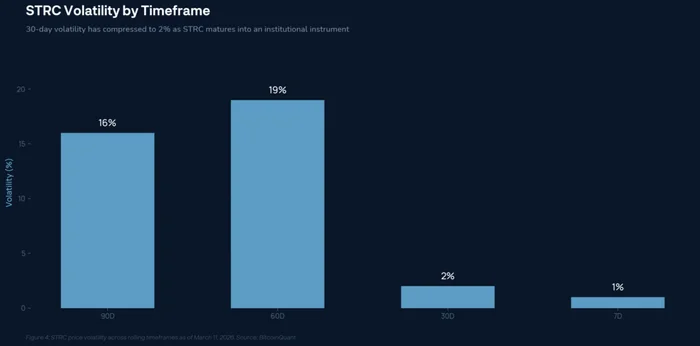
Strategy’s STRC preferred stock is quietly building a structural demand floor under Bitcoin, funded by Income markets that does not seem to care about crypto sentiment. STRC recorded $409 million in single-day volume on March 10 while 30-day price volatility compressed to ~2%. Whether this trend holds, we will see but record liquidity paired with record-low volatility is the signal that this channel is maturing.
STRC is showing its strength as a primary mechanism through which traditional fixed-income capital is converted into spot Bitcoin demand. If this flow scales, Bitcoin acquires a persistent bid that compounds independent of the cycle… not many participants are currently pricing that in. Let’s dive in.
How the STRC Machine Works
STRC is a variable-rate perpetual preferred stock with a $100 par value. Strategy adjusts the dividend monthly to anchor the price near par, stripping out volatility. When STRC trades at or above $100, Strategy activates its ATM issuance program, selling new shares and routing proceeds directly into spot BTC purchases.
Yield investors get a high-coupon, low-volatility credit product and Strategy gets a non-dilutive funding source. Bitcoin gets a persistent buyer whose purchasing depends not on sentiment, but on the availability of yield-seeking capital. STRC is better understood as a capital flow mechanism than a security.
The Acceleration Is Real…
BTC price down… STRC demand up?
In January, STRC contributed $119 million toward BTC purchases. By the first week of March, that figure hit $377 million in a single week, roughly a third of Strategy’s $1.28 billion in total BTC purchases for that period.
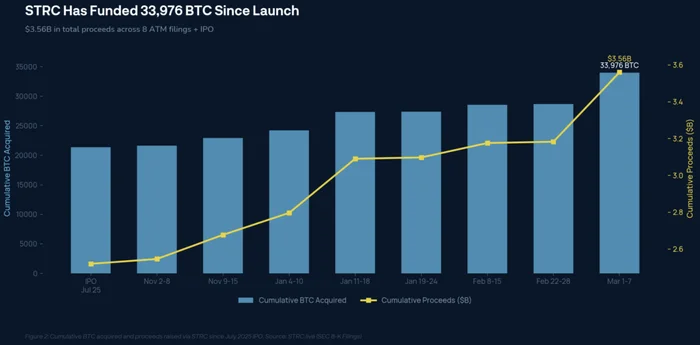
Since launch in July 2025, STRC has funded 33,976 BTC worth $3.56 billion across 8 ATM filings. This acceleration came while BTC traded below $70,000 amid geopolitical tensions and risk-off positioning. Monday’s $300M and Tuesday’s $409M record both occurred near BTC’s local lows. 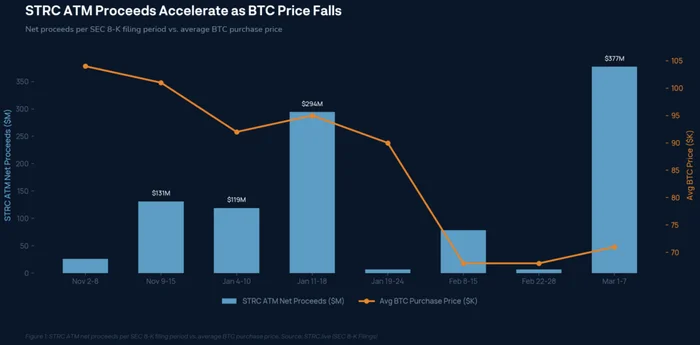 STRC is currently decoupled from Bitcoin price momentum.
Why This Matters Structurally
Money market funds hold over $6 trillion. At 11.5%, STRC offers triple the yield of a T-bill and STRC is trying to compete for that capital.
If even a small fraction rotates into STRC, the downstream effect on Bitcoin demand is disproportionate. Daily mining produces ~$30 to $35 million in new coins. In the Mar 1-7 filing period alone, STRC funded 5,315 BTC, equivalent to 1.7x total mining output for the same period.
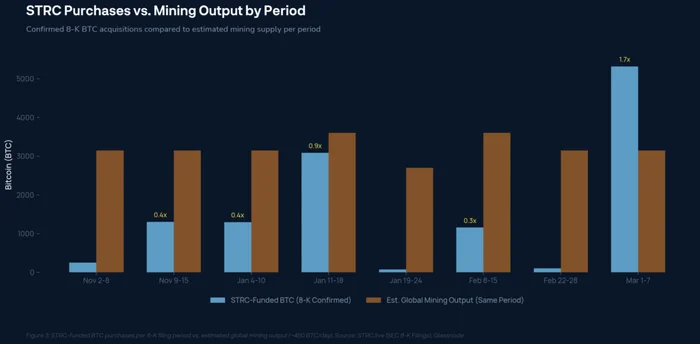
Fwiw B. Riley initiated coverage on Strategy and Strive with Buy ratings, framing “Digital Credit” as a viable long-term structure. The consensus is that Bitcoin’s long-term CAGR only needs to exceed the cost of preferred capital (8-12.5%) for the model to compound indefinitely as that spread is the engine.
Risks and What to Watch
The risks are real – Strategy’s annual STRC dividend obligations now run ~$442 million. If Bitcoin stagnates while issuance continues at escalating yields the spread compresses. The 7th consecutive dividend hike signals ongoing incentive is required.
If STRC volumes continue to grow, the implication is a persistent, price-insensitive bid under Bitcoin that scales with the income market’s appetite for yield rather than crypto sentiment.
Closing Summary
The market is pricing STRC as a yield product. If we layer on a BTC lens then structurally it becomes a demand engine. If income capital continues rotating into STRC at this pace, Bitcoin acquires a “durable bid” (if trend continues and is sustainable that is) that seems to compound independently of the crypto cycle funded by the deepest capital pool in finance. Imo definitely a trend worth watching to see if the trend continues to grow over the next few months.
One more thing to note is STRC’s ex-dividend date falls around the 13th of each month. With T+1 settlement, the last day to buy and qualify is typically the 12th (today). Volume typically builds in the week before as yield chasers flow in and Strategy’s ATM window opens.
Post ex-div sellers exit / volume drops and STRC can soften below par temporarily shutting the ATM. Buyers usually return closer toward month-end as the next cycle approaches.