About a year ago, Trump touched down in Riyadh, shook hands with MBS, and walked away with a $600 billion Saudi investment pledge. Jensen Huang stood on the same stage and announced that 18,000 Nvidia GB300 Blackwell GPUs were heading to HUMAIN, a brand-new company owned by Saudi Arabia’s sovereign wealth fund, the PIF. The press framed it as a technology diplomacy story, butbut only partially.
Right now, those data centers in Riyadh and Dammam, each pulling up to 100MW, are being built. Across the Gulf, the G42 and OpenAI-led Stargate UAE cluster in Abu Dhabi is tracking its own 200MW first phase this year on a 10-square-mile site with a stated long-run ambition of 5GW.
Most coverage of this has treated it as a petrostates-diversifying-into-AI story. While that is not wrong exactly, we need to examine this through a different lens. Saudi Arabia did not buy compute access by paying market prices for it. They bought it by pledging $600 billion back into American companies. Compute access was priced in geopolitical alliance and nothing else. The chips were not the product being sold, they were the condition being met. That is a structurally unusual arrangement, and it matters for how you think about the compute market going forward.
Export controls under the Biden Administration have previously blocked Gulf states from acquiring NVIDIA’s most advanced hardware, partly over concerns about technology leakage to China through regional intermediaries. This dynamic totally changed under the Trump administration. GPU access is now something negotiated at the level where defense treaties and arms sales get negotiated. HUMAIN securing a pre-approved pipeline for Blackwell chips, and Stargate UAE being structured as a public-private arrangement coordinated directly with the US government. These are not typical procurement outcomes. They reflect compute moving into the same category as strategic assets.
When it comes to the crypto and deAI space, the argument for decentralized compute has historically been built around cost and censorship resistance, framed mostly as a technical alternative to AWS and Azure pricing. That argument has struggled to get real traction at scale because the centralized hyperscalers are genuinely competitive on both price and reliability at the workloads that matter most. But the HUMAIN and Stargate UAE story reframes things. If GPU access is increasingly mediated through sovereign wealth funds and diplomatic arrangements, the addressable case for neutral, permissionless compute infrastructure grows considerably, and it grows in places that matter. A developer or startup in a country without a trillion-dollar investment fund to deploy as a negotiating chip does not have a seat at the Riyadh table.
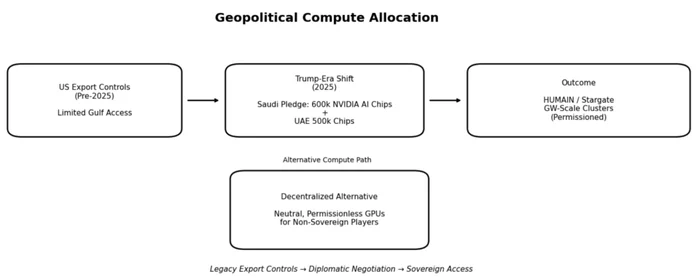
The deeper structural tension is that both dynamics are going to be true simultaneously for a while. State-owned AI infrastructure at this scale will run real workloads and accumulate real data gravity. HUMAIN has a 10-year target of 6.6GW of capacity, which would make Saudi Arabia one of the top-five AI compute markets globally by the mid-2030s. Stargate UAE is targeting 5GW on a single site. These are not demonstration projects. At the same time, the same geopolitical logic that produced HUMAIN is precisely the argument for why compute infrastructure probably should not function as a diplomatic asset in the first place. Those two things coexist, and the pressure they create on each other is the actual macro context in which decentralized compute networks are operating right now.
Decentralized protocols are not going to win on raw GPU throughput against a 100MW government-backed data center in 2026. That is not the near-term bet. The near-term case is that compute geography is fracturing, allocation is increasingly non-market, and the population of developers and organizations with an active reason to care about an alternative is getting larger. When sovereign nations are spending sovereign wealth to lock in compute access, the value proposition for permissionless infrastructure becomes less of a philosophical position and more of a practical one.