
The onchain options sector is the largest whitespace in crypto derivatives. Retail demand is already proven at massive scale in TradFi. And onchain, the binding constraints are no longer regulation, infra, or maker liquidity. Using Derive’s RFQ, you’ll notice quotes on majors are frequently competitive with Deribit while quotes on HYPE straight up beat Deribit. For those who haven’t been following, onchain options have been in a quiet bull market and hit a new monthly ATH in August:
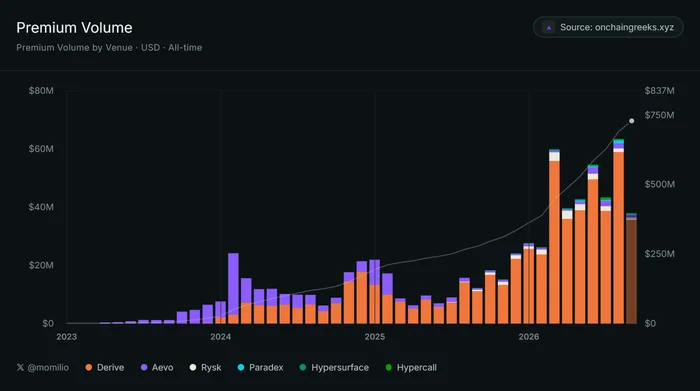
After the exodus between 2021 – 2024, the sector is finally heating up and primed for its ultimate challenge: hitting escape velocity by onboarding non-toxic (retail) taker flow at scale. I will lay out my entire thesis in my onchain options report but to boil it down: the winner will take most (just like we saw with HL & onchain perps), and there are two paths to winning taker flow at scale:
- Structured products / vaults (options vaults on RWAs providing yield on traditionally non-yielding assets. For depositors, vaults strip options complexity away entirely, and for makers, they provide a steady stream of predictable flow to quote)
- Sexy frontend and UX tailored to retail (sleek UI users can actually comprehend and navigate) + Fomo playbook for user acquisition (tiktok and IG ads, UGC, leaning into social trading / public PnLs etc)
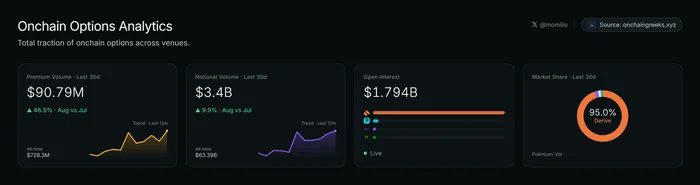
Currently, Derive sits squarely at the pole position, commanding a whopping 95% of onchain market share by premium volume (actual cash paid for the options contract). Yet, the market is still tiny compared to centralized venues. Onchain options are just 4.3% of Deribit’s notional options volume for the last 30 days.
Yesterday, Derive posted its latest DIP: Launch Derive V3, the last step before v3 goes live in the next few weeks. I’m very excited for this deployment because I believe it will take us much closer to the promised land. With the migration to v3, many changes are enacted with my favs summarized below:
- Derive Chain will be sunset, v3 is a zkVM program settling on ETH mainnet instead → Ethereum-native custody, e2e privacy, forced inclusion of L1 actions
- Huge increase in throughput & reduction in deployment speed for builders, products, and features
- True cross-margin for your port
- New “risk universes” which enable better risk mgmt and risk isolation → quicker listings of more RWAs and long tail assets
- Borrowing of non-cash assets
- Vaults vaults vaults (native deployments)
The new infra alone has many benefits for builders, users, makers, and instos. I’ll cover those in the deep dive as I don’t want to get deep in the weeds on architecture here. The takeaway is simple, v3 unlocks a new level of performance that enables innovation of new products and features around onchain options.
I want to zoom in on the vaults and the RWA listings since they pave one way for adoption at scale in my view. Once Derive v3 is live, I expect options on equities, indices, metals, and energy to follow soon after. No onchain venue currently provides competitive depth on these assets, so the v3 launch will meaningfully deepen Derive’s network effects and stickiness. Native vault deployments are even more interesting because v3 will enable bespoke deployments. This means anyone can be a curator and construct strategies, tailoring yield, speculation, and hedging into different structured products while earning mgmt and performance fees.
I’m especially bullish on accumulator / decumulator strats (would entirely revamp how I buy and sell assets onchain) and covered call vaults for RWAs. Besides permissionless access, onchain stocks and RWAs do not have much of a value proposition yet. Borrow / lending yield sucks, liquidity onchain lacks competitive depth for the most part, and the most widely adopted products are wrappers giving you no shareholder rights.
Earning 5-10% in APY on your TSLA tokens by depositing them into a covered call vault opens the door to yield that doesn’t exist offchain. For the first time, there’s a great reason to hold RWAs in your onchain port instead. Add to that the simplicity of navigating the product (literally a 1 click deposit), and I see it as very likely that Derive’s vaults, and RWA vaults across other venues (e.g. Rysk and Enhanced Finance), experience massive TVL growth.
So Derive v3 attacks structured products & vaults directly, but what about a retail friendly frontend? From talking to Nick, it’s apparent that he wants Derive to evolve into THE onchain infra and liquidity layer for others to integrate with / build on top of. And deployments are much more straightforward with v3.
While there are several teams already building on top of Derive, I want to quickly highlight Dream. This team is building a mobile app (working on v2 atm) that caters to retail. Even if you’ve never traded options before and know nothing about greeks, you’ll be able to navigate and express your view in the Dream app easily. I recommend checking it out. Everything’s abstracted, users only need to pick the asset, direction, strike, and expiry. If Dream or another team building on Derive cracks distribution, the second path is also unlocked and taker flow on Derive will explode. There is also a case to be made that Fomo should integrate with Derive and bring options to the social trading experience for the sake of both products.
To reiterate, I believe the onchain options sector is the largest whitespace in crypto derivatives. When looking at the TAM and sizing the opportunity, it’s a matter of when not if onchain options take center stage. From a speculator’s PoV, almost every project competing in this sector, including Derive, is trading at depressed valuations.
Stay tuned for the report on onchain options, I’ll go deep on Derive v3 and notable competitors. If you want to track any changes in this market and see if a team is gaining ground against Derive, check out my dashboard at onchaingreeks.xyz.
Disclaimer: I hold DRV.