
We are halfway through our DeAI series, so I thought now may be a good time to call out a few themes / categories which I was particularly bullish on which hadn’t been discussed much.
So far, my top three candidates are:
1) Datalakehouses / Warehouses
2) Graph Neural Net Foundational Models
3) Agent Orchestration / Interoperatibility
Data Warehouses
For AI and crypto to truly converge, both smart contracts and on-chain agents will require more context-specific data. Today’s smart contracts are quite limited in the data available to them at the point of execution. High performant data warehousing solutions could make large swaths of, hopefully verified, data available to query at the point of execution – providing a much higher degree of personalization on-chain.
These tools could help protocols better tailor their products to individuals users (Why should all users on Aave get the same rate?) Or they could assist users in navigating crypto’s complexity? (Can you help me get the best risk-adjusted yield across major DEFI money-markets with an 8% floor?).
This level of personalization / enhanced user experience will only be possible in bringing AI on-chain, which requires having trusted, available data sets informing those queries.
There is a reason both Snowflake and Databricks are worth >US$40b dollars. If you believe AI has a similar role to play in web3, data warehouses are essential pieces of infrastructure with a lot of room to growth…
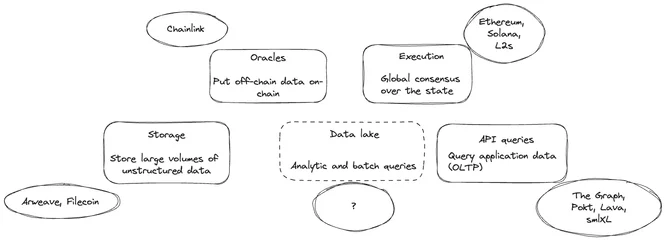
Source: Subsquid Whitepaper
Example projects: Space & Time, Subsquid, Covalent, Hyperlane
Graph-based Foundational Models
Where LLMs delineate patterns in large corpora of texts and learn to predict the next word, Graph Neural Nets (GNNs) process, analyze, and learn from graph-structured data. GNNs focus on learning patterns and relationships within the graph structure – quite relevant in social network analysis, recommendation engines, or fraud analysis. Graph databases are heavily used in the enterprise today with Neo4j being the most prevalent.
As blockchains are effectively networks, GNNs seem well-positioned over other types of model architectures like transformers. Additionally, transformer-based models have the added complication of being probabilistic in their outputs, whereas blockchains are deterministic computers which must reach consensus between nodes as to the chain’s state. As GNNs process information and make predictions about the future state of the network, they are highly relevant in trading, DeFi and even social use cases.
I’m quite bullish about GNN adoption in defi and crypto more broadly, but I’m still a bit worried about foundational model commodification longer-term. However, like Foundational LLMs the utility is so clear and the adoption cycle is so early, well-placed bets in emerging leaders today based on traction / monetization being figured out down the line, still make sense to me.
Examples: Pond (if you know of others, please comment below, I would be interested to check them out).
Agent Interoperability
Agent interoperability protocols are quite competitive these days, so I’m not sure I would say this category is “under the radar”. However, the potential network effects and size of the market mean it’s worth watching closely.
There is an ongoing debate regarding a handful of all powerful foundational models vs. small networks of interwoven specialized models. Increasingly, assuming effective routing, networks of millions of specialized experts would seem more compute efficient for most use cases.
While foundational models represent the integrated approach, these “agent collectives” represent the modular approach to building intelligence: a hivemind of open components and libraries and agents which can be modularly pieced together to solve a given task. Obviously, accomplishing this effectively requires sophisticated “routing algorithms” to know exactly which agent or component to tap for a given task, but the beauty of the approach is in the composability: hopefully leading to compounding agent libraries over time – reinforced with real remuneration to developers based on usage.
These protocols require the establishment of flexible, adaptable communication standards and interfaces for agent-to-agent interaction, mechanisms for agents to establish trust and verify the authenticity and reputation of other agents, and the facilitation of seamless payments between and among agents and users, as well as easy discoverability and composability in constructing collectives.
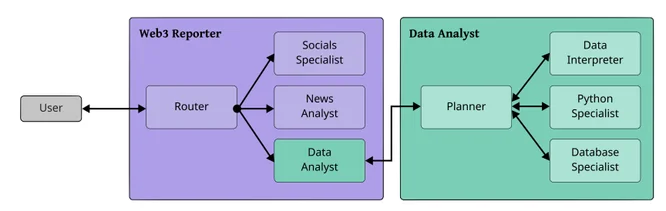
Source: Theoriq Litepaper
While competitive, any particular standard or collective that gains steam should have a massive runway with the powerful feedback loops between developer remuneration, composable components and reusable libraries. If Google became a US$2 trillion dollar company indexing the world’s information, the protocol which successfully indexes and interconnects the building blocks of intelligence should have a long way to run…
Examples: Autonolas, Theoriq
More will be coming in this month’s report. Feedback welcome in the comments.