Yuga Labs: From PFPs to Games - Where Does It Go From Here?
AUG 01, 2023 • 37 Min Read

Introduction
On April 30th, 2021, Yuga Labs created Bored Ape Yacht Club (BAYC) as an exclusive members club gated by a 10k collection of ape-inspired profile picture (PFP) NFTs. The project became renowned for continually driving value back to its holders, ranging from commercial usage rights to several supplementary token drops — Bored Ape Kennel Club (BAKC) and Mutant Ape Yacht Club (MAYC). Yuga Labs acquired two additional IPs, CryptoPunks and Meebits, from Larva Labs and solidified its position as the leading PFP ecosystem in Web3. The company has gone on to acquire brands such as WEMADE and 10KTF to further expand its ecosystem of brands.
At some point, however, Yuga Labs understood that it could not perpetually release additional NFTs or minor perks in order to maintain user engagement and the FOMO-driven high valuations. Thus, the company adjusted its strategy to focus on content and revenue-generating business models. It is now self-described as an ecosystem brand with a focus on multimedia entertainment that leverages its various IPs to create meaningful consumer experiences. As reflected by a number of recent hires, games and gamified experiences have and will continue to play a pivotal role in Yuga Labs’ short to medium-term vision.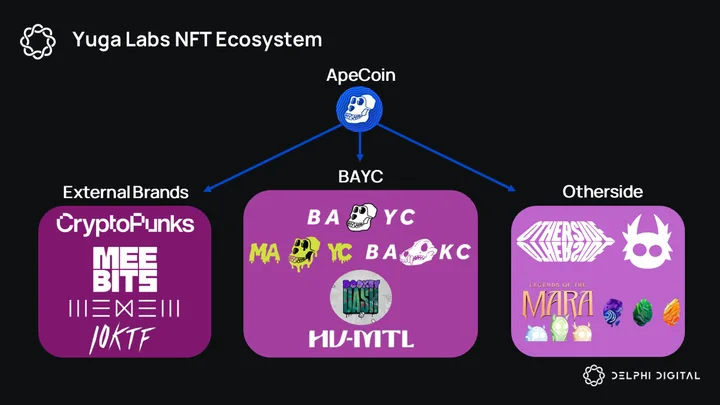
In recent months, Yuga Labs has concentrated its efforts on its two main pillars, the BAYC IP and the Otherside metaverse, with ApeCoin being the fuel that freely moves between ecosystems. The majority of the company’s focus and resources have been allocated to build out several story-driven initiatives that live within these two worlds and often cross over. We caught our first peek at what was to come from Otherside from this leaked pitch deck. We later saw the BAYC episodic experience unfold via the mysterious MDVMM website, as well as the Otherside adventure, as outlined by the Obelisk roadmap.
This report will, at a high level, outline each one of Yuga Labs’ gaming-related ecosystems and dive into a granular analysis of the pros and cons of each. By the end, we hope you have a better understanding of what Yuga Labs is trying to accomplish as a newly formed games developer and what this means for the future of the firm and the underlying assets within.
Fueling an Ecosystem – ApeCoin
ApeCoin was introduced to be the fuel that powers the various initiatives within Yuga Labs’ ecosystem, namely the BAYC and Otherside IPs. The ERC-20 token’s two main functions are governance and in-app utility, but additional features on the official website are noted to be token-gating content and incentivized participation.
ApeCoin has a fixed supply of 1B, and the team has explicitly expressed how no mint or burn functions have been included in the token’s contract interface. Four main groups were allocated ApeCoin, as detailed below: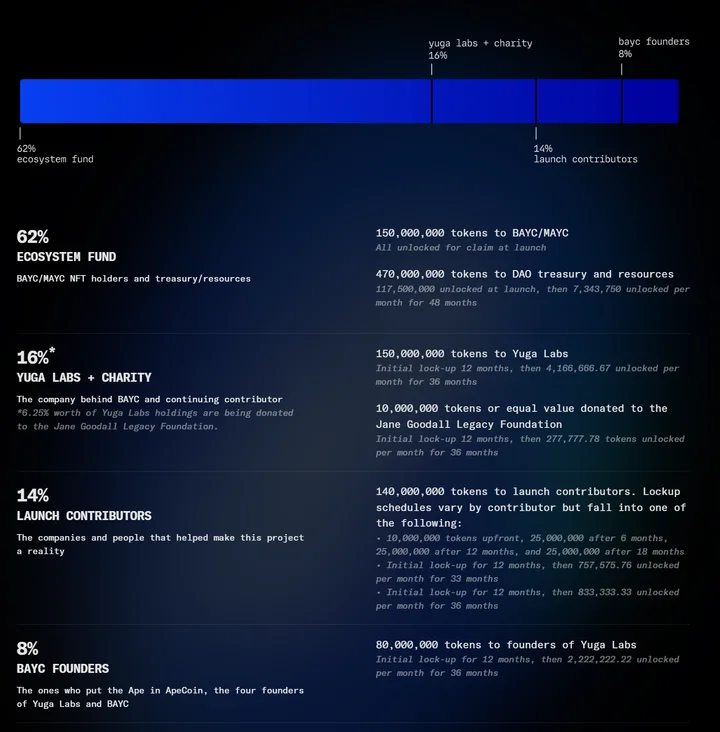
Additionally, holders of BAYC and MAYC NFTs (with or without a companion BAKC NFT) could claim a predetermined amount of ApeCoin in March 2022. The claim lasted for 90 days, and token allotments were calculated based on the difference in average floor price between BAYC and MAYC NFTs — I guess floor price does matter. Any tokens left unclaimed by the end of the event were returned to a custodial wallet for the ecosystem fund. By the end of the 90 days, a total of 142.6M APE (more than $480M based on the price of APE at the end of the claim period) was claimed, or roughly 95% of the allocated amount. The top five APE-claiming wallets received >500k tokens, and the largest claim was 1.4M tokens or ~$3.1M from a single wallet (dingaling.eth).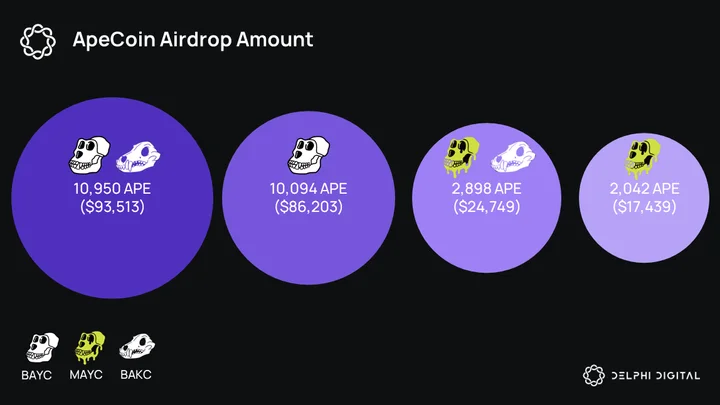
The ApeCoin treasury is currently valued at just over $792M (spread across 92 wallets), providing the DAO with a relatively large war chest to allocate toward ecosystem expansion. The DAO treasury has so far spent an approximate total of $89.6M (~$4M excluding staking rewards), with $64.3M of that spent over the past six months.
On March 17th, 2022, the APE token went live, and within three days, the price increased by 52% to hit $12.99 before falling back down to ~$9.5 shortly after. After a brief period of price fluctuations between these two levels, on April 30th, APE reached its all-time high price of $23.63 shortly after the launch of the Otherside collection and an announcement from OpenSea that it would start accepting payments in APE.
Although the price of APE is now down by 92% and the total volume has fallen by 99% from all-time highs, the 14-day average number of transactions is actually almost double what it was in October last year. Transactions in this context refer to all APE token transfers, and a likely reason for the increase is due to the launch of several casual games that allow for ApeCoin in-app spending. APE saw a sudden influx of ~23k new holders (a 33% jump) in the 24 hours leading up to the Otherside mint and then a sharp drop of 21% (just under 19k wallets) in the 24 hours following. Since then, the holdership has increased by 81% to reach its current number of 127.7k token holders, with the largest holder amassing 10.8M APE. To put this into perspective, IMX, GALA, MAGIC, and RON tokens have 54.4k, 245.9k, 363.7k, and 11.4M unique wallet addresses, respectively.ApeDAO & Token Staking
The ApeCoin DAO is a decentralized governance organization comprised of ApeCoin holders in charge of ecosystem fund allocation, governance rules, partnerships, and more. The Ape Foundation consists of nominated members of the DAO and acts as a legally recognized entity to enact the necessary administrative tasks to fulfill ApeCoin DAO initiatives. To date, DAO members have submitted a total of 108 proposals that have made it to vote, with 17 passing. Proposals have ranged from Ape-themed water to an APE token-powered games publisher.
ApeCoin staking was introduced via AIP-21 and AIP-22 and launched on December 2nd, 2022. The premise was to incentivize long-term community commitment and encourage new holders to join the ecosystem by allowing stakeholders to stake ApeCoin, BAYC NFTs, MAYC NFTs, and BAKC NFTs (following a “stake tokens to earn more tokens” model). Within the first two months that staking went live, the APR ranged from 90% (ApeCoin only staking) to 171% (ApeCoin + NFT). This drastically increased sell-side pressure following the launch, and reports showed how the token was heavily shorted in perpetual markets in the months following. There is currently 152.4M APE being staked in one of four possible pools, with a current APY ranging from 29% (APE-only pool) to 88% (max staking to paired pool – BAKC + BAYC or MAYC).
The Otherside Ecosystem
In what would become its most ambitious and controversial NFT mint to date, in March 2022, Yuga Labs teased the Otherside. The Otherside will begin with a centralized narrative-driven experience that heavily leverages NFT-based assets and transition over time into a Games-as-a-Platform (GaaP) model where third-party developers utilize the Otherside
Read the full report
This report is part of Delphi Pro.
- 800+ Pro reports across every major sector
- Talk directly with our analysts
- Private community of funds and builders
Already a Pro member? Log in
0 Comments