Bitcoin_Sage, a guest author from Delphi Labs, updated some of the below information and charts in his report ‘Friend.Tech Continues Making Waves‘, published on September 26th, 2023.
In our Reflecting on EthCC report, we mentioned how most of the crypto discourse has been about the infra layer as opposed to the application layer. Friend.tech, a new social app launched on Coinbase’s rollup Base, has proven to be an exception to this trend. Since its launch on August 10th, Friend.tech has not only attained significant user traction but has also taken crypto Twitter — deprived of fun, social apps — by storm.
Friend.tech is a mini-app. Its core feature is token-gated private chats. Users link their Twitter accounts to onboard, upon which each user gets to create a group chat where they are the “creator.” Other users can search for creators and join their chats by minting the “keys” of that creator and becoming their key holder. For as long as they own a single key of the creator, they can participate in the chat.
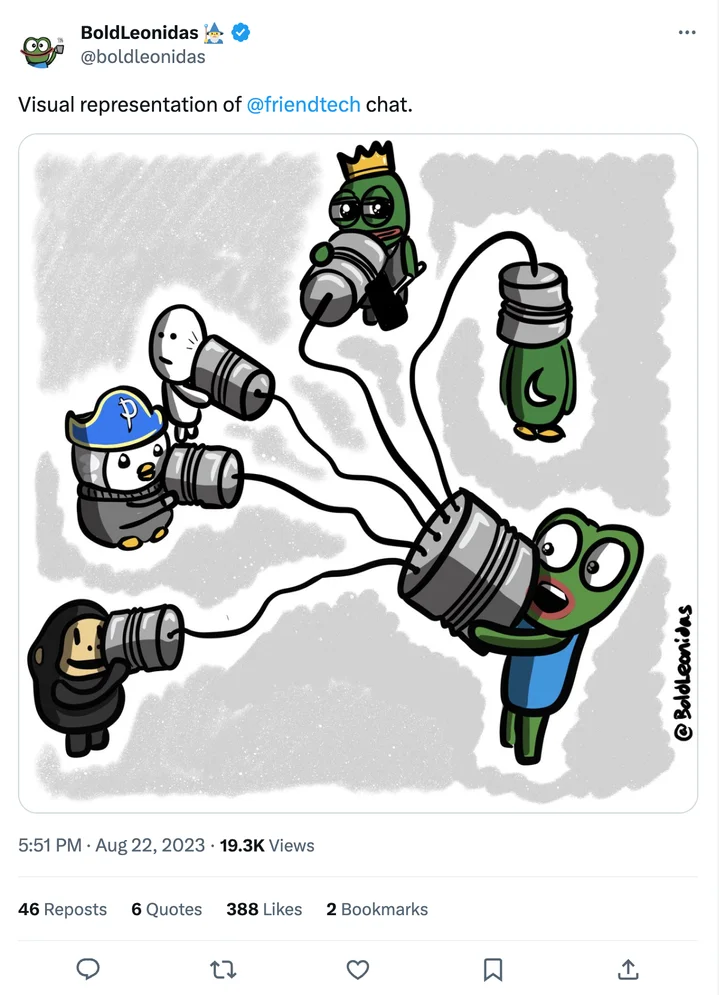
The group chats are 1-to-many. While the creator can see messages from all key holders, key holders can’t see messages from each other, only from the creator.
Keys are bought (minted) and sold (redeemed) against a bonding curve. The price (denominated in ETH) increases every time a new key is minted and decreases every time a key is redeemed based on the slope of the curve. We will dive into the mechanics of this curve in later sections.
Thus, if a user is interested in joining the chat of his/her favorite influencer, there is a natural incentive to be an early key holder. That said, the motivation to mint keys isn’t just to access the chat but also to speculate on the creator’s key price. Indeed, users can mint multiple keys of a creator with anticipation of redeeming for a higher price later on.
Each time a creator’s key is minted or redeemed, a 10% cut is taken away from the proceeds which then gets equally split among the creator and the protocol. Thus far, Friend.tech has managed to attract 125k+ users (users with at least 1 trade) and generate $8M+ in fees off of $4.2M daily average volume. Half of these fees ($4M+) have accrued to creators.
While FT got off to a hot start, activity has cooled down a bit as it starts to settle into a new floor. Active users were ~8k/day before the Paradigm announcement and >40k at the peak, and have since settled at ~20k/day more recently. As users who have already onboarded don’t have any incentive to leave, we imagine TVL will be fairly sticky here at least until the airdrop. As for the actual usage of the app, the average in-app minutes/day is actually below where it was at the start and is an important metric to keep an eye on moving forward. The bull case for FT, just isolating it to people on crypto Twitter, is that all of the “alpha” is shared on FT, a sort of exclusive club for people with high signal information that you don’t want to miss out on.
Friend.tech Went Viral
While token-gated social apps aren’t a new idea (see BitClout and Steemit), there are a number of factors that contributed to the virality of Friend.tech. The most notable ones include:
- Twitter angle: Every user has an associated Twitter account that needs to be linked to their Friend.tech account as part of the onboarding process.
- Simple onboarding process (thanks to the progressive web app and the embedded Privy wallet — to be explained later).
- The initial hype around Coinbase’s Base.
- Bonding curve dynamics.
- Airdrop anticipation: Users accrue airdrop reward points over the course of six months during beta. Points were announced to have a special purpose when the app is officially released.
Twitter Angle
An engaging aspect of Friend.tech is how it bridges Web3 to Web2; namely Friend.tech <> Twitter. To onboard to Friend.tech, users have to link their Twitter profiles to their Friend.tech account. This helps users to easily recognize who is who when navigating in the app and looking for chats to enter or keys to speculate on.
Importantly, Friend.tech directly incentivizes Twitter accounts with a large follower base to, at the very least, give the app a try. Upon onboarding, every user gets to be the first to mint their own key for free. As users are guaranteed to be the first to own their own key, they are more than likely to earn risk-free money especially if they already have a large follower base on Twitter. Furthermore, users can buy multiple keys of their own early on when their key price is low in anticipation of redeeming them for a higher ETH price later on (i.e., dump on themselves). Finally, Friend.tech is attractive for large Twitter accounts even if they don’t want to financially invest in the app. After all, every account accrues fees off of the 5% trade volume on their keys. As stated previously, cumulative fees captured by creators have well exceeded $2M in current ETH prices.
The underlying incentives have also captured the attention of those who aren’t strictly crypto natives. In addition to well-known crypto Twitter accounts like Hsaka and Cobie, Friend.tech has managed to attract big names across other industries such as @disclosure, @graciehartie, @FaZe_Rain, and @GraysonJAllen.
However, this is not to say Friend.tech is only financially rewarding for mega Twitter accounts. Below, we see the market cap of the top 10 Friend.tech accounts. As can be seen, Twitter follower base isn’t always indicative of the market cap.
Twitter follower base gives you a boost at the start, but creators must be active and committed to the app if they want to sustain a high valuation.
So what are some ways creators have been using Friend.tech? We summarize a select few creators below.
| Select Top Accounts | How They Use Friend.tech? |
| 0xRacerAlt | The creator of Friend.tech, shares alpha on it. |
| @0xLawliette | Highest share price outside of Racer, not a massive Twitter following (15k) but shares price tickers and has pledged to share their points (potential airdrop) with key holders. |
| @cobie | Crypto OG, price reflects his brand and standing within crypto Twitter, but not as active as other accounts. |
| @blknoiz06 | Pretty active on the app. Constant stream of AMA, gives access to a Discord where he is more active. Has even let people book calls with him. |
| @0xSisyphus | Does AMAs. |
| @Banks | First big non-crypto account to join. Price was front-run heavily and has been trading straight down since. |
| Other Interesting Accounts | How They Use Friend.tech? |
| @0xCaptainLevi | Key collectooor. Holds keys to 600+ accounts. Uses his access to stream content to his key holders from most active Friend.tech chats. |
| @Melt_Dem | Holds shareholder meetings. |
| @disclosure, @Not3Lau_Capital, @boysnoize | Do AMAs about songs, history. Share unreleased songs.
|
| @alpha_pls | Partnered with Artemis to give all key holders free access to Artemis’ Pro product. |
The Tech Stack: PWA & Embedded Wallets
An interesting aspect of Friend.tech’s tech stack is its use of an embedded wallet (powered by Privy). While embedded wallets provide users with a fully self-custodial experience, they function differently than the consumer wallets (MetaMask, Rainbow, etc.) that many crypto natives are familiar with.
The biggest difference is that with embedded wallets, users don’t have to explicitly download wallet software separately from the app. As their name suggests, embedded wallets provide a tightly integrated experience with the application. Namely, they are installed along with the app by default.
This is powerful as it eases the onboarding process, particularly for people new to crypto who have never experienced self-custody before. New users can skip many steps that consumer wallet users take (download wallet, save 12-word mnemonic, switch networks, connect wallet to app, etc.) before interacting with a dApp.
The downside of embedded wallets is interoperability. If you want to use the assets in your Friend.tech wallet on another dApp (say, Friendmex), your options are somewhat limited. Commonly, the easiest way to do so is to export your private keys and import them into a consumer wallet such as MetaMask or Rainbow and go from there.
Nonetheless, this feels like the right direction to onboard new people into crypto; trading off ease of interoperability for ease of onboarding. Users are likely to put in the time and effort to migrate to consumer wallets later on as they become more familiar with crypto and are mentally and/or financially invested in it.
The Privy toolkit that powers Friend.tech wallet uses a Shamir Secret Sharing (MPC) to split the private key into 3 shares under the hood, where any 2 can be used to generate a signature. The 3 shares are:
- Device share: Fully protected by the client. In Friend.tech’s case, it’s protected in the client’s browser under an isolated domain. Privy and/or Friend.tech doesn’t see this share.
- Auth share: Protected by the Privy server. Privy SDK retrieves this share for users when they log into the app.
- Recovery share: This share is used as a substitute for the first two shares in case any one of them is lost. Privy allows app devs to choose how they want to store and encrypt this share. It can either be encrypted by the user via a strong password or by Privy in a way only accessible to the user.
In no case does Privy and/or Friend.tech, without permission from the user, transfer assets from their wallet. When and if the user wants to migrate their assets to another wallet, they can do so by exporting and importing their private key to a new wallet.
Another unique aspect of Friend.tech is its mobile-first approach with a progressive web app (PWA). For the uninitiated, PWAs are web applications that look and feel like native mobile apps. They can be added to the home screen of your device (displayed with an icon similar to those of native apps) yet aren’t downloaded through an app store but the web via browsers.
As such, they aren’t bound by most of the limitations imposed by app stores such as Google Play or Apple’s App Store. Most importantly, they can adopt crypto payment rails and get around the exorbitant store fees for in-app purchases!
While PWAs have been available for many years, Apple has only recently enabled push notifications for PWAs that are added to the home screen.
| Progressive Web App (PWA) | Native App | |
| Distribution | Platform independent, run from a browser. Can be added to home screen. | Platform dependent, downloaded via app stores. Conform to rules of the store. |
| Security/User Trust | Medium: Apps aren’t vetted by the store. | High: App stores conduct security checks. |
| Payment Rails | Custom payment rails (where crypto fits in!). | In-store payment rails only. Third party payment rails not accepted. |
| Functionality | Limited, can’t access hardware functionalities such as bluetooth, NFC, geolocation, sensors, etc. Can’t execute code in the background.
Since the recent 16.4 iOS update, push notifications are enabled for PWAs! |
Full, can make full use of the hardware functionalities. |
| Cost of Development & Maintenance | Low, single codebase for all distribution channels. Run the same PWA across iOS, Android, and others. Faster iterations and time to market. | High, separate codebases for iOS and Android. |
Historically, Apple has been supportive of PWA-enabling technologies. How their policy around PWAs will take shape in future years remains to be seen. If they continue to be supportive as they have been in the past, PWAs close the gap with native apps in functionality and unlock new use cases for crypto.
For the time being, with their platform-independent nature, push notifications, and “add to homescreen” capabilities, PWAs already offer a strong alternative to native mobile apps and traditional web apps. With PWAs and embedded wallets, Friend.tech might have nailed just the right blueprint for a new wave of mobile-first noob-friendly crypto applications!
A Key Driver of Base
Friend.tech has also been a key driver of activity on the Base rollup, at times accounting for more than half of transactions on it.
In addition to 10% app fees, users have paid significant gas fees on Base while busy flipping keys. This has allowed the Base sequencer to generate more than $2M profit (= L2 tx fees – L1 data costs) in less than 2 weeks, surpassing both Optimism and Arbitrum in profitability.
The Bonding Curve
The main reasons that we’ve seen such a large drop off in volume have to do with the bonding curve and associated fees. Prices of keys start to become prohibitively expensive after ~150 keys are bought and this is why we’ve only seen two users (with one being the founder Racer) maintain a share price >2 ETH.
First, on the curve itself, the average price broken down into lots of 50 keys is:
- Keys 1-50: 0.059 ETH
- Keys 51-100: 0.406 ETH
- Keys 101-150: 1.10 ETH
- Keys 151-200: 2.13 ETH
- Keys 201-250: 3.51 ETH
An implied market cap of ~$1M USD (or 2.86 ETH/key) is hit with key #214 and has so far shown to be a hard psychological barrier to pass, as there is not really any meaningful way to value shares on fundamentals other than price. The liquidity available in the curve is much less and can be approximated as 1/3 of the FMV (visualized as “effective market cap” in the chart below).
Second, purchasing keys has a 10% buy/sell tax, with 5% going to the platform and 5% to the creator. Not only do later purchasers pay a higher nominal ETH fee due to the bonding curve, but these fees are paid in both directions, equating to ~20% to buy in and sell out of an account. For example, the buyer of key 50 pays 0.17 ETH which includes 0.015 ETH in fees, while the buyer of key 150 pays 0.14 ETH in fees alone. For key 150 to sell shortly after, they will again need to pay the ~entire purchase price of key 50 just in fees. Trading fees are also currently how creators monetize, incentivizing volume over having people hold keys (although the FT point system seems to be rewarding holding recently).
It also takes longer for later buyers to reach profit. This is best visualized by the profit delta (h/t @dennis_qian), a metric that represents the number of buyers that need to buy keys after a certain key # in order to sell in profit. The more keys that are purchased, the more buyers need to come in to make later buyers profitable. This has had a dampening effect on speculation at higher prices, and is why we saw a rush of bot/MEV activity scooping up early shares to quickly sell after.
If there’s money to be made, you can be sure that searchers will find their way there rather quickly. Shortly after the announcement that Paradigm had backed FT, speculation exploded and with that came the bots. Due to a mempool leak, bots were able to see new account creations and buy shares in the same block as the creator (i.e., they knew an account was created before it was created on-chain). While this has since been patched, it just moves the MEV wars to the next block once the creator’s account creation has been made public. With this came an explosion not just in transactions but failed transactions as well, with failed FT transactions peaking at 309k/59% of all transactions on August 21st.
When Ansem joined, the app was still rather unknown (along with Paradigm’s backing). While there was a volume spike at the start, in total it was spread out over a period of 1+ week, and reached the price peak ~1 week after creation. This allowed for a more diverse and non-botted holder base. When Banks joined, bots (and real users) acted fast, with a total volume of ~80 ETH in the first hour quickly ascending to his peak price just shortly after. 1 bot was able to snipe ~20 keys alone, which found them looking to offload quickly after. At this point, the game had somewhat changed, and everyone was racing to be first on the trigger for new accounts.
Banks wasn’t the most botted account, however, as we saw even more egregious sniping as outlined below. The top botted account, FaZe_Rain, had 84 keys sniped by just 3 searchers, netting them 34 ETH in quick profits, and Bitlord was sniped for 82 by 5.
The proliferation of bots buying up the early part of the curve meant that they were also looking to offload quickly. The top bot made ~345 ETH and held shares for an average of only 17 minutes. Other bots were similar, and outside of a few outliers, average holding periods were relatively short. This had the knock-on effect of making new accounts less enticing for regular people to buy, as they knew that such a large percent of the supply was held by a few bots that were known to be looking to sell shortly after. It became much harder for an account to actually build an organic audience than it was one week prior, limiting the potential outreach they could achieve.
In a short period of time, 125 bots have made ~$2.1M off of sniping, about 1/4 of the $7.8M the platform has taken in through fees. To understand the requirements to avoid this, CT’s resident cat CL outlined the complex process that they had to utilize with the help of an MEV firm to avoid getting sniped by bots.
So, are the bonding curve and games being played unfixable? We should start with the question of, what’s the actual point of Friend.tech? It’s clear that speculation was the main use case so far, but we shouldn’t write it off completely after just 2 weeks. If FT stays as a private chat where people just trade their friends in a PvP style, then it’s hard to see it having any staying power outside of niche CT circles. While it is clear that the ability to speculate on prices of individuals is the main reason it gained popularity, there needs to be some tangible value to actually make this speculation sustainable in the long-run. Could these be a writer giving exclusive access to their reports? An athlete doing merchandise giveaways or game tickets? A music artist giving pre-release access or concert tickets? Private AMA’s with celebrities? It seems unlikely that people will just trade popular people similar to high value NFTs without some sort of value returned, and we’d expect to see some more experimentation in this area if the platform is to become sustainable.
As for the mechanics, should they change? Should the bonding curve, trading fees, keys limits, etc. be customizable? We think there are merits to both sides, so we’ll start with why FT would want to keep everything as is. Having the bonding curve and fees standardized offers a simple experience for end users. They do not need to do any additional research when creators join the platform, and can easily go in and out of keys knowing what they’re getting. They know the fee structure and bonding curve mechanics and become familiar with them. It also puts less burden on a creator joining as they don’t need to think about anything other than what value they will provide to their room. Customizability may be overwhelming for both parties.
On the other side, we think some creators will demand to see some changes, either by the platform or the ability to customize themselves before joining. Notably, creators may want to be able to customize different factors as they see fit.
- Bonding Curve: In its current form, the bonding curve will always be subject to MEV wars. Even with the mempool leakage fix, searchers will constantly be looking for new popular accounts to join. Even if a Flashbots-style mechanism is added, this just shifts the value to the sequencer (Base) running the auction. To prevent this, one addition could be to start the curve in a sort of Dutch auction. This could even be standardized by the platform, running a Dutch auction for the first 50 or so keys and then moving to a curve from that starting point after. An auction would allow new accounts to sell a material amount of keys at some fair market value instead of offering basically “free money” to snipers. In addition, the bonding curve itself could be customized. While the current iteration caps groups to 150-200 holders, some creators may want to reach a wider audience, and some less. A professional athlete or musician may want to reach thousands of people while a researcher may want to have it be more intimate.
- Trading Fees: Creators make all of their income off of trading fees, which is irrelevant to the value they provide. To be the most profitable creator, you would want to be somewhat sporadic in your usage; periods of high activity and low activity and teasing content or “alpha” in advance. While the point system seems to have shifted towards holding over trading keys recently, this value doesn’t go back to the creator (even if this were to increase the creator’s airdrop amount, it’s not a long-term solution). Putting the ETH in the bonding curve to work by staking it and giving the creator yield would remove some of the dependence on trading fees, but the yield would still be minuscule compared to fees (e.g., $300k in curve @ 5%/yr yields $15k/yr, approximately the same amount as the fee income through the buying of the first 200 keys, excluding any additional fees from selling). One solution here could be to give creators the ability to sell consumable, premium items as well. Of course, it would need to balance not taking too much value away from key holders at the same time.
- No Key Caps: Any one person (or bot) can buy as many keys as they desire, yet there is no extra utility provided by holding more than one key. Having key caps could put a damper on the bot sniping as accounts need to be created with a unique Twitter account and email. While there are obvious workarounds here if one was motivated, the limit would still require more resources, time, and maintenance than using a single account. People can of course trade as many wrapped ERC-20s as they desire; putting a cap in the app would mostly be a Sybil resistance measure for the launch, although an auction upon account creation (as mentioned prior) would be more effective.
- Over-Financialization: While financialization is the main reason the platform became popular, it’s also what has held some parties back, most notably large brands. As an example, for Delphi Research, a FT account does not make sense in its current form. The bonding curve is too steep and our product would not be able to reach the broad audience we require. It prices out too many people and results in PvP trading of our brand above all else. At a minimum, to have Research on FT we’d want to see a customizable flat curve and more of a subscription model to consider, although the economics still likely won’t make sense. Besides the economics, we also like to control our own platform, and directing members to a third party goes against this desire. It’s our opinion that this product is more suitable for individuals for these reasons.
- No Clear Exit Strategy: While you can debate if the points above need adjusting or not, the fact that there is no clear way for a creator to exit gracefully is a clear issue. As it stands, if a creator wants to leave, it’s basically a race to the bottom by their shareholders. No clear exit strategy may be holding creators back who don’t want to commit to putting in the effort to maintain a price in perpetuity. One option would be to allow a creator to flatten the curve on exit, allowing everyone to exit at the same price. While this would remove a race to the exit, it still would be detrimental to late buyers who would take a substantial haircut. Public backlash and angry key holders may prevent creators from exiting when they want to, somewhat forcing them to remain active or slowly try and fade away over time. If FT can figure out a more graceful exit option, we could see more creators join. With >$4M in protocol fees collected and token incentives, it’s possible these are utilized in a shift to a more sustainable v2 model to soften the exit impact. If keys keep declining in price, then this actually makes this easier, as there’s less of a gap to fill.
- Join Without Issuing Shares: Some people may want to join but not have themselves tradable. This seems like an easy implementation to add and would increase the number of potential key holders who want to use the platform to speculate on and enter rooms of other people.
We don’t know exactly what FT will change moving forward, but imagine there will be some tweaks over the coming weeks/months in a potential v2.
Tooling
Putting the mechanism/bonding curve aside, there’s been tooling that has popped up recently that is worth taking a look at. In addition to the points farming for 6 months, other protocols are launching their own Friend.tech integrations/rewards on top so it’s likely people will continue using FT for that reason alone. We’ll touch on some tooling here and then the points mechanics and potential airdrop in the next section.
Portfolio/Trading UIs
- FriendMEX: Built by Anish Agnihotri, FriendMEX is a trading interface with real-time price feeds, charts, leaderboard, customizable favorites, and more. The name and UI is a throwback to BitMEX, the OG crypto perps platform.
- Cielo Dashboard: Another dashboard created by CT anon Zoomer, Cielo is another real-time dashboard focused on the top 50 accounts with the price feed being the main feature. It’s a good way to get a quick snapshot of what the top accounts are doing.
Perps/Indexes
- Aevo: An L2 appchain for perps and options built on the Optimism stack, Aevo listed an index based off of the ETH liquidity in the FT shares contract on Base. Essentially, it tracks overall liquidity going into/out of FT instead of specific creator share prices. It is illiquid at the moment with ~$50k OI.
- Hyperliquid: A different construction than Aevo, Hyperliquid is an index constructed on the median price of a static group of the top 20 accounts, a change from their original model (similar to Aevo’s) which they deemed to be exploitable (someone could create a new account, buy a bunch of shares to inflate TVL, and then liquidate shorts). OI is a bit higher at ~$200k, but still low.
Both of these products are quite illiquid at this time and come with substantial risk.
- Curators In-App: Some accounts have created actual indices within FT, buying keys of top accounts, taking screenshots of the chats, and then sharing with their own key holders. This gives people access to a large amount of rooms for lower cost, with the tradeoff of not being able to interact with the individual creators and ask questions themselves.
Protocols Leveraging FT
- ERC-20 Wrapper: A wrapper created by Foobar, this allows people to wrap & mint keys outside of the platform to trade on other DEXs on Base. People can trade without signing up for a FT account, which can be useful if one wants to speculate on creators but not make themselves tradable.
- Velocimeter: A DEX on Base that has AMM pools for creators’ keys with incentives on top. Trading wrapped keys as we mentioned above gives the ability for users to participate without joining the platform, but this is also an area where we could see FT allowing it themselves.
What we’d like to see besides perps and DEXs are protocols that utilize FT groups in a non-trading way. Maybe using FT creators/key holders as a curated (and Sybil resistant) token gate for developers of new apps or integrations to other restricted platforms where creators can give direct access. We don’t know all the answers, but are hoping to see things besides pure trading pop up here over the next few months. One platform creator, Aylo, has done such a thing recently, partnering with Artemis to give all of his key holders access to Artemis’ Pro product valued at $200/month. It’s not clear if there’s any revenue share with Artemis here but these marketing partnerships make a lot of sense and we’ll probably see more.
Points & Incentives – Estimating a Potential Airdrop
Whether or not FT will last in the long-run is a question yet to be answered, although it’s likely in the short to medium-term interest will stay because of the points system at a minimum. FT is backed by Paradigm, and so it seems likely that a FT airdrop would follow similar structures of Paradigm portcos like Uniswap, dYdX, and Blur. On average, about 10% of supply was airdropped to users of these protocols, with dYdX having a tiered system (and thus a higher average and lower maximum) and Uniswap/Blur a wider range.
With a lower bound of a few thousand dollars and upper bound of 6 figures+, we expect people to continue using FT for this reason alone. This isn’t to say that it’s the only reason, but it’s one that will keep people interested.
FT is running a “points” system for 6 months, distributing 100M points (4M/week). As of now, there have been 127k unique buyer accounts, but it’s likely a lot of these will be excluded from the airdrop when scanning for Sybillers. Bots and accounts linked to a freshly created Twitter account are an easy filter for FT to exclude. In the chart below, we assume a 15% airdrop allocation for all scenarios. Outside of that, we estimate the average per account and then a “power user” estimation at 100x the average. Seeing as some accounts have already earned >20k points, the power user column will under-estimate some of the top accounts, especially for scenarios with more total accounts, but gives a rough idea on what a “large” airdrop would look like. It’s also possible the max airdrop amount is capped as dYdX’s was.
If you’re asking how we came up with the FDV estimates, the truth is that they’re mostly just nice round numbers. There is no point in doing a DCF or revenue estimation for FT in its current state seeing how volatile the platform’s usage and fees are, and it’s quite possible the current fee structure is tweaked, again rendering any analysis at this time moot. For an upper bound, BitClout raised $200M @ $1B in the peak of the bull market, so it’s hard to see FT going past here unless it absolutely explodes in the coming months in addition to the crypto markets seeing some of the animal spirits return.
As for forks, they’ll pop up (and they have) but it’s hard to see any of them as serious threats just by launching a token. It is extremely rare that a fork of a novel protocol takes over market share of the original, especially with the brand value of Paradigm behind FT. While FT did announce the other day that they were going to punish users who used competitors, they quickly walked it back, but we wouldn’t be surprised if they take usage of other protocols into more of a points boosting/loyalty calculation instead.
Overall, we expect the carrot (i.e., airdrop) to keep users motivated. At a minimum, people will probably just hold any keys they purchased instead of selling all and exiting completely. They’ve already made the account and they’re already in the game. While the points system recently started rewarding holding over trading, if activity starts to die down, that lever will probably be pulled again.
Friend or Foe?
Will Friend.tech survive or will it be a flash in the pan? This is a hard question to answer, so we thought it is best to first summarize what we think are the positives and negatives.
Positives
- Crypto has an overwhelming number of DeFi and infrastructure projects. Social apps are a net positive that grow the pie and bring back the fun.
- PWAs and embedded wallets abstract away many steps that users typically encounter when they first onboard to crypto. This tech stack has the potential to unlock a new wave of mobile, noob-friendly crypto apps and bring new faces to crypto.
- Monetization of the fan base, social skills, and access to information are impactful use cases of the future that can be scaled globally through crypto rails. We find it positive that Friend.tech brings back mindshare to this space and expect new iterations/forks of the platform.
Negatives
- The current UI (a simple 1-to-many chat with text messages and images) doesn’t seem suitable for hundreds if not thousands of people per room. More importantly, Friend.tech seems like a toy more than anything; one which people are likely to get bored of if it remains as is. While factors we’ve cited before (bonding curve dynamics, over-financialization, no key caps, trading fees, lack of exit strategy, and ability to join as a non-creator) have worked well for virality, they already impose clear frictions for the scaling and sustainability of the application.
- Among the above-cited factors, we think the most important one is the lack of an exit strategy. This makes the key-holding game a race to the bottom when the creator no longer has any interest in investing time and effort into the app. It also discourages new creators from joining the app for this same reason.
Special thanks to Miguel Mendes for designing the cover image for this report and to Brian McRae for editing.


0 Comments