
This report serves as a partial update of a previous report written by Ceteris, ‘Came for the Tech, Stayed for the Friends‘, originally published on August 31st, 2023.
Overview of Friend.Tech’s Growth
Over the past weeks Friend.Tech (FT) kicked off SocialFi in a big way. Many well known crypto twitter personalities have an active presence there by now. Resulting in significant hype. Keys for the likes of Hsaka and CL are priced at 5 and 4 ETH respectively. Currently, ‘self-buyer’ Vombatus tops the leaderboard with a key price of just over 7 ETH.
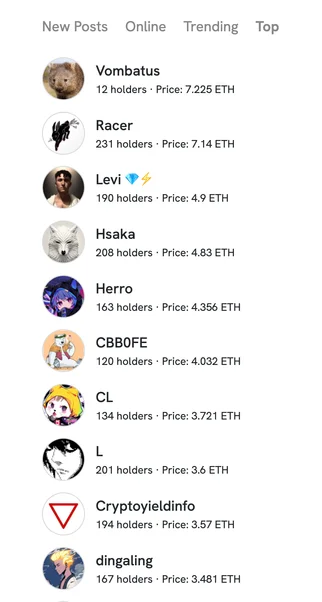
Top Friend.Tech Keys as of September 25, 2022
At the start of September, the TVL sat at $5.3M. Currently, it sits at $39.0M, almost a 700% increase. The parabolic growth of TVL has slowed down recently but it is still increasing steadily.
When looking at the daily USD inflows, it’s apparent that inflows remain generally very positive. Peaking during the weekend of September 10th, 2023, the TVL grew by 50% in one day.
FT’s volumes have grown significantly since the start of September. Over the past week, they’ve settled into a steady range of about $10M/day. Of note is the shifts between the amount of selling vs buying volumes, where we saw significantly increased selling pressure over the last week, signalling profit taking and potentially users exiting the platform. However, since the self-buyer nerf implemented last Friday, more on this later, buyers have regained confidence, as shown by increased buying vs selling volumes.In line with TVL and volumes, user activity has also grown significantly since early September, which is one of the healthiest signals for having product market fit. FT currently has around 10k returning users daily, and an additional average of 9k new users per day over the last week.
When looking at these numbers, it’s important to be aware that there are many (trading) bots active on FT, and it’s unknown what % of users are bots.Friend.Tech Strategies
FT has created a very engaged core community. This core community is generally excited about the potential of the platform, and enjoys using it and/or utilizing it for profit maximization. The core community’s members’ main goals for profit maximization are as follows:
- Maximize points in anticipation of an airdrop
- Trade keys to increase portfolio value
- Increase the value of their own key price
There are several major strategies employed to achieve the goals above.
(3,3)oors
A well known phenomenon from the OHM days, the (3,3)oors combine forces by buying each other’s keys and hodling them. In turn, this increases each other’s key prices, portfolio value, and their airdrop points which are distributed every Friday. The criteria upon which the points are distributed vary weekly, but are generally very dependent on the user’s portfolio size. This strategy is extremely well suited to users without an existing following on other social platforms, since (3,3)oors look at on-chain data to find suitable (3,3)oors, and tend to follow each other’s buys. As such, it’s a great way to bootstrap activity for a room as well.
(3,3)oors have outperformed other segments strongly over the past weeks, making this one of, if not, the most profitable general strategy. See the chart below where the (3,3)oor strategy is highlighted in green (fren,fren).
Similar to the unwind with OHM, this strategy is very reflexive and has potential catastrophic consequences for its users. But due to the social component of FT and the potential to add value to key holders in other ways such as writings, gated access to tooling and access to network, it doesn’t necessarily need to end up in the same way.
The (3,3)oor community is arguably the most engaged community, building many dashboards and tools to not only track, but also incentivize desired long-term behavior. This translates into rooms of (3,3)oors being generally very active and centered around everything going on with FT. It’s interesting to see this behavior play out, where users are actively addressing (potentially) negative issues to ensure their community, and in turn FT, thrive.
Self Buying (or Alt Buying)
The most efficient way to farm points over the last weeks was by buying up your own keys. Either through the same account (self-buying) or through alt accounts (alt-buying).
With this strategy, the user buys up his own shares from the get go. This results in him owning all of his initial shares, leading to no downside price risk, and a ~2.5x multiplier on portfolio value vs if the user had bought shares from others. This is due to the fact that self-buying increases the key’s price with each subsequent buy and as such, increases the portfolio value too. The only expense that the user accrues is a 5% tax to the protocol when buying and eventually selling his keys.
There are currently 15 self-buyers in the top 50 keys. In addition to that, there are likely alt-buyers as well, which are more difficult to identify. As a result, a significant % of the points were farmed by self-buyers.
However, over the past weeks, many have argued that this needs to be nerfed, as self-buying doesn’t add any value to the platform besides TVL in isolated keys. In addition, it dilutes the incentives for organic users. But maybe most importantly, an increasing amount of new liquidity is flowing to self-buyers vs into existing keys.
FT has implemented a drastic change to the points distribution algorithm last Friday, where self-buying got nerfed dramatically. For example, ‘Vombatus’, the highest ranked user, got 3.33 points/ETH, whereas the average (3,3)oor got around 90 points/ETH. Over the weekend, this has lead to several self-buyers selling off their own keys and reverting to a (3,3)oor strategy, where they buy up keys from (3,3)oors in hopes of getting reciprocative buys.
On the chart below, it can be seen how quickly key prices rise as more of the same key is bought.
Snipers
Snipers use bots to buy-up the first keys from users joining the platform. Initial keys go for as low as a few cents. Subsequent buys increase the price rapidly, allowing snipers to take profit generally within hours after sniping keys.
On well known X accounts, snipers have bought up to 50 of the initial keys, and even more at times, to subsequently dump these keys as more ‘organic’ buyers come in.
This has likely been, and might still be, the most profitable strategy for those being technically proficient enough to compete effectively.
Majors
A more simplistic strategy is to buy up majors, keys of known individuals, which are likely to remain near the top of the leaderboard. The main reason for doing this is to get general exposure to FT’s upside, while keeping things relatively easy to manage, and limiting downside risk.
This strategy has been very profitable during the past weeks as the top keys increased from 1-2 ETH to peak around 4-8 ETH. However, as can be seen on the ‘narrative price correlations’ chart above, it hasn’t been competitive with the (3,3)oor strategy.
Other
There are many other strategies employed, but these are outside of the scope of this article. A few other strategies of note are:
- Buying of inactive accounts with a large following on X
- NFT communities buying each other’s accounts. Eg. punks buying punks. This is very similar to the (3,3)oor strategy, but less extreme thus far.


0 Comments