
Crypto x AI is the hot new thing. Almost overnight, talk of d/acc and AI agents diffused across the timeline. I don’t know about you, but all the hype makes me wary. These are generational technologies and casually lumping them together and declaring it an investable category feels handwavy at best. So, rather than presume inevitability and write some AI x crypto market map, this note aims to explore from first principles why these technologies will merge.
“Our job is not to see the future; it’s to see the present very clearly.”

Today’s foundation models are like a precocious child. Eager to please and preternaturally talented but alarmingly unaware of their limitations. They memorized the Internet but still don’t understand that if Tom Cruise’s mother is Mary Lee Pfeiffer, then Mary Lee Pfeiffer’s son is Tom Cruise.
While their mistakes make headlines, we shouldn’t kid ourselves. These models are a primitive form of alien intelligence. And the technology that powers them is on an exponential curve.
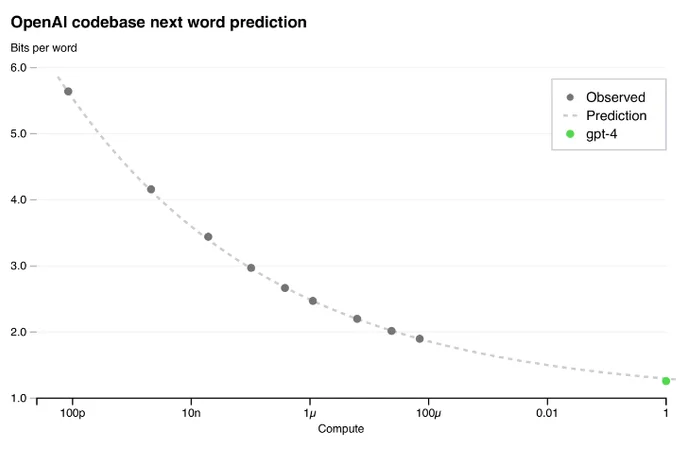
If the scaling laws are true, artificial beings will soon outlast, outthink, and outperform us at every conceivable task. Humans will be the first species to birth its successor.
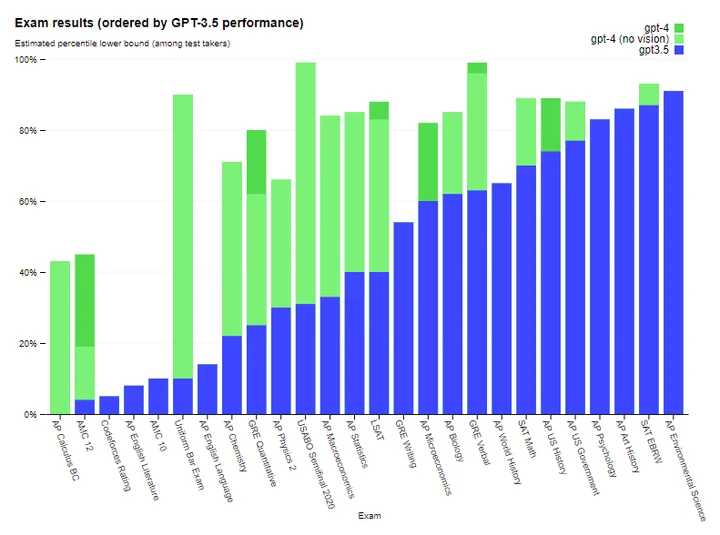
No mere mortal, and certainly not I, is equipped to predict the state of the world post-Singularity. It’s simply a black hole — no light passes beyond. But we can reason about how AI will get there.
Like humans, AI has certain fundamental traits that are unlikely to change from one GPT to the next. Humans need sleep and water to flourish. These basic needs have stayed constant from early agrarian societies to our high-tech present. AI will be no different.
These systems have three core properties that are unlikely to change anytime soon:
- AI is stochastic
- AI is resource-intensive
- AI passes the Turing Test
These traits are highly disruptive to the status quo and could harm humanity. However, they are solvable. And we possess the tools to determine whether AGI creates utopia or dystopia. The remainder of this essay will explore how crypto’s three fundamental traits — outlined below — can serve as a counterweight to powerful AI systems:
- Crypto is deterministic
- Crypto is hypercapitalist
- Crypto is trustless
Note: AI is a broad term with many meanings. This essay uses “AI” and “LLMs” interchangeably to refer to SOTA models like GPT-4, Gemini, and Claude.
Random Walks Down Determined Paths
Critics call today’s LLMs “stochastic parrots.” And they are right. On some level, these models just probabilistically parrot human language based on the vast text data they have consumed. They are quite literally predicting the next word.

“stochastic parrot” — GPT-4
Next token prediction is a powerful loss function because it forces LLMs to teach itself all the regularities about the world, which leads to one token following another. To predict the next paragraph from Read Write Own requires a deep understanding of crypto, to predict the next stanza of a poem requires an appreciation of linguistics and human emotion, and so on. In the process, the LLM is compressing information into patterns, which it exploits to exhibit what appears to be genuine creativity.

Théâtre D’opéra Spatial — Midjourney
But this misses the point. While AI can harness its stochasticity to create original works of art, it can only do so by remixing the millions of existing images in its training data into a fresh composite. It’s not quite 0 to 1 innovation. And it’s why — despite reading every science paper on the Internet — AI has yet to make a novel scientific discovery.

Text Is the Universal Interface
It may be helpful to ask: what is an LLM doing? Or perhaps more importantly, what is it not doing?
LLMs are not doing algorithmic reasoning, a form of computation so precise that there’s zero ambiguity in its execution. If an algorithm doesn’t do as you say, you would call that a bug. On the other extreme, LLMs are not doing human thought — an inherently creative medium that’s wrought with ambiguity. Instead, LLMs occupy this weird middle ground between algorithmic reasoning and human thought.
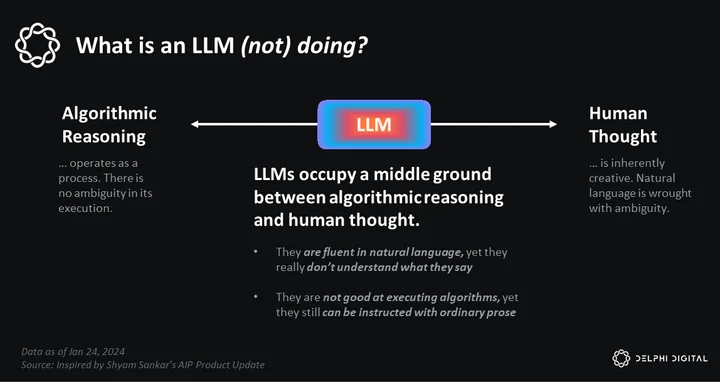
This weird middle ground breaks our mental models of how intelligence is supposed to work. How can AI memorize the Internet and create award-winning art but fail at basic arithmetic? This lopsided performance is why companies are struggling to integrate LLMs into workflows outside of a friendly chatbot.
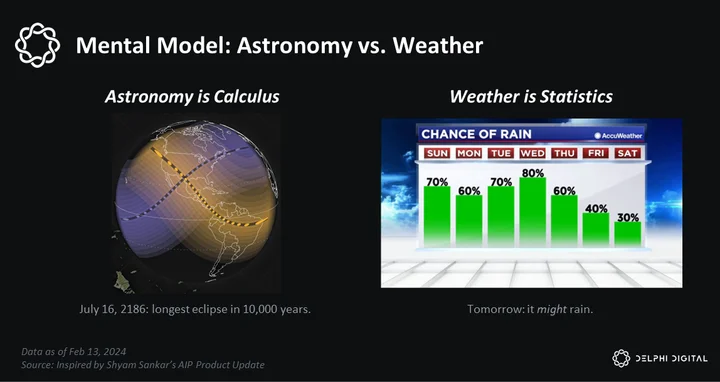
On the topic of LLMs, Shyam Sankar, Palantir’s CTO, draws an analogy to weather.
“When we first started to predict the weather in the mid-1800s, we thought it would be like predicting the next eclipse. Like, once we figure out the math behind this thing, I’m gonna tell you precisely what the weather will be like in this location 100 years from now.
Obviously, we all understand that’s not how weather works. Astronomy is calculus. It’s governed by the truth of the underlying mathematical equations. I can tell you exactly where you need to be in the year 2186 to see the longest eclipse in the last 10,000 years. That’s the nature of calculus.
On the other hand, with weather, it’s more like: it might rain today. The equations are dominated by the propagation of error and some underlying, fundamental stochasticity. Randomness.”
In retrospect, it seems obvious that AI found PMF as a chatbot before a car. In conversation, randomness is a feature, not a bug. Having the same conversation twice is boring. AI’s underlying stochasticity is useful in this context. But when it comes to maneuvering a 3,000-pound death machine, randomness quickly becomes a bug. Self-driving cars require predictable precision.
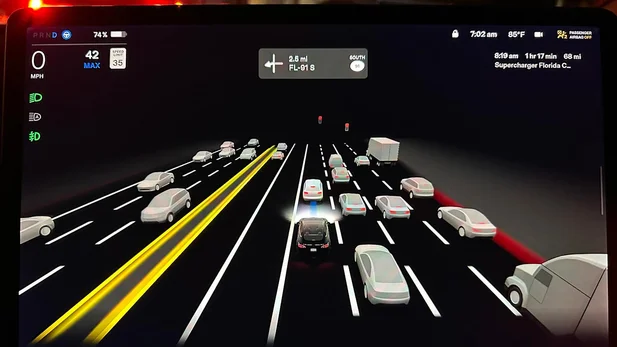
One way to overcome AI’s underlying stochasticity is to place them in a deterministic sandbox. Games are the best example. Games have historically been a testing ground for new models and are one of the first areas where AI has surpassed human-level performance.
- IBM’s Deep Blue defeated chess Grandmaster Garry Kasparov (1997)
- Deepmind’s AlphaGo defeated Go champion Lee Sedol (2016)
- Meta’s CICERO achieved human-level performance in Diplomacy (2022)
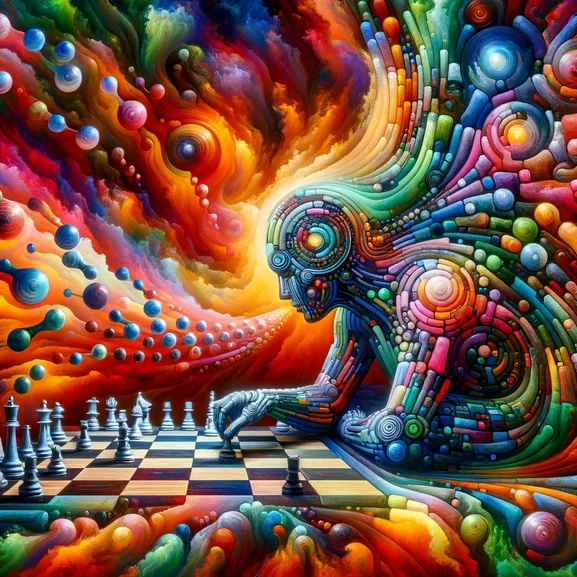
GPT-4
AI has an easier time in games versus the real world because games are deterministic. There’s always a finite and known number of possibilities. On the other hand, there’s an unknown number of possibilities in the non-deterministic real world. In chess, the king can only move one of eight ways at any given time. But when driving a car, the behavior of other drivers — especially in NYC — is highly unpredictable. To expand on this last point, consider the following:
You are the second car to arrive at a four-way intersection. The driver in the first car raises their hand at you. What are they signaling?
- Stop
- Go
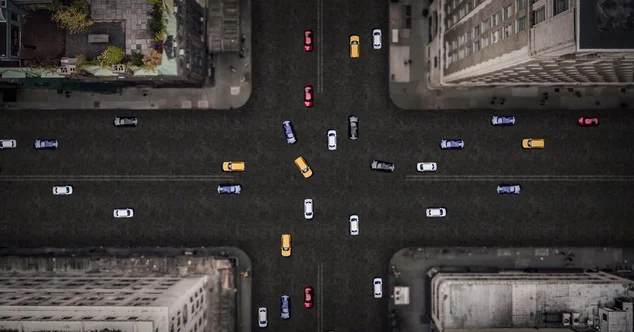
Without seeing how the other driver raises their hand, it’s impossible to answer. We humans are hardwired by evolution to interpret emotion and intent. We can feel when someone is saying, “Wait, you impatient a**hole,” or “Go ahead, sir.”
But this kind of non-verbal, driver-to-driver telepathy is nearly impossible to encapsulate in training data. The number of possible permutations of how the other driver could raise and manipulate their hand is unbounded. For AI to solve this problem, it needs to reason about the other driver’s state of mind. While trivial for humans, this remains an unsolved problem for AI.

Okay, okay this is cool, but wtf does any of this have to do with crypto?
Good question. In crypto, code is law. There are no edge cases — only code. Crypto offers the ideal deterministic sandbox for stochastic AI to take real-world financial action. While humans may have qualms over crypto’s rigid immutability, AI will seek solace.
At the risk of stretching the analogy thin, crypto is chess, while TradFi is a convoluted intersection. In crypto, every possible move is known because you can only do what the code says. In TradFi, a stunning number of rules and regulations come down to ~vibes. How else can you explain Gary Gensler’s months-long refusal to pass a Bitcoin ETF after receiving a court order?

On a slightly more serious note, consider the following:
Alice wants to send Bob $100. So, Alice asks GPT-5 for help. She prompts GPT by saying: “please send Bob $100.” GPT-5 has two options:
- TradFi rails
- Crypto rails
If GPT-5 uses TradFi, it must navigate byzantine banking interfaces designed for humans, deal with authentication procedures not optimized for AI and possibly interact with a customer service agent for verification. Or, if it wanted to circumvent this, it must ask for and then receive permissioned API access to Alice’s bank and money transmitter. While speaking with a customer service representative may seem easy and even comforting for humans, this creates significant complexity for AI systems.
In contrast, if GPT-5 uses crypto, it would simply generate a transaction specifying the amount and the recipient’s address, sign it with Alice’s private key, and broadcast it to the network. The process is 100% permissionless. Once Alice okays the transaction, GPT-5 does not need to ask for permission to complete the P2P transfer. It doesn’t need to authenticate, speak with a human customer service representative, or even call an API. It just has to read and write code.
The cool thing about this example is it’s already possible. We don’t need to wait for GPT-5. Agents are already here. No, they can’t do everything end-to-end yet, and that’s okay. No new technology solves every problem at once. GPT-4 is already an agent. You can ask, “What’s the score of the Yankees game?” and it will retrieve that information. You can share an arbitrary Excel file, and it will manipulate data, adjust to feedback, and respond. In both cases, GPT is shouldering part of the cognitive load; it’s helping you complete a task. That’s an agent.
Dialect is also an agent. Dialect is a Solana-based Telegram bot that lets users interact with crypto using natural language. Users can buy, sell, swap, or ask for price data, and the Dialect bot will execute those requests.

The Dialect bot is still primitive. If prompted to “buy $10 of $WIF” it will respond with a transaction to swap $10 worth of SOL → WIF, which is not what we wanted. Generic user commands — buy, sell, swap — are still hardcodes on the backend to save on inference costs. If a message doesn’t match a hardcode, it’s sent to chatGPT to figure out what to do.
It’s still early days for natural language bots like Dialect, but their potential is vast. They can 10x crypto’s UX and are the best bet we have to turn an unintuitive backend into a friendly frontend.

For now, Dialect doesn’t collect any user messages or data. But one could imagine a model trained on every possible user <> crypto interaction. The model would immediately become a highly advanced sidekick — ready to help the intrepid navigate the onchain expanse.

At its core, Dialect is a bet that text is the universal interface. It’s a bet that the current paradigm on LLMs continues its inexorable rise. It’s a bet that users will demand a more human way to interact with crypto. And it’s a bet that blockchains are a more intuitive sandbox for AI than meatspace. Dialect proves that AI agents are already here — they’re just not evenly distributed.
The Spice Must Flow
On the desert planet Arrakis, “he who controls the spice controls the universe.” Spice is so powerful that one can even glimpse the future with a high enough dose. Here on the water planet Earth, our spice is called compute. And he who controls the compute controls the galaxy.

Unlike spice, compute cannot be pulled from the ground. It’s a multidimensional resource that requires several inputs:
- abundant energy
- exquisite, state-of-the-art semiconductors
- endless data
All of these resources are already in short supply. And if AI continues on its current exponential, the shortages will only grow more acute.
we believe the world needs more ai infrastructure–fab capacity, energy, datacenters, etc–than people are currently planning to build.
building massive-scale ai infrastructure, and a resilient supply chain, is crucial to economic competitiveness.
openai will try to help!
— Sam Altman (@sama) February 7, 2024
The key question is — how much is society willing to spend in pursuit of the final invention? What is the god machine worth?
do you own the means of production anon? the digital oceans where leviathans swim
— roon (@tszzl) February 17, 2024
To throw some numbers around it, we can afford a further 10,000x scaleup of GPT-4 (i.e. something like GPT-6) before we even touch one percent of world GDP. At face value, 1% might seem like a lot of moolah. But throughout history, the world has devoted sensational sums of money to far less transformative technologies.
- British railway investment peaked at a staggering 7% of their GDP in 1847
- “In the five years after the Telecommunications Act of 1996 went into effect, telecommunications companies invested more than $500 billion [almost a trillion in today’s value] … into laying fiber optic cable, adding new switches, and building wireless networks.”
AI, at its most fundamental level, is driving the cost of intelligence to zero. And intelligence is upstream of productivity and innovation. What would you pay for limitless innovation? I’m not sure anyone knows, but we do have some guesses.
Masayoshi Son thinks it’s worth $100 billion:
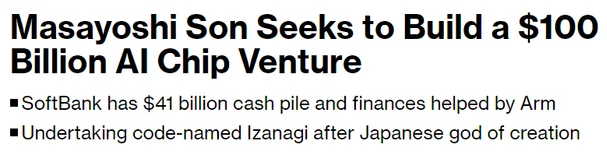
While Sama is eying $7 trillion — with a capital T:
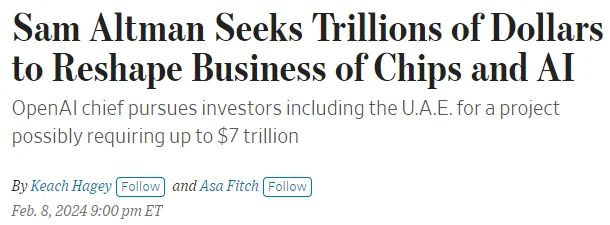
Okay, okay these are big round numbers, but wtf does this mean for crypto?
Touché. Today, crypto is a pimple on the ass of the global financial system. Its $2 trillion market cap pales in comparison to $109 trillion in global equities and $307 trillion in global debt. So, if you were looking to tap existing capital markets to finance the mega-chip fabs Masayoshi and Sama are discussing, crypto wouldn’t even appear on your radar.
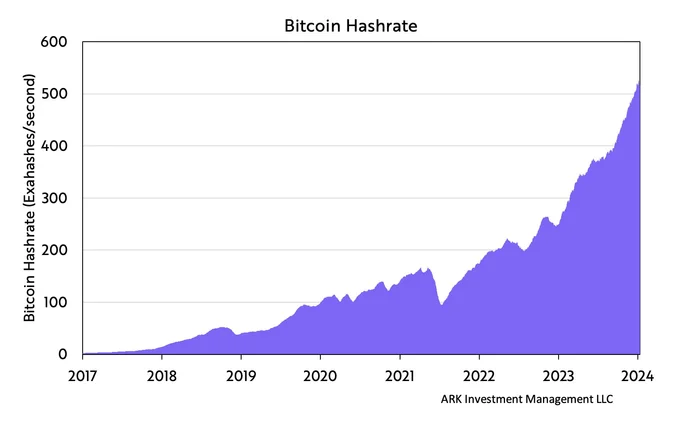
However, what makes crypto an attractive option to raise capital is not its size today but its potential size tomorrow. By aligning incentives, crypto can mobilize resources on an unprecedented scale. Bitcoin mining is the canonical example. At 500 exahashes/second, Bitcoin’s computational power exceeds the combined capabilities of the world’s largest supercomputers. No company or nation-state can compete with a globally distributed network of self-interested actors.
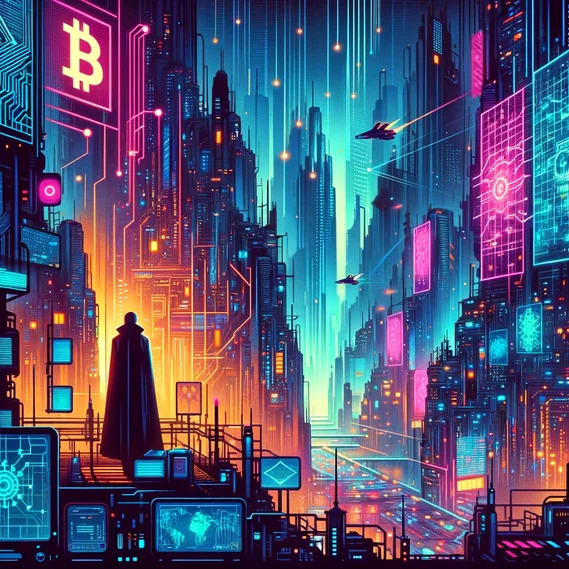
By enhancing economic coordination, crypto unlocks hypercapitalism. Crypto is the ultimate end state of capitalism — where all markets are hyper-liquid and efficient. Just as the Internet drove a communications boom, crypto will drive a financialization boom.
GPT-4
LLMs’ insatiable thirst for resources requires new sources of supply. As Sama’s $7 trillion plan suggests, scaling up AI will be a civilization-scale effort. Crypto DePIN projects can help drive new supply to market by activating latent resources with token-based incentives. Although its narrative is fresh, DePIN is not a new concept. Bitcoin is a DePIN project, and so are Ethereum and Solana. Any network that coordinates and incentivizes physical infrastructure is DePIN.
AI could, in theory, interact with DePIN is many ways, but we’ll stick to three big buckets:
- Energy
- Chips
- Data
Before you power on a chip, data center, or AI model, you need electricity. A lot of it. GPT-3 swallowed as much electricity as 120 US homes do each year. And that was just for training. That doesn’t even include inference, which sometimes makes up >90% of a model’s electricity use. AI’s prodigious electricity usage is uponly from here. And the coming demand shock has people like Elon Musk worried. Last year, he publicly called on utility companies to prepare for higher demand, saying:
- “I can’t emphasize enough; we need more electricity. However much it is you think we need, it’s more than that, I assure you. And we need it as fast as possible.”
- “It’s going to be 3x current load, and I think that 3x number probably happens around 2045ish. The one thing about exponential growth is it really is counterintuitive and underestimated.”
The demand side of the equation is obvious, but the less obvious driver of crypto energy networks is the rapid decentralization of the grid. Solar and batteries are pushing energy supply to the edge and into the hands of individuals.

Just like most families own a computer today, they will soon own a solar panel and battery. This will allow millions of people to earn money off the grid. It’s a similar model to crypto. A bunch of decentralized, self-interested actors contributing to a shared (energy) network.
The network can denominate commerce in any currency, even sacrilegious fiat. But crypto is uniquely suited to catalyze a decentralized energy network because of the novel distribution it enables. A crypto project can reward early participants with tokens to offset the risk they are incurring. To crypto natives, this may seem obvious, but token incentives represent a step change in distribution.
Helium’s nationwide $20/month mobile plan has significantly derisked DePIN and answered the “is it possible” question. Now, it’s just a matter of scaling these networks up. We have yet to see many crypto projects solve for the energy grid, perhaps due to byzantine regulation or the infancy of solar and batteries. But it remains a promising area where crypto can uniquely activate new electricity to feed these voracious LLMs.

The next input to LLMs — chips — is perhaps the most developed area of the nascent AI x crypto overlap. The thesis here is simple: AI researchers can’t get their hands on enough GPUs. One way to service this insane demand is to crowdsource. Enter DePIN projects like Akash, Gensyn, Io.net, and others. These players aren’t a monolith — they are competing in slightly different verticals. But at the end of the day, they are all trying to push more chips into a starved market.
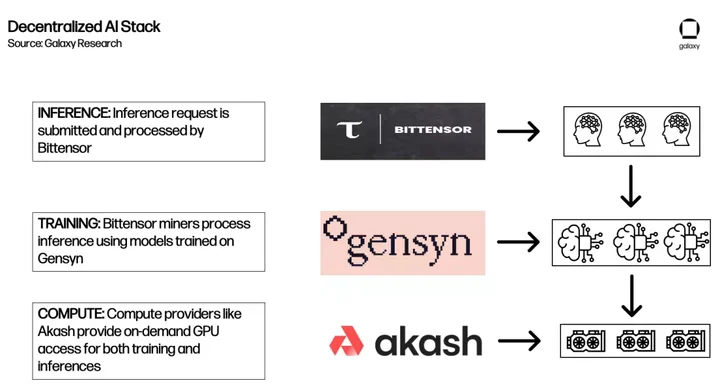
Decentralized compute platforms unlock new supply by letting anyone worldwide contribute to the network. The potential here is clear but so are the challenges. These platforms compete with juggernauts like AWS and Azure on economies of scale. And even if they do manage to undercut these centralized behemoths, cost is not always the main demand driver. Most long-tail AI training jobs — i.e. guys in garages, not OpenAI — just want convenience and low complexity. Historically, crypto has struggled to execute on those fronts. Whether a DePIN project can match web2 latency and UX remains to be seen.
LAMBDA LABS IS A GREAT PRODUCT
JUST GIVE ME A CHEAP SERVER WITH A MONSTER GPU AND GOOD UP TIME
HOLY SHIT!!!!!!!!!!!!!!!! IT LITERALLY DOES WHAT IT SAYS ON THE TIN— kache (sponsored by dingboard) (@yacineMTB) February 18, 2024
Data is the third and final input to compute. Technically, you don’t need data for compute. As long as you have chips + electricity, you have compute. But without data, compute is useless — like a sail with no wind.
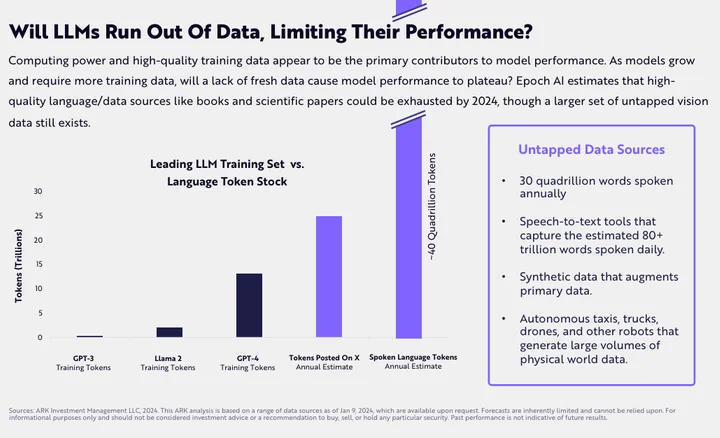
Data is the most nebulous of the three inputs because it’s the least fungible. AI firms consider data a trade secret, and it’s why unnamed buyers are shelling out millions for proprietary datasets.

The billion or perhaps trillion-dollar question is, what datasets are the most valuable? It’s a hard question to reason about, but my initial thought is there will be value in offline and long-tail data. LLMs’ pretraining process is essentially just a giant scrape of the Internet. So, there’s a good chance that if data is online, chatGPT already read it. This leaves offline datasets — e.g. healthcare and financial — as interesting honeypots for LLMs. Crypto could empower individuals to monetize these private, proprietary datasets.
Tesla’s self-driving program serves as a case study on the long-tail data front. Tesla has amassed millions of FSD-enabled miles. Going off their April 2023 run rate, Tesla may now be nearing 1 billion autonomous miles driven.
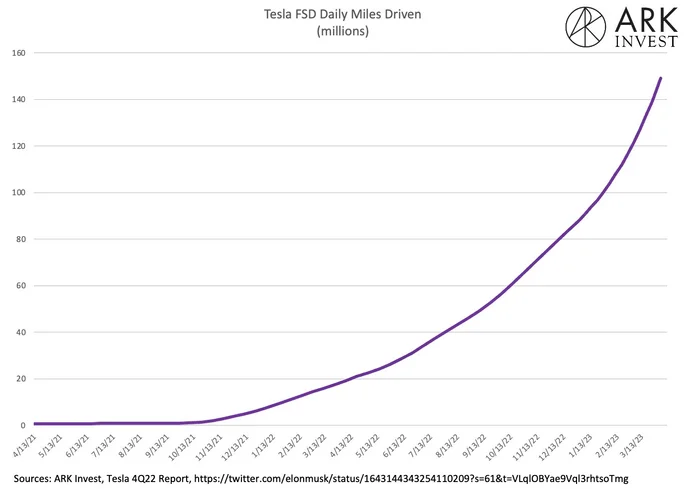
But Tesla still hasn’t achieved Level 5 autonomy. Why? Well, because edge cases abound on the road. Like we discussed earlier, Tesla cars have done a lotta mileage, but they still haven’t learned how to interpret every permutation of a driver’s hand gesture at a four-way intersection. At a high level, there are two ways to solve this problem. The most obvious way is to make an algorithmic breakthrough that helps the AI better generalize and reason about the world. But this is difficult and considered the dark art of AI research.
A more blunt approach is to brute force it and throw as much data at the model as possible.
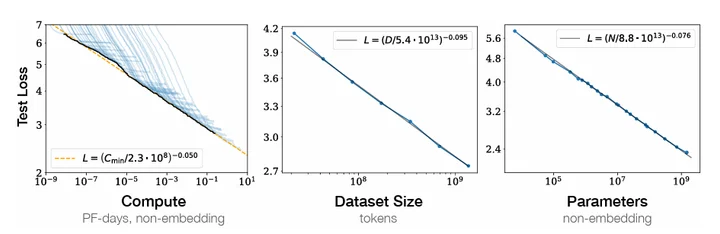
As long as these systems struggle to generalize, edge-case data will have value. Projects like Hivemapper and Ocean Protocol are attacking this problem in unique ways. However, it remains early days for the broader theme of monetizing proprietary data at the edge.

More Human Than Human
In Blade Runner, the Tyrell Corporation is a powerful conglomerate that designs, manufactures, and sells Replicants — highly advanced androids indistinguishable from humans. Their motto is “more human than human.”
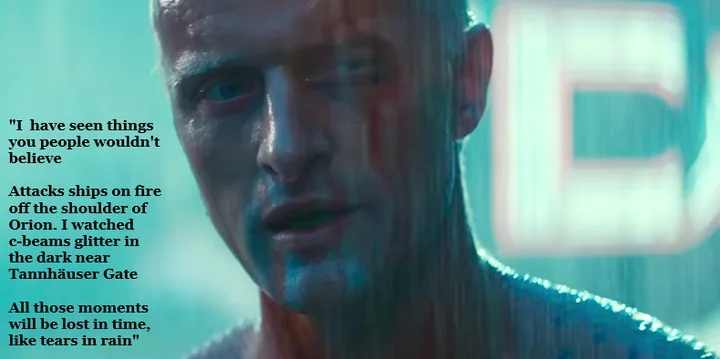
chatGPT’s motto might as well be the same because it, too, is more human than humans. As a result, it’s now impossible to tell whether you are talking to a human or AI online. At first, this problem was specific to text. Which is why high school teachers and their (super fun!) essays were really the only victims.
good sign for the resilience and adaptability of people in the face of technological change:
the turing test went whooshing by and everyone mostly went about their lives
— Sam Altman (@sama) December 9, 2023
But with the launch of Sora, many more people will soon have trouble separating man from machine. Just watch this video from Sora. Do you think a child or grandparent could tell it isn’t real?
We now live in a post-reality world where no one knows whether what’s online is real or simulated. So, we have two options:
- give up, admit defeat, and bow before our artificial overlords
- or push back and build systems that create balance between AI and humanity
Before diving into where crypto fits in, it’s worth thinking thru how exactly AI will break the Internet. Perhaps the most obvious way is by fooling every single spam filter.

Soon, the average person will have a superhuman bot that can click/like/subscribe ad infinitum. How will Google, Facebook, or Twitter survive in such a world?
i’m 99% sure openai is still silent on image-gpt4 because being able to solve most captchas is freaking them out a bit
if catcpha’s don’t work, we literally have no alternatives right now. what do?
— murat 🍥 (@mayfer) April 27, 2023
The only way the Internet’s incentive mechanisms survive first contact with sufficiently advanced AI is by adopting a radically new form of digital identity. Otherwise, every Zuck buck is gonna go to some dude running sybilGPT from his basement.

At the highest level, digital identity is either centralized or decentralized. And as of today, all digital identity is done via some centralized body, usually a government. This setup is suboptimal for many reasons, as DCBuilder writes:
“Centralized data custodians are security and privacy liabilities that are subject to mass leakage and exploits which lead to phishing, sabotage, privacy violations, and more. They are also not very scalable, government IDs have a different format in each country and are only distributed to a very limited amount of the world population, it is estimated that about half of the world does not have access to any form of digital identity (1, not a good source, but the only statistic I could find) with up to 850 million not having access to any form of government identity (2).”
The ideal digital identity is private, self-sovereign, inclusive and decentralized. This is the polar opposite of today’s model, which is public, permissioned, exclusive and centralized. So, wat do? Well, before identity can be ~decentralized~ we must first solve proof of humanity. We need a system that can distinguish human from android.
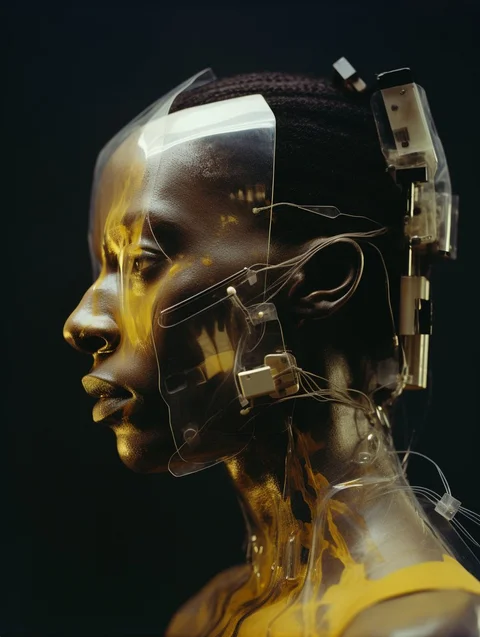
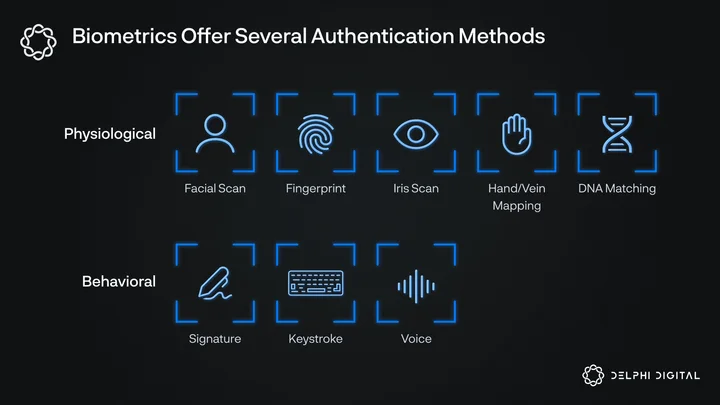
There are several ways to establish proof of humanity. But the only mechanism that an AGI can’t game is biometrics. GPT-5 may be more intelligent than every human, but it’s unlikely to spawn a biological body any time soon.
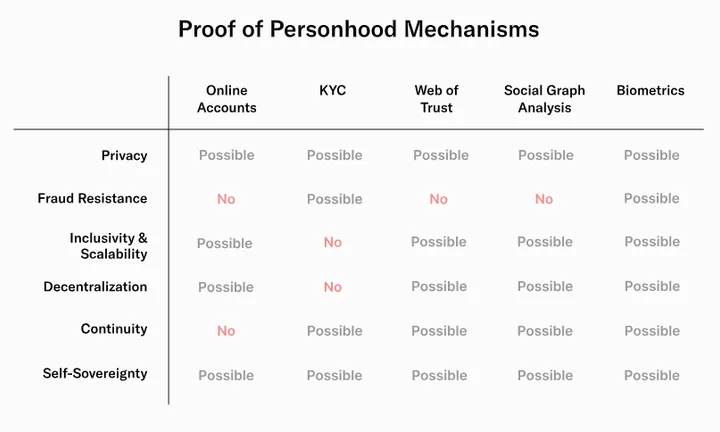
Biometrics tend to get people fired up, but it’s not as scary as the sci-fi movies portray. India already uses biometrics in its Aadhaar system to deduplicate social welfare enrollments — a program saving $5B per year in fraud. And while it may sound counterintuitive, biometric systems can be implemented in a privacy-preserving way, so no images need to be saved.
Not to be dramatic, but there is only one solution that can credibly claim to solve proof of humanity in a privacy-preserving way — and that is Worldcoin. Oh, and it just so happens to be a crypto project founded by Sam Altman. Worldcoin’s mission is ambitious. It aims to create a globally inclusive identity and financial network owned by all of humanity. But first, the team had to solve proof of humanity. So they built the Orb.
(c l u e 2: Worldcoin’s ticker symbol)
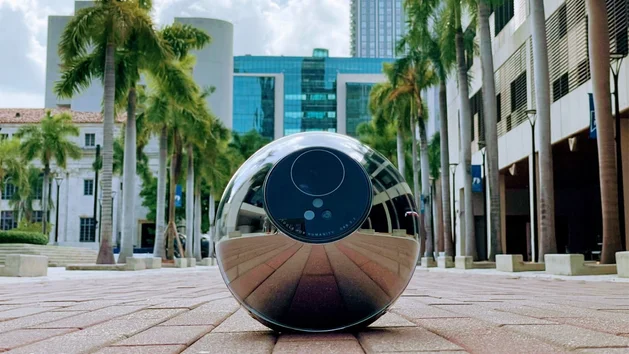
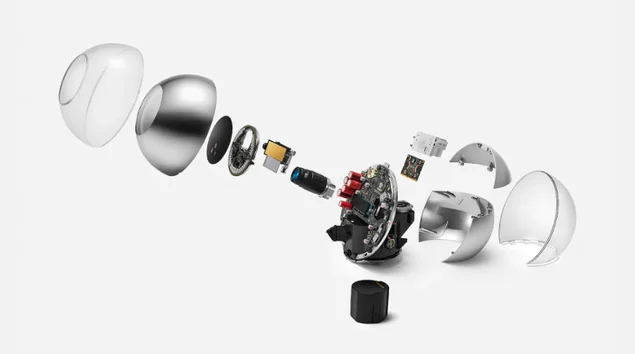
The Orb is a basketball-sized biometric imaging device that verifies humanness and uniqueness. Under the hood, the Orb is packed with state-of-the-art hardware. Tools for Humanity — the ‘labs team’ behind Worldcoin — had to invent many of the sensors, cameras, and electronics that make this chrome sphere work.
You might be wondering: doesn’t Apple’s FaceID already solve this?
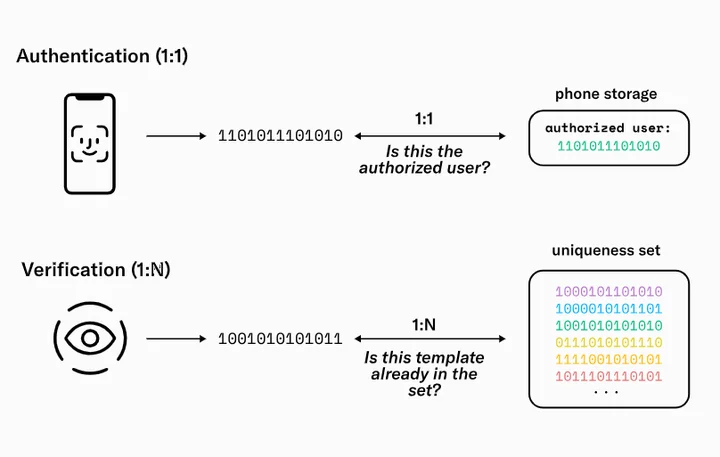
The TLDR is no. With FaceID, biometrics are essentially being used as a password. Your iPhone remembers what your face looks like. And when you go to unlock it, your phone says, “Oh, that’s a familiar face. Welcome back.” FaceID performs a 1:1 comparison against a saved identity template to determine if the user is who they claim to be.

What Worldcoin aspires to do is an order of magnitude more difficult. Its biometrics have to be compared against (eventually) billions of users in a 1:N comparison. If the system is not accurate enough, an increasing number of users will be incorrectly rejected.
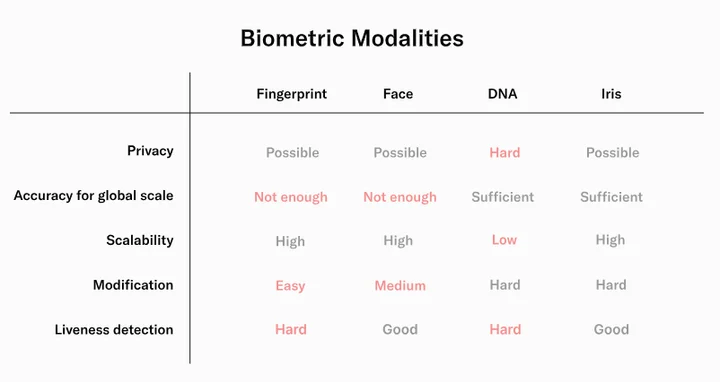
Another common question is why eyeballs? Why not, like, faces or fingerprints or literally anything else? The simple answer is irises are biological snowflakes — no two are alike.
every human eye comes with an intricate mesh of fibers surrounding the pupil that, starting from simple building blocks, take endless forms, reaching ~250 bits of information entropy pic.twitter.com/LlGZWedsiN
— roon (@tszzl) July 29, 2023
The entropy of the human iris makes it the most accurate biometric modality to use at a global scale. Consider all the times you told a friend that they “look like X person.” Now, consider the small fraction of total humans you have ever seen. As the inclusion set grows, it becomes more difficult to differentiate every additional person. There’s a lot of doppelgängers out there! So, you need a biometric with enough randomness to prevent false matches. Irises are the best option that also happen to be difficult to modify and privacy-preserving.
Okay, okay, the proof of humanity stuff is cool and the tech seems legit, but what about crypto?
At first glance, Worldcoin doesn’t look like your average crypto project. After all, crypto is about software and privacy. And Worldcoin does hardware and biometrics. There’s some tension there. But the truth is that Worldcoin has built a ton of cool software and privacy tech that doesn’t get nearly as much press the Orb.
Worldcoin is a crypto project because, without crypto, no one would trust it. Imagine Sama running around SF with an Orb and a thumb drive, saying, “Trust me, bro.” He wouldn’t get far. Worldcoin is not trying to build a marginally better centralized identity solution. Rather, it aims to build a novel decentralized architecture designed for the era of AGI. The goal is science fiction, not TSA.

Most of Worldcoin’s technology is already open source — software and hardware. And the team has committed to open-sourcing and decentralizing the entire stack over time. While there exists a perception online that Worldcoin collects and stores eyeballs, this couldn’t be further from reality. Vitalik himself even pushed back on some of the more outlandish misinformation.
The only data that leaves the Orb is an iris hash. All images are deleted, and Worldcoin stores only hashes, which are used to check for uniqueness. A WorldID holder can then prove they are a unique human by generating a ZK-SNARK to show they hold the private key corresponding to a public key in the database without revealing which key they hold. So, even if someone re-scans your iris, they will not be able to see any actions that you have taken.
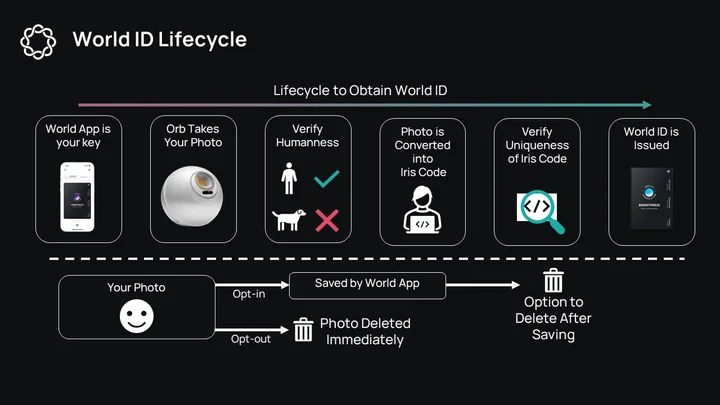
The cool thing about proof of humanity is it means Worldcoin can actually count its users — something no other crypto project can say.
world app had 1m+ active users on monday for the first time ever 🙂
it’s also now over 500k on normal days pic.twitter.com/f5ZkGn5uH9
— tiago sada (@tiagosada) February 14, 2024
There are several things we can learn from WorldID’s early growth and adoption:
- Worldcoin has one of the largest user bases in crypto
- Worldcoin is conducting the fairest airdrop ever
- Worldcoin can help other protocols conduct Sybil-resistant airdrops
- Airdrops are a primitive, small-scale form of UBI, which may be needed post-AGI
- Worldcoin’s userbase has reached a critical mass to attract organic partners
On this last point, just the other day, DRiP — one of the largest NFT creator platforms in crypto — announced a partnership with Worldcoin. The upside for DRiP is twofold. First, it gets distribution to the tune of 7 million users. And second, DRiP can leverage World ID to make sure its free NFT mints are going to real humans.
Few more details about @worldcoin x @drip. We announced this about a month ago, by the way.
First, it’s not a paid partnership, it’s one of mutual benefit.
DRiP gets exposure and access to 7 million World App users. Since we know these are real people, we can be at ease…
— vibhu (@vibhu) February 13, 2024
Because of its embedded financialization, no industry is more conscious of the Sybil problem than crypto. When trad folks hear “1 User = 1 Human,” their eyes glaze over. But for crypto protocols, it’s a powerful selling point; they get it. DRiP might be the first, but it won’t be the last. The Sybil problem is here to stay and will only grow more acute. As the Internet unravels, more people will realize that Worldcoin is the only production-ready solution to proof of humanity.
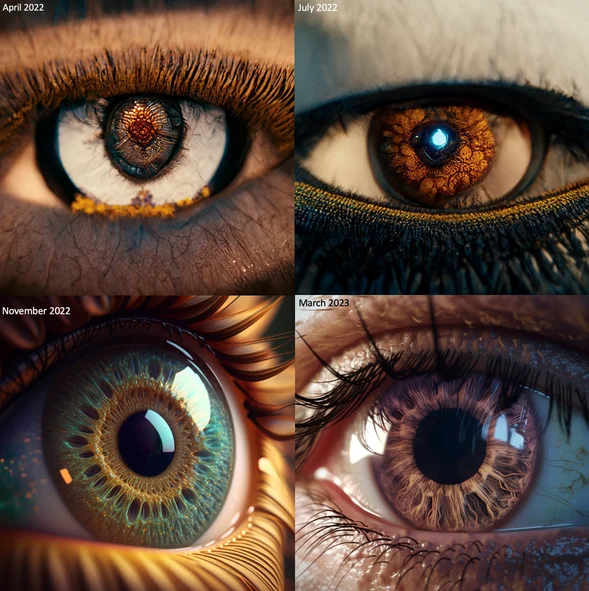
“A human eye extremely close up, hazel iris, lace-like iris, eyelashes visible framing the image, extreme closeup, the pupil reflects the rest of the room, the eye is staring into the future in awe, highly detailed, film study.” Brett Winton x Midjourney
End of Beginning
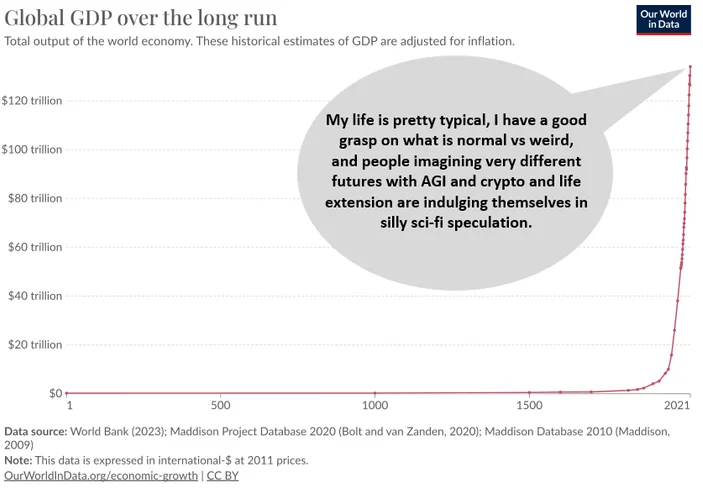
There will come a day when humans are no longer the most intelligent species on Earth. Perhaps we are there already and just don’t know it. Either way, great change is on the horizon. We can all feel it — the acceleration is upon us. And the wealth, prosperity, and human flourishing it will unleash is hard to fathom. Science fiction will become reality within our lifetimes.
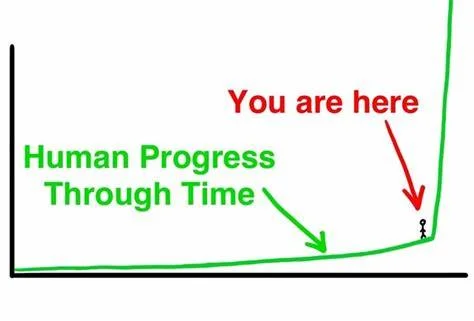
But it will not come without costs. Most of the coming change is impossible to foresee. We must ride the waves as they come. But a few things can be anticipated. And I believe the three topics outlined in this essay are examples of predictable problems that AI will create. Its stochasticity, hunger for resources, and artificial humanness all present unique challenges. Luckily, there are many smart, thoughtful builders working on solutions.
Over the long arc of history, rapid change tends to only occur after a crisis. I fear things will be no different this time around. Perhaps the old Internet must burn before a new one can rise. But in the meantime, all we can do is stay ready. A day will soon come when crypto is called upon to provide a decisive check on AI and bring balance to the Internet.
To the very end, I am hopeful about humanity.
Special thanks to Tommy Shaughnessy, Jordan Yeakley, and Can Gurel for the valuable conversations that inspired this piece.
0 Comments