
Introduction
In launching the first vampire attack in crypto history, SushiSwap provoked a reluctant Uniswap into launching UNI. Uniswap airdropped 15% of the supply to its 250K users, with the minimum 400 UNI airdrop worth $3.6k today. Uniswap’s airdrop set the standard for token go-to-market.
At their best, airdrops decentralize the protocol, reward early users, align incentives, and solidify a community. At their worst, airdrops alienate the user base, curb hard-earned momentum, contaminate community discourse, and leak massive amounts of value to sybils.
Airdrops have become increasingly scrutinized and are rarely celebrated now. Entitled users and tone-deaf project teams sit at opposite ends of a polarized spectrum. Airdrops have taken on a PvP dynamic between users and the protocol, which is causing many to wonder if airdrops are still viable. In this report, we will explore recent airdrops, analyze protocol health pre/post airdrops, and discuss potential solutions for the issues facing token launches.
Airdrop Frenzy
Since the UNI airdrop, we have seen a number of high-profile airdrops that have rewarded early adopters, including dYdX, ENS, Jito, Arbitrum, and many more. This strategy worked well for many projects in attracting capital and users. Users started expecting a future airdrop from every new project, and projects sustained this expectation by saying that their airdrops were “returning part of the value created to their users.”
Returning value to users was a smart incentive, especially when attracting liquidity and attention is what can make or break a project. Airdrops also helped projects initially distribute their token supply to a large set of users, making Governance more distributed. The expectation of a future airdrop was often enough for degens to move their attention and liquidity from established protocols to riskier, untested protocols.
Not all airdrops are equal. Some, such as Internet Computer and APE coin, have mostly trended downward in price since the airdrop. Meanwhile, airdrops such as BONK (280x), TIA (2.5x), and UNI (2.9x) are trading at multiples of their launch valuations.
Four of the top 10 airdrops distributed over a billion dollars each to their early users and community members. While the dYdX airdrop was valued closer to $800M at its launch, any user with over $100k in trading volume received an airdrop equivalent to $60K.
The UNI airdrop outperformed every following airdrop and was worth a whopping $6.4B at its peak. The 50 biggest airdrops in crypto have distributed value worth over $26.6B. This multi-billion dollar opportunity has attracted sophisticated actors looking to exploit the system. 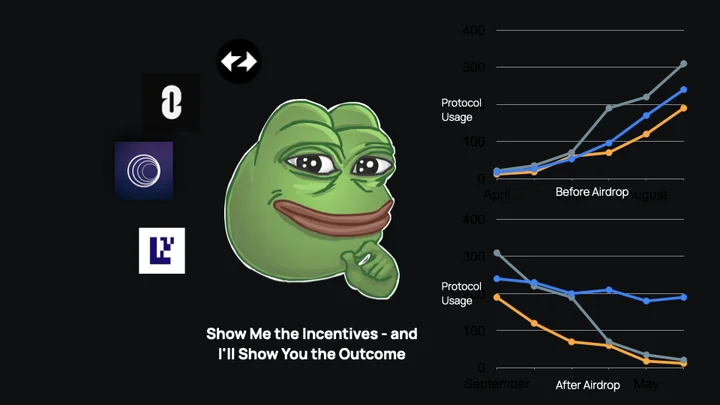
This has created a new cohort of crypto users – the Airdrop Farmers. Airdrop farming is extremely lucrative as the risk associated with most of these programs is usually minimal. Airdrop farmers follow a simple process:
- Explore the platform
- Identify how the airdrop allocations will be calculated (e.g. transaction count, transaction volume, locking liquidity, etc)
- Make transactions that add little value to the protocol but rank those users at the top
- Repeat across several wallets
Every exciting protocol launch in crypto is now synonymous with inorganic activity from sybils and bots to acquire a large portion of the initial airdropped token supply. Airdrop farming has now developed into a small sub-sector in the industry, with airdrop-oriented CT influencers, campaign platforms, airdrop farming applications, and the farmers themselves.
This farming activity heavily skews application performance and traction metrics. To counter this farming activity, airdrop criteria have evolved significantly since the UNI drop. Protocol and application teams know this behavior and have now started counter-farming such users through the promise of the future airdrop or their points program.
Evolution of Airdrop Design
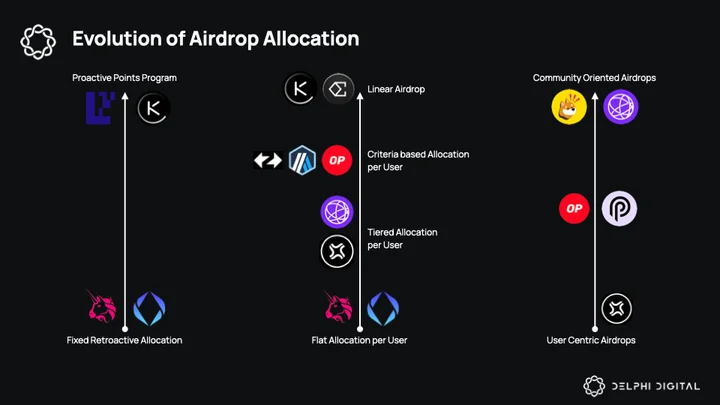
Airdrops started by retroactively rewarding users for their behavior (trading volume on dYdX, registering an ENS domain, etc.). But now, most airdrop programs follow an extensive points program, wherein the protocol team determines how to value user behavior and allocates tokens accordingly.
The UNI airdrop started with a flat reward (400 tokens) for each swapper. Then, we saw tiered airdrops, where protocols started to make a general tiered distinction between users, and the airdropped amount within each tier remained constant (Jito). The Optimism team popularized multiple criterion-based airdrops, with qualifying users receiving incremental tokens for each criterion they satisfy. This methodology was utilized by many protocols, including Arbitrum and zkSy
Read the full report
This report is part of Delphi Pro.
- 800+ Pro reports across every major sector
- Talk directly with our analysts
- Private community of funds and builders
Already a Pro member? Log in
0 Comments