
We’re 42 months into what was supposed to be a 36-month DeFi bear market, and the DeFi landscape remains as turbulent as ever. Vitalik’s recent comments on unsustainable yield, repetitive financial primitives on new chains, liquidity fragmentation, protocol exploits, and increasing MEV are critical issues plaguing DeFi. These aren’t just abstract problems – they cost users real money with their interactions in DeFi.
Among all these issues, MEV has become one we’re spending a lot of resources solving. Even though we as an industry spend a lot of time and resources tackling MEV at the protocol and dApp level, most users don’t truly understand the gravity of the problem. Here’s a sobering thought: If a DeFi user loses an average of 0.75% of each transaction’s value to MEV and fees—which is conservative compared to the memecoin trenches on Solana—by the 93rd transaction, half of their original balance will have disappeared into the MEV dark forest. It’s a silent drain on users’ funds that often goes unnoticed.

For DeFi to truly scale and succeed, we must protect participants from severe value leakage caused by MEV. If left unchecked, we face a shrinking user base, with remaining participants slowly bleeding funds to MEV bots and validators. However, this scenario is unsustainable even for those currently profiting from MEV. As extraction increases, DeFi’s health deteriorates, leading to decreased liquidity and activity. This creates a negative feedback loop, reducing future MEV opportunities and pushing some users back to CeFi.
Enter Paladin, offering a first-of-its-kind solution to predatory MEV. By aligning the incentives of validators and stakers through the PAL token, Paladin aims to reduce negative MEV, helping unleash the true potential of DeFi on Solana. The ultimate goal is to increase the value and activity in the ecosystem. By reducing predatory practices, Paladin could help multiply DeFi liquidity and activity over time, creating a more valuable ecosystem for all participants instead of extracting diminishing returns from a shrinking user base.
MEV on Solana: A High-Stakes Game
Solana’s is a powerhouse of speed and efficiency. Its high throughput, low latency, and low costs make it incredibly attractive for fast bots looking to execute their transactions to capture MEV value before anyone else. However, this very efficiency has turned Solana into a high-stakes battleground for MEV extraction.
In the first quarter of 2024, most metrics associated with Solana MEV repeatedly hit new highs. On March 9, 2024, Solana validators and the Jito protocol had a record day, collecting over 10,000 SOL (approximately $1.5 million) in MEV tips. The same week, Solana validators earned over $7 million in Jito tips for blockspace inclusion.
However, this MEV bonanza came at a cost. The features that made Solana attractive for users had also led to increased front-running, sandwich attacks, and spam transactions, making the user experience worse for average users. The blockchain’s efficiency was being weaponized against its own users.
The situation had reached a tipping point, and on March 9th, Jito announced the suspension of their flagship mempool feature, which allowed searchers to view incoming transactions within a 200ms window. This feature was being heavily exploited for sandwich attacks on swap transactions. Recognizing the significant negative impact on users and the broader Solana ecosystem—where every user transaction was at risk of being front-run or sandwiched for poor execution—Jito decided to disable the feature to prevent further harm.
Despite this setback, MEV activity on Solana continues to thrive. In a recent transaction, over 866 SOL was tipped for a single bundle – a testament to the high-value stakes in play.
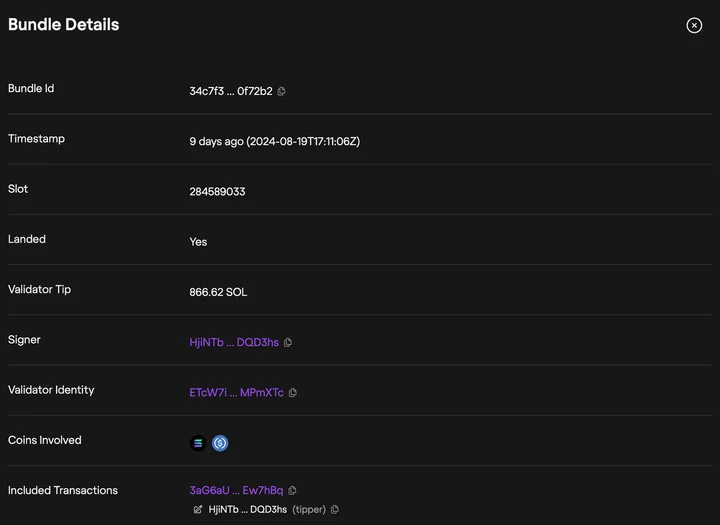 Year to date, tips received by Jito validators and stakers have already crossed $225 million, while priority fees paid by transactions have exceeded $230 million. The most frequent transaction origin
Read the full report
This report is part of Delphi Pro.
- 800+ Pro reports across every major sector
- Talk directly with our analysts
- Private community of funds and builders
Already a Pro member? Log in
0 Comments