Apps and Chains, Not Issuers: The Next Wave of Stablecoin Economics Belongs to DeFi
OCT 27, 2025 • 19 Min Read
The stablecoin boom has generated massive value, just not for liquid market participants. Two reasons explain why.
The first is that their core utility is well understood: they allow users to store dollars, move capital, and settle transactions with near-instant finality. For crypto natives, these advantages are already embedded into everyday onchain activity. As a result, while useful, stablecoins don’t feel particularly groundbreaking to crypto natives who interact with them daily, outside of a handful of new innovations like USDe looping or yield-bearing models like USDai.
The second reason this perception has persisted is because exposure to the sector’s upside has been limited outside of venture. Onchain investors have had few direct ways to participate.
The main liquid options have been Circle equity, which a) is an equity not a token, b) has had limited price discovery in liquid markets, and c) trades at an extremely rich multiple with many headwinds ahead. Ethena’s ENA remains difficult for many to underwrite from a tokenomics perspective given its high FDV and persistent sell pressure from early investor unlocks. Finally, while prelaunch investors in Plasma (XPL) did very well, liquid participants post-TGE faced only a brief window of price discovery before it cratered ~60% below launch levels.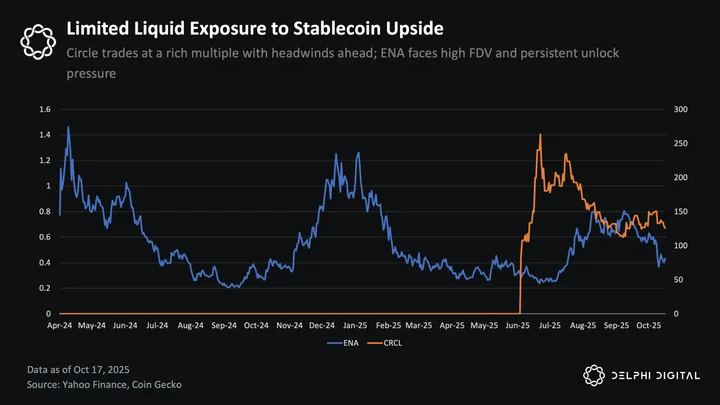
Circle is down ~60% from its IPO high amid rich valuations and rate cut headwinds. ENA’s market cap has recovered, but the token price remains well below peak due to high FDV and persistent unlock pressure.
Despite stablecoins scaling massively and solving real inefficiencies in global commerce, particularly for the unbanked or those seeking dollar-denominated wealth preservation, most market participants have had little reason to look closely.
Beyond Crypto: Stablecoins as a Validated Macro Trend
The view around the rapidly growing stablecoin sector looks completely different when viewed outside the lens of public, onchain market participants.
Policymakers and venture capitalists have identified stablecoins as one of the most important financial innovations of the past decade, even siloing crypto and stablecoins into two distinct investment categories: stablecoins as legitimate infrastructure, crypto/web3 as unproven and potentially just ZIRP artifacts.
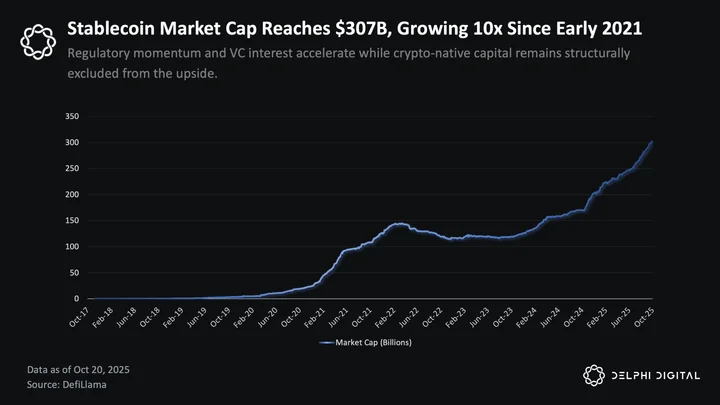
Circulating stablecoin supply has grown from ~$30B at the start of 2021 to over $300B today; a chart that’s been up only across nearly every time frame, regardless of broader crypto market cycles.
The growth of stablecoin supply has outpaced nearly every other onchain sector, with a massive addressable market and expanding regulatory clarity. What crypto natives largely see as “plumbing” is increasingly treated by external capital as a structural trend that cannot be ignored.
Yet this growth won’t accrue to incumbents the way it once did.
Tether and Circle’s Moat Is Eroding: Distribution Beats Network Effects
Incumbent market share held by Tether and Circle has likely peaked on a relative basis, even as aggregate stablecoin supply continues to grow. While total market cap will likely surpass $1 trillion by 2027, that expansion won’t accrue to incumbents at the same rate it did in the past cycle. Instead, a growing share will flow to ecosystem native stablecoins and white label issuance strategies as chains and applications move to internalize yield and distribution.
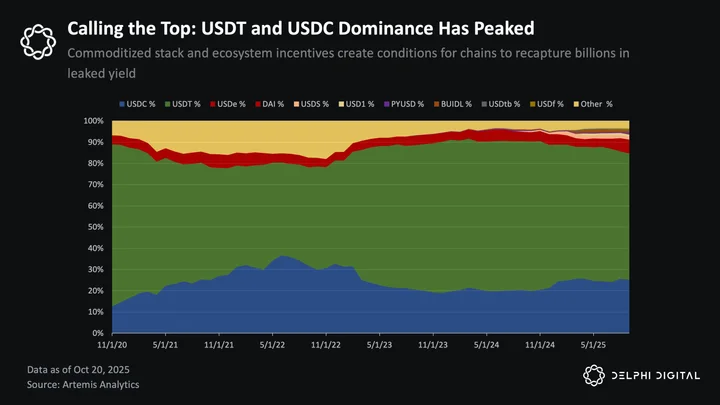
Today, Tether and Circle account for roughly 85% of circulating stablecoin supply, or about $265 billion.
For context: Tether is reportedly raising $20 billion at a $500 billion valuation, with $185 billion in circulating supply. Circle trades at roughly $35 billion, with $80 billion in circulation.
The network effects that once reinforced their dominance are weakening. Three fo
Read the full report
This report is part of Delphi Pro.
- 800+ Pro reports across every major sector
- Talk directly with our analysts
- Private community of funds and builders
Already a Pro member? Log in
0 Comments