
Introduction – #L2’22?
You’ve seen it shilled on twitter, #L2’22, but is it true? In this report we’ll try to answer that question by looking at some Arbitrum adoption metrics: how it stacks up compared to other EVM chains, unique L2-specific metrics (with Optimism thrown in), and the overall state of the ecosystem. We’ll be focusing on on-chain data and what to expect from Arbitrum’s Nitro upgrade. This report assumes a basic understanding of rollups; for an extreme deep-dive on them, I refer you to John Charb’s latest bible.
State of EVM Chains
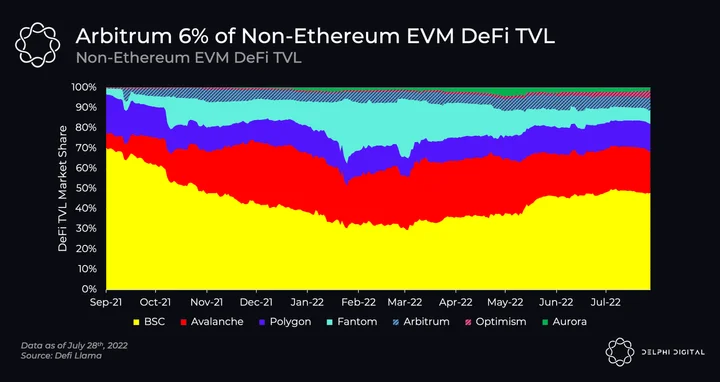
To start we must look at the landscape of alt-EVM chains. Few may remember, but there was a lot of skepticism, pushback and mocking when chains like BSC and Polygon popped up last year, with “L2s around the corner”. What actually happened is that these alt-EVM layer 1s got a significant amount of users as people left Ethereum’s high gas fees for cheaper chains. Even as it stands today, Arbitrum makes up just 6% of Non-Ethereum EVM TVL, with BSC still holding ~50%.
*Note that while I am grouping these all as “Non-Ethereum EVM” for the purposes of comparison, Arbitrum & Optimism (being L2s) settle on Ethereum unlike the layer 1s who are separate monolithic chains. Still, the comparison is useful because for a lot of users they just want to use cheaper EVM-chains.
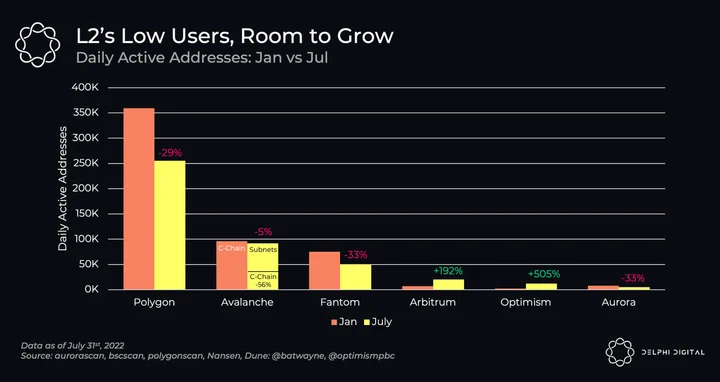
So while Arbitrum (and Optimism for that matter) have a low market share, this also gives them substantial room to grow. Since January, the broader market has seen a decline of around 1/3 of active addresses/users. The L2s on the other hand have seen a pick-up as they start to build out their ecosystems and, in Optimism’s case, offer token incentives.
What’s holding back more adoption? First, with many “ecosystem funds” it can be more profitable for developers to build on new L1 ecosystems instead of Ethereum L2s. Optimism is trying to help address this with protocol-specific airdrops. Second, L2s have very few exchange listings. This means if users want to use an L2 then they need to bridge on-chain. While Binance has support for both Arbitrum and Optimism, other major exchanges like Coinbase do not (although they did just enable OP-only deposits). We can see this in the data.

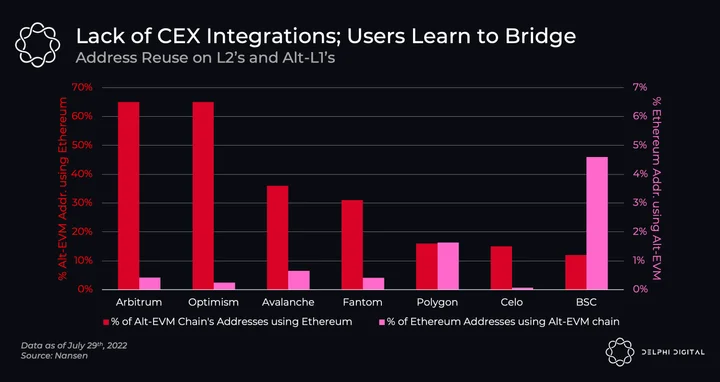
This chart may be a bit confusing at first glance so I’ll break it down:
- % of Native Addresses on Ethereum: The % of alt-EVM chain addresses that have also been used on Ethereum. For example, Arbitrum has ~1 million created addresses and 65% have been used on Ethereum. This means that ~650K of these accounts are also active on Ethereum.
- % of Ethereum Addresses on Native: The % of Ethereum addresses that have been used on an alt-EVM chain. Ethereum has >200 million created accounts which means that ~0.3-0.4% have been used on Arbitrum.
With a lack of CEX integrations (and in the beginning none), the only way to get onto these L2s was from a used address on L1. The 1/3 of addresses not used on L1 have still mostly likely interacted with addresses in the 2/3 group to receive funds. The pink bars (% o
Read the full report
This report is part of Delphi Pro.
- 800+ Pro reports across every major sector
- Talk directly with our analysts
- Private community of funds and builders
Already a Pro member? Log in
0 Comments