Arcium: Enabling The Next Phase Of Private On-Chain Activity
JUL 08, 2026 • 25 Min Read

1. Charting The Next Frontier
Transparency in public blockchains was a feature, not a bug. Visibility made verification cheap, reduced the need for intermediaries, and allowed early users to coordinate in environments where trust was scarce.
Crypto grew inside a narrow band of activity where exposure was a necessary factor. Trading, speculation, governance, and experimental finance all tolerated public balances. Participants are self-selected, capital is reflexive, and the cost of being seen is part of the system.
But at times, it feels like we’ve hit a wall.
Every day, economic activity assumes a baseline of discretion. Paying for groceries does not imply consenting to reveal one’s balance, spending history, or future cash flows. Businesses do not expect routine payments to expose supplier relationships, margins, or operational cadence.
Public ledgers collapse these boundaries because a single transaction exposes far more than the act of payment itself. Identity, balance, history, and intent become linked in a way that is easy to query and quite challenging to conceal. Arkham was able to chart out 10 on-chain addresses for BTC ETFs that were never publicly released. The same could be replicated for any other TradFi institutional venture on-chain.
ALL 10 BTC ETFS NOW ON ARKHAM
On-chain addresses for the Invesco, Valkyrie, and ARK Spot BTC ETFs are now on Arkham.
We are the first to identify all 10 BTC Spot ETFs. pic.twitter.com/3V26OPlxQ2
— Arkham (@arkham) January 31, 2024
Transparent systems did exactly what they were designed to do. They optimized for verification because that tradeoff enabled early adoption. But the same design choice quietly caps who can participate once the system scales.
This is where Arcium fits in, and why its existence is less about “privacy” itself and more about unlocking real world use cases that already have demand. Most privacy infrastructure teams position themselves solely around adding privacy as a feature. Arcium’s approach is fundamentally different.
Arcium works with transparent blockchains by separating verification from execution. Outcomes remain public and enforceable, but balance checks, counterparties, and intermediate logic no longer need to be exposed as a side effect of correctness.
Let’s dive into how Arcium enables encrypted computing on public blockchains.
2. Arcium: Architecture and Technical Stack
Arcium is designed as a distributed encrypted computing network, built to execute arbitrary programs over private data while keeping outcomes verifiable. The architecture is modular, and each layer exists to solve a specific technical problem.
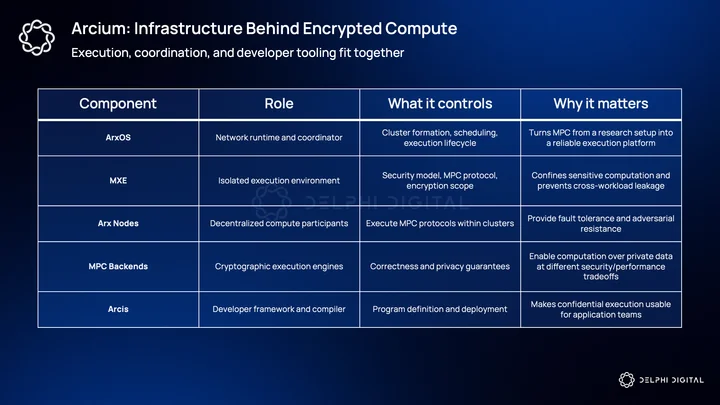
Multi-Party Execution Environments (MXEs) are at the center of the system. An MXE is a logically isolated execution environment where a computation is defined and run. Each MXE specifies its own security model, MPC protocol, encryption scheme, and performance parameters. MXEs do not share state with each other.
The isolation ensures that confidential computations execute as intended while no leakage is propagated across the network. Multiple MXEs can run in parallel at once targeting different parts of the workflow.
For example, in a standard on-chain payment flow, a transfer requires exposing the sender’s balance, prior transaction history, and counterparties. Anyone observing the chain can reconstruct spending patterns over time, even though verification only requires confirming that the balance is sufficient and the signature is valid.
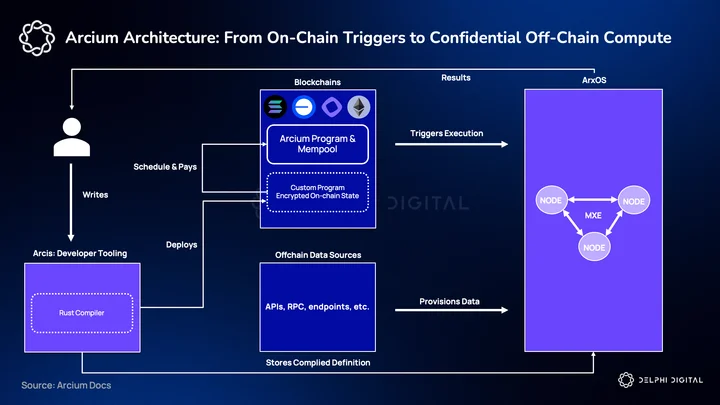
With Arcium, that balance check runs inside an MXE. The user submits an encrypted payment instruction. Nodes in the cluster jointly verify balance sufficiency and authorization using MPC. No node sees the full balance. The output is a single signed transfer that settles on-chain and the workflow from the user’s pov is exactly the same as a normal transaction. What disappears is the accumulation of public financial history as a side effect of routine usage.
MXEs are executed by Clusters of Arx Nodes. A cluster is a group of independent nodes running Arcium’s distributed operating system, arxOS. Nodes contribute compute resources and participate in MPC protocols according to the trust model selected for that MXE. Arcium supports multiple security assumptions, ranging from dishonest-majority protocols, where up to N-1 nodes may act maliciously, to honest-but-curious settings optimized for performance. Cluster configuration determines fault tolerance, latency, and adversarial resistance, and can be adapted to the sensitivity of the computation.
arxOS is the coordination and runtime layer for the network. It manages node participation, cluster formation, scheduling, and execution lifecycle. From a systems perspective, arxOS abstracts a distributed MPC network into a coherent execution platform. It ensures that MXE definitions are respected, that nodes agree on execution state, and that failures or misbehavior are handled deterministically. arxOS is what turns MPC protocols into a production-grade service rather than a research construct.
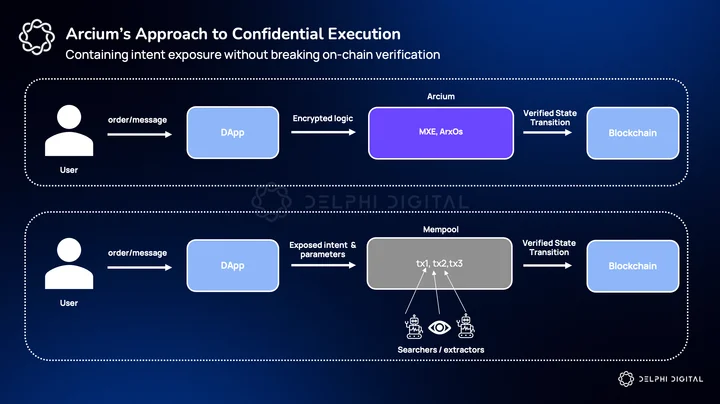
For example, on a public DEX, when orders enter a mempool, searchers simulate the order, insert transactions ahead of it, and extract value via sandwiching or arbitrage. This degrades execution quality.
When a DEX integrates Arcium, order evaluation and routing are moved into an MXE coordinated by arxOS. Orders are encrypted and matched inside the cluster. Routing decisions are computed without broadcasting intent. Only the final swap settles on-chain. Liquidity remains shared. Settlement remains verifiable. But the execution no longer advertises the strategy while it is being evaluated.
Execution within MXEs relies on Arcium’s MPC backends, currently Cerberus, which is live on mainnet and Manticore, which will go live in the future. Cerberus is the primary backend and operates under a dishonest-majority model. It uses authenticated secret sharing and MACs to detect cheating, guaranteeing correctness as long as a single honest node exists. Manticore trades some of these guarantees for performance, operating in an honest-but-curious setting with a trusted dealer for preprocessing. This dual-backend approach allows Arcium to support both high-security financial workloads and computation-heavy tasks such as machine learning inference.
Encryption is handled at the MXE level. Each MXE defines its own encryption scheme, allowing developers to balance security and performance. Lightweight encryption can be used for latency-sensitive workloads, while stronger schemes are available for highly sensitive data. Crucially, encryption is scoped to the execution environment. Arcium does not provide global encrypted state by default. This prevents long-lived state from becoming an attack surface and keeps confidentiality tightly bound to computation.
Arcis is the developer framework that interfaces with this infrastructure. It provides tooling and a Rust-based compiler to define computations, target-specific MPC backends, and deploy programs to MXEs. Arcis also handles how results are surfaced externally, ensuring outputs can be consumed by on-chain or off-chain systems without revealing inputs or intermediate state. Verification is preserved, but raw data never leaves the confidential environment.
To bring all of this together, Arcium uses an on-chain coordination layer, across chains, for orchestration and enforcement. Task queues, execution priority, rewards, and slashing are managed on-chain. This ensures that off-chain computation remains aligned with a public, verifiable state machine and that economic incentives enforce correct behavior across nodes. This activity is publicly visible in Arcium’s network explorer at explorer.arcium.com, which surfaces live computations, MPC rounds, and compute units processed.
Arcium’s architecture is designed to change where execution happens without changing how settlement works. Transactions can still be verified publicly. Only the evaluation of balances, conditions, and logic that precede settlement are kept inside a private environment. Payments are one use case where Arcium plays a pivotal role. On a public ledger, they reveal salary structures, cash-flow cycles, vendor relationships, and operating margins. None of that information is required to verify that a payment is valid.
Let’s dive into how payments have become a critical part of crypto and how Arcium can push the envelope in taking payments further.
3. Payments: Why The Last Mile is Still Broken
Stablecoins already move real volume. Monthly stablecoin payment activity increased from about $1.9B in January 2023 to over $10B by mid-2025. The fastest growth came from cards. Stablecoin-linked card volume rose from roughly $100M per month in early 2023 to about $1.5B per month by late 2025, reaching an annualized run rate near $18B. Peer-to-peer stablecoin transfers over the same period grew slowly, to roughly $19B annualized.

Most volume flows through cross-border contractor payroll, remittances across under-served regions, and crypto-native users spending on cards. Outside these lanes, volumes flatten despite working rails and merchant acceptance because the last mile component of user privacy/safety is broken.
When it comes to payroll, a salary payment on a public ledger links identity, income, employer, and cadence. Over time, this reveals compensation bands and organizational structure. Many companies use stablecoins for one-off contractor payments, then stop short of moving recurring payroll on-chain.
Card usage also faces the same roadblocks. A single grocery purchase carries little signal. Months of grocery, rent, transport, and subscriptions produce a detailed spending profile. In some crypto card designs, that profile is easier to infer because funding and settlement activity sits on transparent rails and can be linked back to a user over time. In custodial cards, this exposure is less likely, as purchases don’t flow through the chain transaction by transaction, but the same behavioural dataset still exists, concentrated among intermediaries.
Remittances, while less prone to the public eye, are still susceptible to many third parties. Stablecoins already compete on speed and cost against major traditional options like Transfer Wise and Western Union. India alone saw approximately $338B in crypto inflows in the twelve months ending June 2025. Much of this volume consists of recurring family transfers. Public traceability at that scale exposes social and financial relationships, which users work around by fragmenting flows, switching between multiple wallets, or avoiding on-chain rails altogether.
Confidential execution removes this constraint. With Arcium, balances, counterparties, and intermediate checks can be made private. Users can transact without publishing every single detail into public records.
Confidential SPL Token standard takes what already exists, i.e., SPL, Token-2022 (Confidential Transfer Extension), and pairs it with Arcium’s encrypted MPC compute so developers don’t have to stitch together half a privacy stack themselves. It helps hide amounts, balances, and transfer metadata in the flows where public traceability hurts adoption, then settles verified outcomes on Solana without forcing apps to hardcode privacy logic into their tech stack. Developers get to work with SPL ergonomics, plus confidentiality that survives contact with real product constraints like payroll runs, card funding, and recurring remittances.
C-SPL targets the two bottlenecks that kneecapped Token-2022 confidential transfers for applications:
- Programs cannot touch confidential balances. Token-2022 keeps confidential accounts under EOA control, which blocks confidential DeFi and any programmable payment logic. C-SPL routes confidential state and execution through Arcium so Solana programs can control encrypted token accounts and move funds without exposing the underlying balances.
- Recipients must pre-create confidential accounts. That breaks basic transfer UX. C-SPL lets senders create confidential token accounts for recipients and lets recipients claim them later with their decryption key, so a transfer behaves like SPL again.
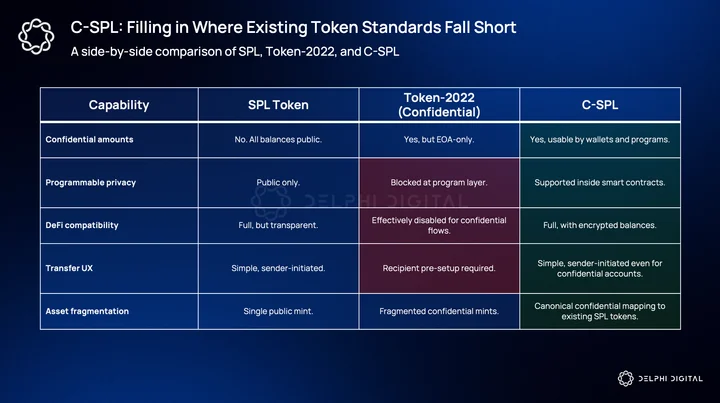 It also cleans up the “how do I get there from here” problem, so teams can use existing assets without issuing new mints or building wrapper mazes:
- Canonical confidential wrapping: any SPL token can map into a unified confidential variant through a token-wrap program, with interoperability back to the original asset.
- A Confidential Transfer Adapter: extends Token-2022 confidential transfers with program and PDA-owned account support through Arcium.
- An Encrypted SPL Token program: lighter-weight accounts and ciphertext formats designed for Arcium’s Cerberus MPC, aimed at cheaper, higher-throughput confidential transfers and DeFi operations.
- Auditor tooling: privacy-preserving compliance hooks that let teams specify auditors without the awkward key-discovery requirements that constrain Token-2022 flows.
C-SPL helps developers access encrypted computing to build real payments and DeFi applications.
We could have confidential payroll platforms built on-chain. They can clear on stablecoin rails without exposing compensation data. Non-custodial card usage can grow without address rotation or wallet fragmentation. Remittance flows can scale without publicly revealing family networks on-chain.
Arcium operates at this very cusp of the execution layer. Payment logic runs inside a confidential environment while only the resulting transfer settles on-chain. The network verifies outcomes without seeing the inputs that produced them.
For example, in a payroll flow, a company submits an encrypted payment instruction to Arcium rather than broadcasting a transfer on-chain. Salary amounts, employee lists, and balance checks are executed inside Arcium’s confidential environment. Once those checks pass, Arcium emits a single signed transfer per employee. Only the final verified transfers settle on-chain.
4. State of DeFi Execution
As we’ve mentioned earlier, your intent is clearly observable on public blockchains. As orders sit in mempools, sensitive details about lending positions, such as LTV ratios, are exposed.
MEV or Maximal Extractable Value is the second-order effect of this design. On Ethereum alone, cumulative MEV extraction has crossed several billion dollars. For passive users, this appears as slippage. For active strategies, it shows up as persistent decay. Size, timing, and conditional logic lose edge once broadcast.
Arbitrage and Sandwich attacks are a common form of MEV.
Arbitrage = Buying and selling an asset in different markets (or in derivative forms) to take advantage of differing prices.
Atomic = The entire transaction sequence successfully executes together, or they all fail together (no partial execution).
Example – A large ETH buy was just executed on SushiSwap. ETH is now $1,000 on Uniswap, but it’s $1,010 on SushiSwap. MEV searchers can submit bundles to atomically buy ETH on Uniswap and then sell it on SushiSwap until the arbitrage is closed.
Sandwich attack = Exploiting predictable execution order by trading immediately before and after a user’s transaction to extract slippage.
Example – A user submits a large ETH buy on Uniswap with a wide slippage tolerance. A searcher sees the transaction in the mempool, buys ETH just before it executes to push the price up, lets the user’s trade clear at a worse price, then sells ETH immediately after. The user overpays, the price returns to baseline, and the spread becomes the attacker’s profit.
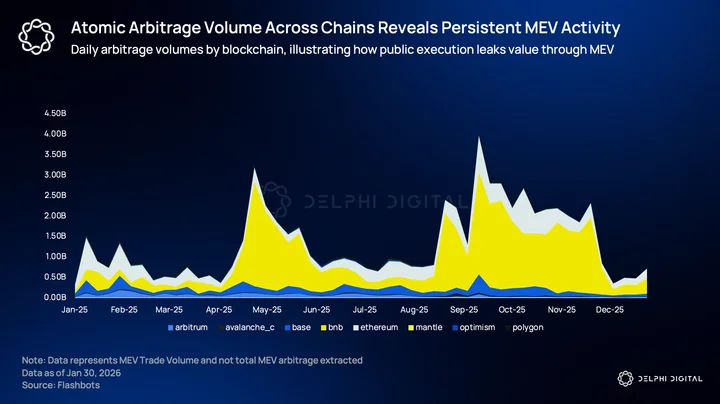
Atomic arbitrage volume remains elevated across chains, with repeated spikes concentrated on Ethereum and BNB. It should be noted that the data represent MEV-related volume and not the exact amount of MEV extracted. Public price updates, observable ordering, and predictable settlement windows create short-lived but repeatable arbitrage opportunities.
Over time, this shows up as progressive decay in user experience as they face slippage and trading strategies lose their edge. The larger and more conditional the transaction, the more surface area it exposes.
Strategies that depend on discretion adapt by moving off-chain, routing through centralized venues, solver networks, or avoiding DeFi entirely. What remains on-chain skews toward reflexive capital, where leakage is tolerated because actors are used to the on-chain complexities.
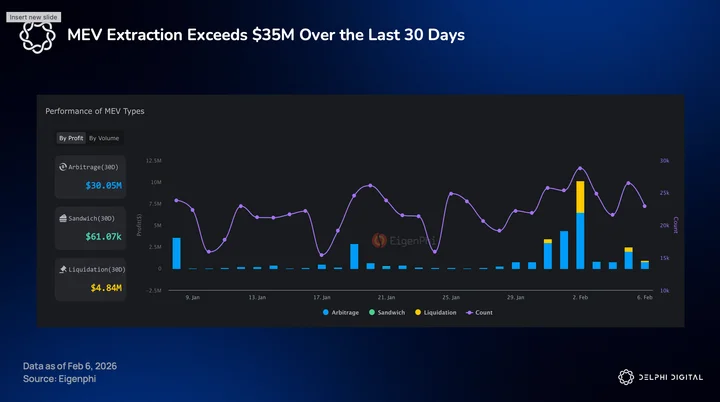
Privacy-oriented DeFi has tried to address this by enclosing everything but has failed quite miserably.
Most implementations run in isolated environments. Liquidity pools are smaller with little to no composability, which is one of the main drivers of DeFi growth. Bridging adds latency and trust assumptions.
The constraint sits at execution. Information leaks during evaluation, ordering, and intermediate state changes. Confidential execution narrows what needs to be visible. Positions can be checked without exposing limits. Orders can be evaluated without revealing size or direction. Auctions can clear without publishing bids mid-process.
Arcium takes sensitive logic and executes it in a confidential environment. Inputs and intermediate state remain contained and only outputs settle publicly and remain verifiable. This reduces the surface area available for extraction without compromising on composability.
DeFi today supports trading strategies that survive observation. Strategies that require discretion stay away and so will most of the TradFi capital we’ve been hoping to accommodate.
Arcium shifts execution off the public path while leaving settlement unchanged.
In traditional DEXs, execution quality deteriorates because order intent is visible before settlement. Size, direction, and routing can be inferred from pending transactions, allowing searchers to simulate the trade and insert malicious transactions. With Arcium, routing and pricing logic execute before transaction details are exposed.
Lending protocols intentionally expose position health so third-party liquidators can manage risk. While preserving that property, Arcium can help lending protocols run private auctions to award liquidation rights to the highest bidder. This way, the protocol can retain most of the extracted value and ensure timely liquidations.
This only scratches the surface of use cases. Here’s how projects are leveraging Arcium’s tech to build the next wave of DeFi and payments.
5. Arcium’s Ecosystem
Several applications use Arcium directly at the execution layer to limit information leakage during computation.
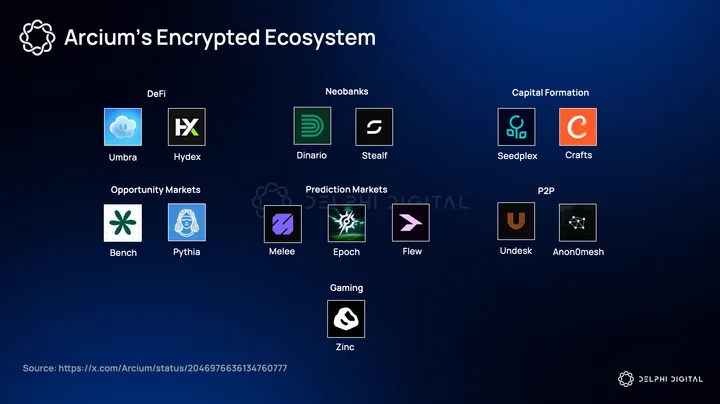
Umbra
Umbra is a shielded finance layer on Solana that enables private, unlinkable transfers with optional, rule-based auditability. It combines two cryptographic systems. For private transfers and swaps, Umbra uses client-side zero-knowledge proofs, generated locally on the user’s device. Through its Mixer Pool, these proofs cryptographically sever the link between deposits and withdrawals, which is what provides anonymity
For balances, Umbra uses Arcium’s MPC to enable fully confidential balances, implemented as Encrypted Token Accounts (ETAs). Balance state is computed over secret-shared inputs, so no single node reconstructs full state and values never appear in plaintext. This private shared state is also Umbra’s main edge over purely ZK-based shielded pools. Because Arcium holds shared private state for balances, Umbra does not need to parse every zero-knowledge proof to recreate a balance on each use, the way Railgun does, which makes those systems slower the more they are used. Umbra avoids that performance decay. At the time of writing, it holds roughly $400K in TVL.
Users typically enter Umbra once and stay inside. Funds move into the shielded pool and are reused for transfers, payroll, or internal treasury flows. Each action updates commitments rather than accounts, so repetition does not produce a public trail. From the outside, the chain only observes settlement events. From the user’s side, transfers behave like normal Solana transactions, just without leaking transaction information.
Melee Markets
Melee Markets is a prediction market built on Solana where market resolution runs privately under encryption. Users trade outcome tokens tied to real-world events by taking positions on either side of the market.
These markets could exist across a spectrum of topics such as politics, sports, geo-political events. Resolution usually relies on a single oracle or a visible voting process, and that step is where these markets tend to break. On Polymarket, disputed outcomes have been settled by token-holder votes that large holders can sway in their favor.

How is Arcium used in Melee Markets?
Melee uses Arcium for one specific job: private resolution. When a market closes, the votes that decide the outcome are encrypted at the edge and routed into Arcium’s MPC environment, where they are tallied over secret-shared data. No participant can see how others are voting while the resolution window is open, so no single large holder can watch the tally form and vote to swing it. The chain only ever sees the final resolved outcome and the settlement transactions.
Arcium also changes how Melee handles voting and signals at resolution. Instead of relying on a trusted operator or a public oracle feed, Melee tallies encrypted votes and resolution inputs inside MPC, then publishes the result once the window closes. That prevents early signals from getting copied, reduces last minute gaming, and keeps late votes from adapting to visible consensus. The market still resolves correctly, but individual stakes, beliefs, and voting patterns stay hidden during the process.
Beyond prediction markets, Melee uses Arcium to run opinion markets. Traditional opinion markets leak every vote in real time, so people herd toward whatever looks like the winning view instead of giving their own read. Melee keeps opinions private until the market ends by running vote submission, aggregation, and scoring inside Arcium. When the market closes, Melee decrypts the final aggregate for everyone to see, without exposing who voted for what along the way. The result is a commit-reveal market that surfaces independent opinions rather than a mirror of the visible consensus.
Anonmesh
Anonmesh is a privacy-focused cold wallet and encrypted messaging system that operates without internet access. Devices establish a peer-to-peer mesh network using Bluetooth Low Energy, connecting to proximate phones to relay data across the network in a self-healing configuration.
Messages and Solana transactions undergo end-to-end encryption, with signatures and queuing performed offline. Transactions incorporate durable nonces to block replay attacks, and intermediate devices in the relay chain access no content. Settlement finalizes on-chain when any networked device reconnects to the internet.
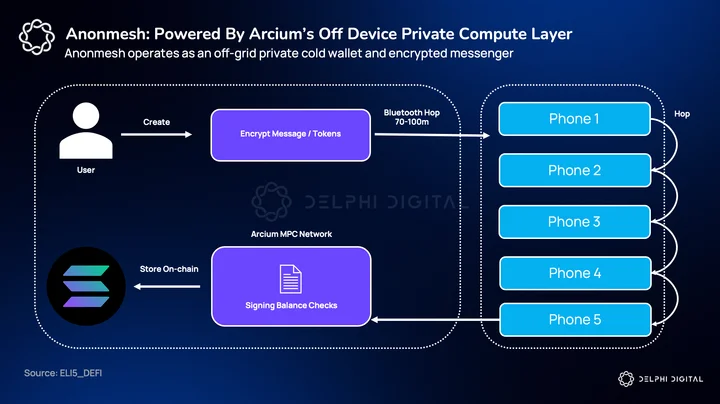
Anonmesh integrates Arcium’s Multi-Party Computation framework within several MXEs to execute computations on encrypted data without decryption. Data is split into secret shares distributed across independent Arx nodes, preventing any single node from reconstructing originals.
For messaging, Arcium enforces cryptographic protections on content and metadata during relay, ensuring the mesh network processes without exposure. Transactions compute privately in MXEs, concealing sender details, receiver information, and values through encrypted logic execution, with verifiable proofs submitted to Solana for settlement. Arcium abstracts MPC complexities, enabling Anonmesh to prioritize offline privacy while maintaining composability.
Users deploy Anonmesh in connectivity-challenged environments like festivals, protests, or remote areas by installing the app and enabling BLE. Devices auto-form meshes for local communication. Payments to vendors are signed on-device and propagated encrypted via relays, settling later upon internet access. Messaging routes through the mesh with Arcium-secured encryption, supporting private exchanges among users without centralized infrastructure or surveillance risks.
Bench: Private Markets for Decision-Makers
Bench takes a different view of what a market should do. Public prediction markets chase an observable truth. They surface probabilities and broadcast them in real time. That works when the goal is price discovery for everyone. But the same can’t be applicable when the goal is gathering insight that someone intends to act on.
Bench runs private opportunity markets. A sports team, music label, or investment firm frames a question. Participants stake SOL on the option they believe carries the most value. Their stake signals conviction. The data stays encrypted inside Arcium. Who staked, on what, and how much never becomes a public feed for competitors to copy. The market still aggregates judgment, but the signal belongs to the party that funded it.
That privacy changes the incentive structure from what you’d find in a traditional prediction market. In a public market, strong signals leak instantly and lose their edge. In Bench, the encrypted design creates a property right over the signal itself. The launching partner supplies the reward pool, effectively paying for insight. Participants lock capital to show seriousness rather than to gamble on a public outcome. Arcium keeps the underlying positions hidden while allowing the platform to compute rewards and finalize results. Decisions draw from a pool of staked conviction, without diluting that conviction by broadcasting it publicly.
ZINC
ZINC is a proof-of-work mining game on Solana, powered by Arcium for encrypted tile selection and trustless randomness. Players deploy SOL onto a circular 30-tile board, and landing on the winning tile wins SOL from the losing tiles and mines fresh ZINC. A new round starts every 30 seconds, and the minimum to play is 0.001 SOL. Each player picks up to 30 tiles and stakes SOL behind their picks. Those selections stay encrypted, so no one can see what anyone chose until the round closes. When it does, one tile is revealed at random as the winner, and everyone on that tile splits the SOL from the losing tiles plus a share of newly minted ZINC, pro-rata to what they deployed. Mining gets harder over time, so early miners earn more ZINC per SOL than later ones, similar to Bitcoin’s halving. Two things have to be true for ZINC to work: no one can see which tiles a player picked until the round closes, and no one, including the team, can predict or influence which tile wins. Arcium handles both. Tile selections are encrypted client-side and computed inside Arcium’s MPC network, so no strategy can be copied or front-run, and the winning tile and bonus-round winners are all drawn using Arcium’s MPC-generated randomness (ArcisRNG). ZINC is live on Solana mainnet today.
Crafts: Token Launchpad with Sealed Bids
Crafts runs token launches through sealed-bid, uniform price auctions. A bidder submits price and size. The bid encrypts at submission and moves into Arcium’s MPC network. No public order book forms. No one watches demand stack up in real time. Arcium aggregates the encrypted bids, computes the clearing price inside MPC, and returns a single result to settle onchain. The chain records allocations and the final uniform price. It never exposes the individual bids that produced them.
This is similar to how major, existing capital markets handle issuance. The U.S. Department of the Treasury sells debt through uniform-price auctions, where participants submit bids privately and are cleared at a single price. Google used a Dutch auction for its IPO to surface demand without backroom allocation. On public blockchains, open bidding leaks intent. Bidders anchor on other bids, compete on what they see, and shift strategy as the book builds, often inflating and running prices up much higher than where the market would normally meet. Crafts removes that feedback loop. During the bidding window, participants see only their own submissions.
On most on-chain launches, both founders and bidders end up trading against a live feed of other people’s intent, watching a public book form, and adjusting in real time. Crafts shuts that channel off. Founders stop reading tea leaves from visible whale bids and last-minute swings, because no one sees the demand curve while it builds. Bidders stop playing reaction games because nothing leaks mid-auction. They submit a price and size, Arcium computes the uniform clearing price once the window closes, and the chain only sees the final allocations.
Arcium Blackthorn
Everything above is a third-party app built on Arcium for a broad set of use cases. Recently, Arcium announced Blackthorn, a confidential AI inference system that runs frontier models on NVIDIA GPUs with prompts, files, and outputs encrypted end-to-end, shielded from the cloud provider, the operator, and Arcium itself.
The core technical change is replacing the x86 CPU trusted execution environment (TEE) that has historically served as the host processor for GPU inference. That TEE has a long track record of hardware-level exploits.
Today, TEE holds the GPU session’s encryption keys in full, in plaintext, and negotiates the session directly with the GPU. Blackthorn replaces it with maliciously secure multi-party computation (MPC): keys are split into secret shares across multiple parties, so no single party, including Arcium, ever holds a complete key. That quorum negotiates the GPU session and encrypts data crossing into it as joint computation over shares, while the host CPU simply passes data along without ever seeing it. The GPU still runs inference inside its own protected memory, unchanged.
Because the CPU is no longer a point of trust, Blackthorn runs on the same NVIDIA GPUs already deployed today. Only around 2,000 GPUs worldwide are available to rent as confidential-AI compute right now, since the CPU TEE and its certified cloud stack narrow the pool sharply. Removing that requirement opens the rest of the world’s GPU supply to the same guarantee, with no new hardware needed.
To Arcium & Beyond
Arcium’s contribution is not another privacy silo. It changes how existing systems execute without forcing a redesign of what already works. Final outcomes still land on-chain. Other contracts can still read and react to them. What moves off the public path is the part of the system that leaks the most information for the least benefit, i.e. the execution logic.
We believe payments are one of the most crucial areas where Arcium can lead. On a public ledger, repetition turns routine activity into a dataset. Payroll reveals compensation bands. Non-custodial card usage could reveal user transaction history, future payments, and eventually their whole spending pattern. Remittances on public chains can expose family networks.
None of this information is required to confirm that funds moved correctly. By pushing payment logic into confidential execution while keeping final transfers on-chain, Arcium allows stablecoin rails to scale beyond crypto-native niches without forcing users to fragment wallets or abandon on-chain settlement.
In DeFi, transparent chains reward actors who can observe, simulate, and race. That dynamic works for reflexive capital and short-horizon strategies. It excludes participants whose edge depends on discretion. With confidential execution, trades can be priced and routed before exposure. Prediction market positions can form without steering sentiment mid-process. Lending protocols can still expose health and liquidations while not giving away major portions of liquidation rewards to extractors. TradFi institutions would finally be comfortable enough to use more crypto rails for their operations and acquire more customers if confidentiality were at their discretion.
For most of its history, crypto optimized for transparency because it solved a coordination problem. Public state reduced trust assumptions, made verification cheap, and allowed open systems to bootstrap liquidity and participation. But if we were to scale usage beyond our niche into the every-day common world, the same feature would turn into a bug.
Arcium’s confidential execution allows us to work around that constraint by keeping public blockchains verifiable while keeping all sensitive data private. A much needed shift to make crypto usable outside reflexive, sophisticated niches.
If the next phase of adoption involves everyday payments, institutional participation, and long-lived on-chain activity, then user discretion is a must. Arcium is a step into a future where transparency remains a tool for trust, without compromising on privacy.
0 Comments