Art Blocks Summer, GameStop NFTs, & The Stablecoin Landscape
JUL 14, 2022 • 6 Min Read

Chart of The Day: Pussy Riot’s Proof of Protest NFTs
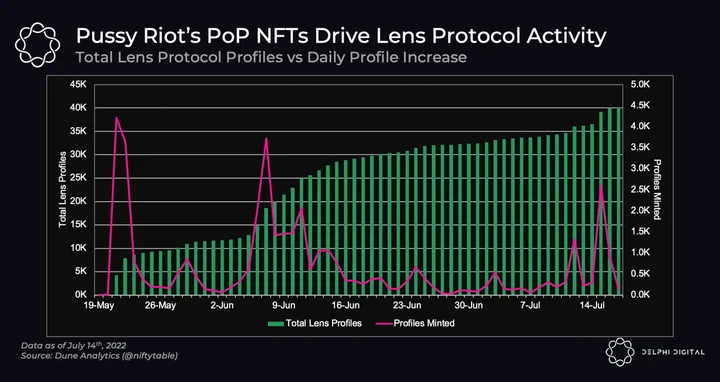
- On 7th July, Pussy Riot, the Russian feminist protest art collective, collaborated with artist Ksti Hu to launch a series of Proof of Protest (PoP) NFT collections that helped raise >$107K for charity on Lens Protocol. Pussy Riot sent all the revenue generated to LegalAbortion.eth so the collective can donate to reproductive rights non-profits while maintaining transparency.
- The fundraiser represents ~69% (nice!) of Lens Protocol’s total user-generated revenue ($155,370) since its May 18th launch. Lens added about 5k Lens profile owners in 5 days by giving holders of the Limited Edition and Special Edition PoPs access to mint a Lens Profile.
- For more on Lens Protocol, you can listen to our previous Delphi Podcast here.
Gamestop NFT Is Here, CryptoPunks Revive & Art Blocks Summer
[Excerpt from a Delphi Insights report]

- GameStop’s NFT marketplace launched its public beta on Jul 12. It is a non-custodial marketplace built on Loopring Layer 2. In less than 48 hours from launch, it has already achieved:
- >2,000 ETH in trading volume (>$2M)
- >45,000 transactions made
- 260+ collections listed
- It has exceeded the total volume for Coinbase NFT (~1702 ETH since inception). This is quite remarkable, especially given that the launch was relatively low-key compared to Coinbase NFT. Users can bridge their funds seamlessly from ETH to Loopring L2 directly on the marketplace website. The interface is still relatively raw and requires polishing, but it will be interesting to see if it continues to draw new users in.
Weekly Highlight — Art Blocks Summer Is Here
- Introduction: There has been a resurgence of interest in generative art in recent weeks, particularly Art Blocks. This is evident if we take a look at the price action in Chromie Squiggles, the first Art Blocks collection by its founder Snowfro.
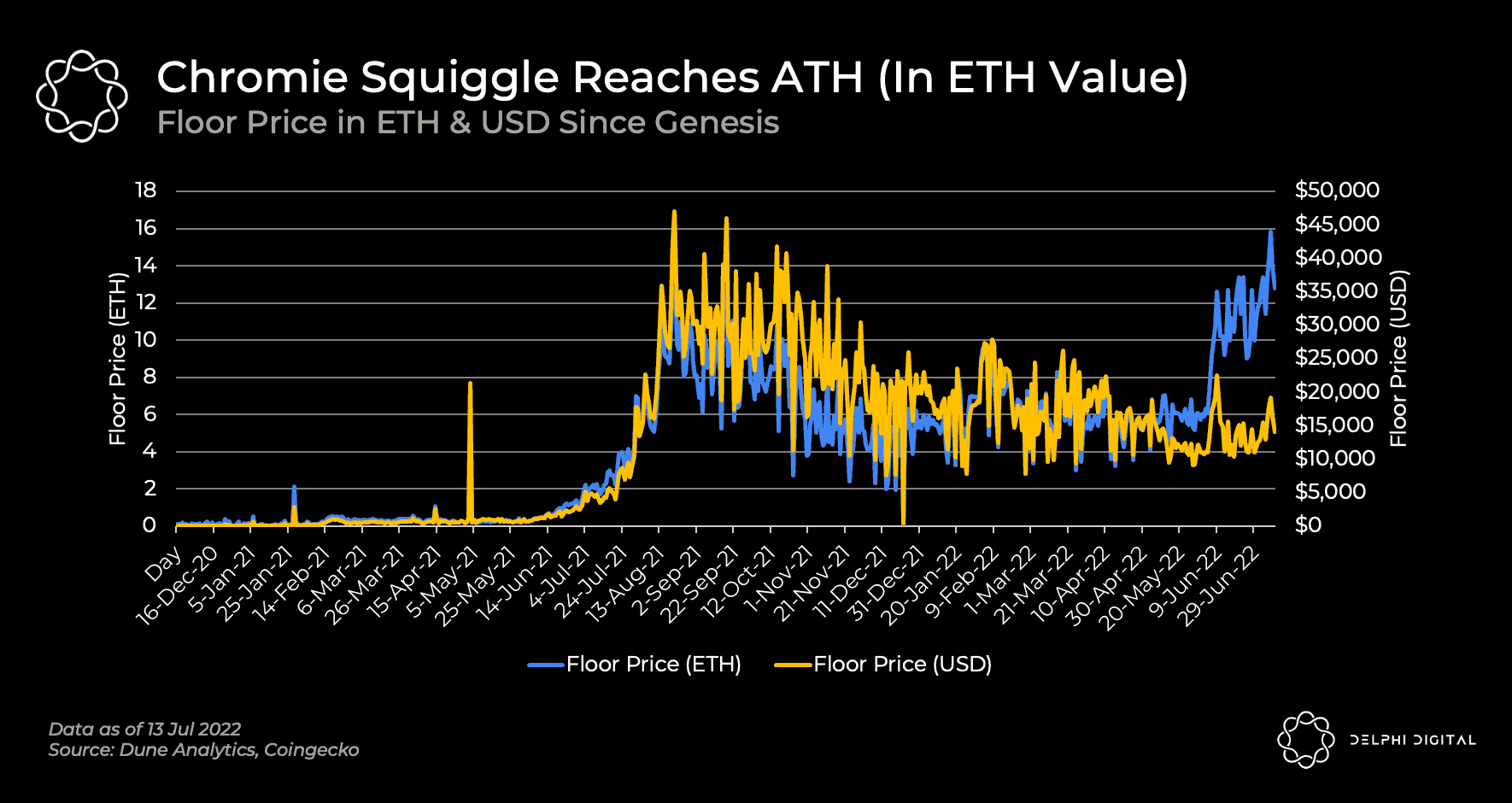
- Chromie Squiggles are iconic and a good barometer of collector sentiment in the space. It hit an all-time high (in ETH terms) of just over 15E this month, although it is still >50% down in USD terms from its peak because of the steep drop in ETH price since then.
- Despite being a 10K collection (large for an art collection), only ~2.5% is currently listed for sale on OpenSea, making it one of the collections with the lowest number of listings. This suggests that many owners are diamond handed and do not have the intention to sell, perhaps believing that their cultural value is greater than the market value today. For comparison, Doodles has a similar floor price but with ~6% of items listed for sale on OpenSea.

- Looking deeper at the ownership of Squiggles, it is worth noting that the top 5 holders collectively own 23% of the entire collection, yet none of them have sold a single Squiggle on the open market. At current floor prices, their holdings are collectively worth ~30,000E (or ~$33M). Most of these Squiggles were acquired at the mint and not touched since then.
- The top 2 wallets (with 1006 and 413 Squiggles, respectively) are anonymous, while Snowfro, Gmoney & Squiggle DAO are vocal and publicly active. Interestingly, the top holding wallet listed a HyperRainbow Squiggle for sale at 750E on 1 Jul, its first activity on Squiggles in over a year.
- For more information, Delphi members can see the full Delphi Insights report here.
Your Guide to the Collateralized Stablecoin Landscape
[Excerpt from a Delphi Pro Report]
- If you’re invested in crypto assets, you have probably held stablecoins in your portfolio at some point in time. Chances are, you have also heard of several high-profile stablecoin depegging events, leaving unsuspecting holders unable to redeem their stablecoins at par value.
- Stablecoins have become the backbone of DeFi, with nearly $150B in cumulative market cap. Of this, over 97% are in collateralized stablecoins while the remaining portion is made up of their undercollateralized counterparts. As the name suggests, fully collateralized stablecoins are backed by some sort of collateral – either fiat-collateral or crypto-collateral. Undercollateralized stablecoins, also known as algorithmic stablecoins, are either not backed by collateral at all or partially backed. FRAX is a notable example of a partially backed stablecoin, typically using financial incentives to encourage the market to keep the stablecoin at its peg. UST was a notable example of an uncollateralized stablecoin, and subsequently the risks of such a design.
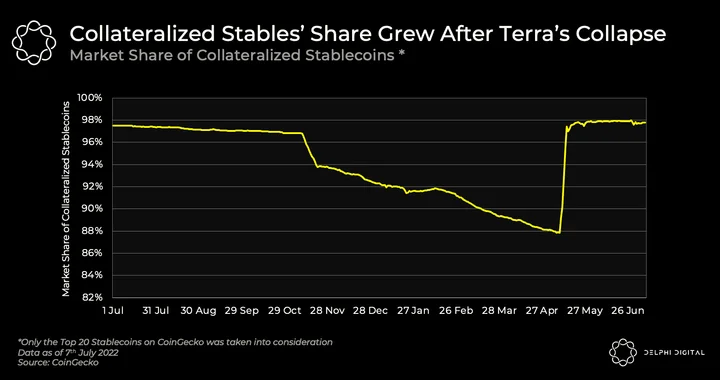
- Stablecoins are useful for market participants looking to avoid price volatility. They’ve also taken on the mantle of being the main medium of exchange when moving between different assets or transferring value from one entity to another. A reliable stablecoin is one that is able to hold its peg to a certain value – the most popular of which is the U.S. Dollar (USD). In this report, we explore some of the top collateralized USD stablecoins to understand the risks and benefits holders inherit while owning each of them.
Centralized Stablecoins
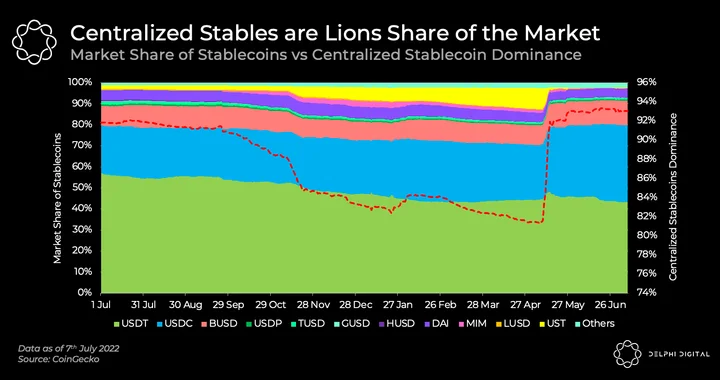
- Centralized stablecoins are IOUs for assets attached to a legal entity. Those assets could be cash reserves in a bank account (ideal case) or other liquid assets. A key difference between centralized stablecoins and their decentralized counterparts is the custodial nature of centralized stablecoins. Notably, holders of centralized stablecoins bear counterparty risk and censorship risk. The former deals with risks associated with bankruptcy or mismanagement of collateral by the issuer, while the latter deals with censorship by issuers or governments who can coerce the issuer.
- Another point of risk with fiat-backed coins is that issuers have disproportionate commanding power when it comes to legitimizing a blockchain fork. For example, imagine if USDC had existed on Ethereum at the same time as the occurrence of the DAO hack. Only 1 of the USDCs on either Ethereum Classic or Ethereum would be redeemable at par by Circle. Whichever Circle chooses to support is therefore critical as most protocols and developers will follow suit. This centralization of power in DeFi poses risks that reach far outside the purview of the stable asset.
- Currently, centralized stablecoins make up over 90% of stablecoin TVL; USDT, USDC, and BUSD consistently take the top three spots by market capitalization.
- For more information, Delphi members can see the full Delphi Pro report here.
Notable Tweets
Circle Begins Its Monthly Breakdown Of USDC
1/ As part of our commitment to increasing transparency and disclosure around USDC, today we’re publishing our first monthly breakdown of the USDC reserve assets, by each and every Treasury Bond and list of cash reserve custodians. https://circle.com/blog/providing-greater-transparency
— Jeremy Allaire (@jerallaire) July 14, 2022
Crypto Lender Celsius Files for Bankruptcy
BREAKING: Crypto lender Celsius files for Chapter 11 bankruptcy a month after freezing customer withdrawals, the latest casualty from the rout in cryptocurrencies https://trib.al/R5AiarY
— BloomBerg Crypto (@crypto ) July 13, 2022
DiversiFi Rebrands to Rino
DeversiFi is no more. Now, we’re https://t.co/2DkuiMYxqj 🦏
We’re no longer just a #DEX. We’re a frictionless #Layer2 gateway to multi-chain DeFi.
This is the future of DeFi – let’s grab it by the horns.https://t.co/RrTKklcnZEhttps://t.co/2ao0jYv7SC pic.twitter.com/7fdfJy83k2
— rhino.fi (previously DeversiFi) (@rhinofi) July 14, 2022
0 Comments