
USDC Consumer Chain: Solidifying the Hub as an IBC Focal Point
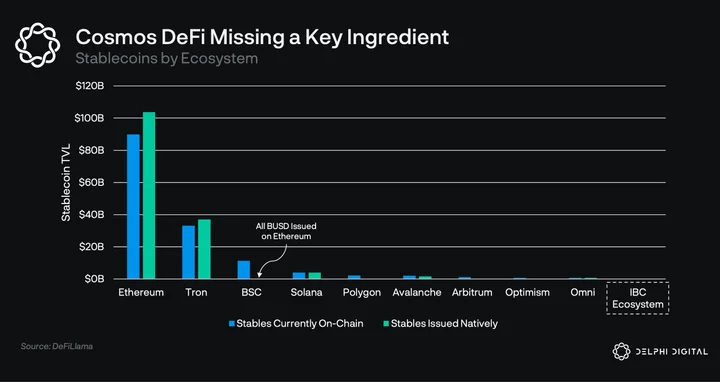
Before diving into the ATOM 2.0 whitepaper, I want to do a bit of a pivot (no, not the one you’re probably looking for) and talk about what I believe to be the most important announcement from Cosmoverse – the USDC Consumer Chain. We’ve talked about this before, but the Cosmos DeFi ecosystem severely lacks any real amount of stablecoin liquidity. Its $85M in stablecoins across the eco (with only ~$16M issued natively) pales in comparison to nearly every other eco and even the Ethereum L2s. For a DeFi ecosystem to take off, stablecoins are a must.
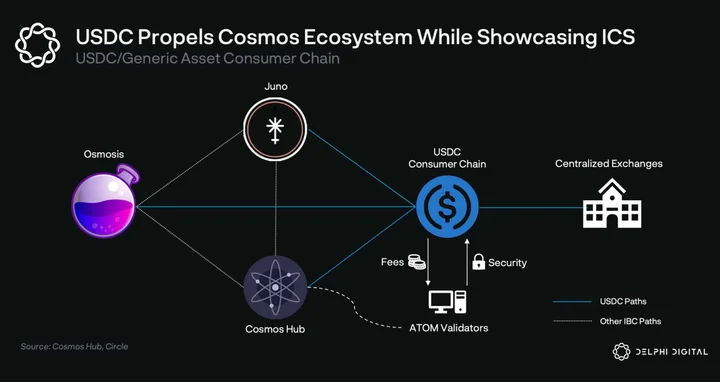
Enter the USDC Consumer Chain. To be completely accurate, this will be a chain for generic asset issuance, with USDC being the first and most likely largest. I won’t dive deep into Interchain Security here, as I have done so already, but the basics are that this will be a separate chain to issue USDC and other generic assets secured by ATOM validators and stakers. This means that every transaction on the consumer USDC chain will pay fees to ATOM.
Other chains that want to make use of USDC will have to bridge it from the USDC chain. Once USDC is bridged, USDC transactions on remote chains will no longer generate activity on the USDC chain. On the other hand, cross-chain USDC transfers will, as USDC will most likely be bridged back to the USDC chain before moving somewhere else to prevent liquidity/UX fragmentation. USDC chain will also be the only chain where deposits/withdrawals from centralized exchanges are settled.
With that being said, the fees here won’t be significant. USDC on Ethereum has ~75k transfers/day. If we take a generous 10% of this @ $0.05/tx, we get $375/day or $137k/year. There will be fees for other assets and the ICS module but the takeaway is that it won’t be generating some massive amount of revenue for the Hub (low gas fees are the point of having isolated app chains). As for the amount of USDC issued, we should expect a combined ~$500M from dYdX and Osmosis rather quickly, and demand from orderbook chains like Injective and Sei to follow suit. The big benefit here is that Cosmos chains will no longer have to rely on custom third-party bridges to access stablecoins; they will only have to rely on IBC. While IBC is generally considered to be the most secure option among existing bridges due to its security model and the collective effort that went into its production over the course of years, it is still vulnerable to implementation bugs just like other bridges.
So why is it important for the Hub if fees generated will be low? Because it further solidifies the Hub’s place in the ecosystem as a major Schelling point and showcases Interchain Security as the Hub strives to build out an “economic zone.” In Zaki’s words,


Before moving on, as a little digression here, the censorship resistance properties of IBC USDC are quite interesting to think about. Circle will not have the ability to blacklist or freeze particular USDC tokens/addresses on other Cosmos chains as they have no control over the IBC USDC receipt tokens. All they can do is close a channel to another chain. Closing a channel to an entire chain is a rather large leap vs. a single address and makes the discussion more similar to Circle freezing all of the USDC in Maker. If a
Read the full report
This report is part of Delphi Pro.
- 800+ Pro reports across every major sector
- Talk directly with our analysts
- Private community of funds and builders
Already a Pro member? Log in
0 Comments