PART l
Fragmentation and Composability
The Ethereum roadmap is not static and has changed a lot over the years. The birth of L2s was absolutely necessary as Ethereum was at risk of losing users due to economic exclusion.
Recently, the rollup landscape has expanded rapidly, with L2s TVL exceeding 34 billion dollars. However, this growth has a drawback. Each rollup acts as a closed silo environment and they’re interconnected by slow, asynchronous bridges. This has led to a significant breakdown of Ethereum network effects, fragmenting its liquidity, user base and breaking the composability that Ethereum enjoyed a long time ago.
It’s well known that Ethereum can be used as a DA Layer (as calldata) for rollups, but it turns out that Ethereum L1 can also be used as the canonical shared sequencer for rollups without major changes or hard fork, merging L2s with the L1; and would enjoy a half-trillion dollar TVL without needing to address the cold start problem of having to attract initial liquidity (e.g. by giving incentives to users and dApp devs)
In this piece, we will cover the surging of based rollups, preconfirmations, and shared sequencing as possible solutions to the fragmentation problem.
Based rollups
Quoting Justin Drake: “A rollup is said to be based, or L1-sequenced, when its sequencing is driven by the base L1. More concretely, a based rollup is one where the next L1 proposer may, in collaboration with L1 searchers and builders, permissionlessly include the next rollup block as part of the next L1 block.”
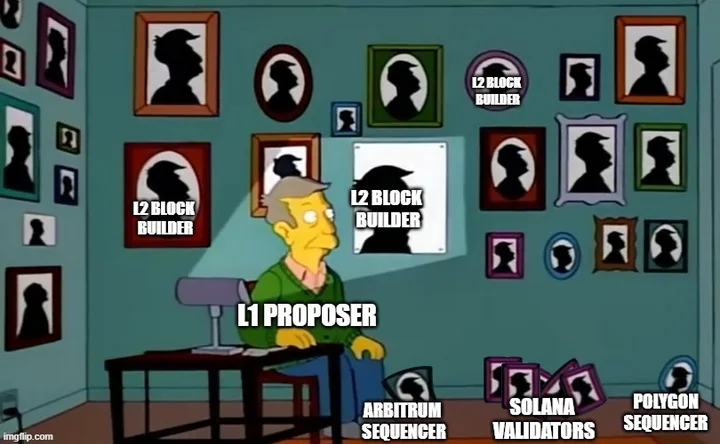
Rollups can outsource sequencing rights to Ethereum (the base layer). Based sequencing or ‘L1 sequencing’ inherits the decentralization of the L1 and naturally reuses the L1 infrastructure involved in block building (searchers, builders, proposers). Now, L1 proposers will also be proposing L2 blocks within their own L1 blocks.
Properties and Limitations
Simplicity: Based sequencing is significantly simpler than even centralized sequencing. Based sequencing requires no sequencer signature verification, no escape hatch, no external PoS consensus, and moreover: no hardfork.
Credible neutrality: Imagine Arbitrum wanting to become part of the OP superchain, and with this acceptance for Arbitrum’s transactions ordered by Optimism’s sequencer. It doesn’t seem feasible because both teams would need mutual trust.
The vast majority of rollups in production today see Ethereum as credibly neutral, as they choose Ethereum as the settlement/DA Layer. With based rollups, every rollup and their competitors can opt-in to use the already bootstrapped and decentralized sequencers in Ethereum.
Risk-minimized: it’s well known that every blockchain has four layers: 1. Data Availability 2. Settlement 3. Execution 4. Consensus. Rollups choosing to be based will have the same three layers from Ethereum (DA, Settlement, and Consensus), thus having the same L1 security assumptions.
The execution still happens on the rollup though, as L2 nodes read the finalized transaction list from the base layer and execute to determine state transition, but notice here that users are not sending their transactions to the rollup anymore, instead they’re sent to L1.
There’s no holistic truth: The point above also can be thought of as a disadvantage as the based rollup would not have the flexibility to choose its own layers, and it would be tied to the base layer and its timing (sometimes extremely low delivery times comparing to other ecosystems), unlike a modular stack where different layers are leveraged.
All rollups inevitably face bug issues, from smart contract exploits to multisigs being compromised. Based rollups don’t have to worry about this since they will be reusing:
- Ethereum consensus (Execution clients + Consensus clients), and
- Social Layer or ‘Layer 0’, i.e. strict infrastructure processes before implementing any change or update to the EVM, e.g. EIPs/ERCs and their long discussions due to security concerns, or even coordinating for a hardfork in extreme cases.
A permanent sequencer outage may require mass exits through rollup escape hatches, where transactions have to wait a timeout period before guaranteed L1 settlement. Transactions that settle through the escape hatch often incur a gas penalty for their users (e.g. because of suboptimal non-batched transaction data compression).
Even temporary takeovers can lead to toxic MEV opportunities through market manipulation, e.g. JIT oracle updates, and market manipulation by sequencer short-time censorship.
Rollups cannot use social consensus to recover from sequencer liveness failures, unlike L1; Based sequencing enjoys the same liveness guarantees and censorship resistance as L1.
Despite the latest developments to deploy rollups such as SDKs like the OP stack, Conduit, or Rollkit, rollup teams still need to invest hundreds of millions of dollars in R&D to develop fraud and validity proofs, and even when finally activated, they might not be entirely code bug-free. For example, the zkEVM circuits contain more than 30,000 lines of code, which is just the tip of the iceberg. These will need time to become battle-tested.
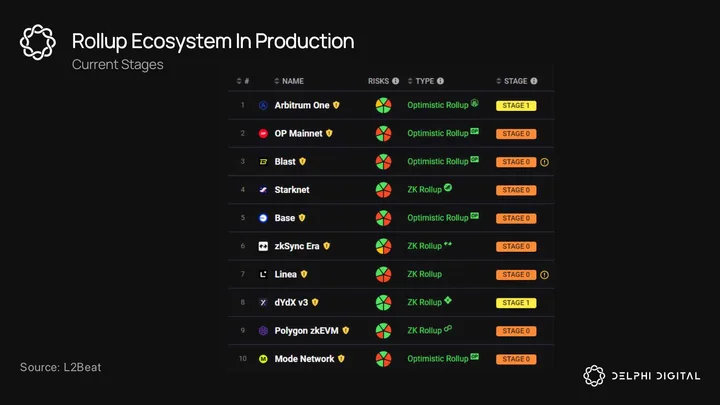
As of today, all major rollups either have fraud/validity proofs in development or they’re overridable and upgradable by the team behind. In simple words, current rollups are not 100% controlled by code, and they all have some level of human intervention.
Based rollups inherit the fork-choice rule from L1; if L2 blocks have been posted to the L1, they can only be orphaned if they’re invalid or building upon other invalid blocks. If they’re valid and submitted to the L1, they have the same security guarantees as the base layer itself.
No governance: governance overhead takes down the protocol’s efficiency, and governance attacks are always a threat. A rollup wanting to become based doesn’t need a token or governance, which also avoids the regulatory burden.
In practice, they could have governance but it would be limited to certain parameters since stakeholders will not have any decision-making over the underlying EVM as the precompile updates automatically, e.g. they unilaterally accept hardforks, and can’t have a say on block building or consensus mechanism.
This potential value proposition of a based rollup token is still unclear since it cannot be used to decentralize the sequencers, but on the other hand, it can be used to incentivize provers the same way Taiko is planning to do.
Vanilla based sequencing gives the L1 proposer the entire ability to capture any form of sequencing revenue (gas + MEV + tips). If current rollups were to switch to become a based rollup, they’d be giving up this value to the L1 validators, limiting their revenue to base fees.
The original based rollup design assumes this would not be a problem arguing that rollup landscape is ‘winner-take-most’ and the winning one would be maximizing revenue, but the current rollup landscape shows us this is not the case as TVL is split between competitors.
Latency: they’re tied to the L1 block times (12s), presumably solved by preconfirmations (explained in Part ll). Theoretically, L1 proposers do not build L2 blocks on their own. Instead, each L2 block is built by an L2 builder, thus not adding overload on L1 validators.
Transaction flow
The supply chain of a based rollup is really simple:
- L2 block builders will be the same entity as L1 searchers.
- L2 block builders pick transactions up from based rollup mempool and build L2 block
- L1 searcher (L2 block builder) include L2 blocks into its L1 bundles and sends them to L1 block builder
- L2 block builder can also be an L1 searcher and include L2 blocks into L1 bundles on its own
- From here on, transaction flow is similar to the current supply chain – L1 block builder builds L1 block, containing L2 blocks
Notes:
- Each L1 b
Read the full report
This report is part of Delphi Pro.
- 800+ Pro reports across every major sector
- Talk directly with our analysts
- Private community of funds and builders
Already a Pro member? Log in
0 Comments