Hyperliquid High Level Architecture
Fundamentally, the Hyperliquid platform is composed of three core modules:
- HyperBFT: Custom consensus mechanism underpinning both the RustVM and HyperEVM. Inspired by the Hotstuff algorithm, HyperBFT employs a decoupled architecture that is capable of theoretically processing 2 million orders per second (100x improvement over Tendermint). This suggests block times are bounded principally by network delay. Thus far, this has translated to median order placement latency of 0.2 seconds with 99th percentile at 0.9 seconds.
- RustVM: Custom rust-based VM that underpins the perps and spot order-books. Importantly, the order-book, matching engine, margin system, clearing house, and oracle system all baked into the RustVM execution logic. At time of writing, the rust-based VM supports approximately 100k orders/sec, again making execution (not consensus) the primary bottleneck.
- HyperEVM: Separate, general purpose EVM that also sits on top of the HyperBFT consensus mechanism. While this theoretically enables the HyperEVM to interact directly with the native components of the RustVM (i.e., spot and perp orderbooks), cross-VM composability will not technically be “synchronous” given execution speeds will vary across VMs.
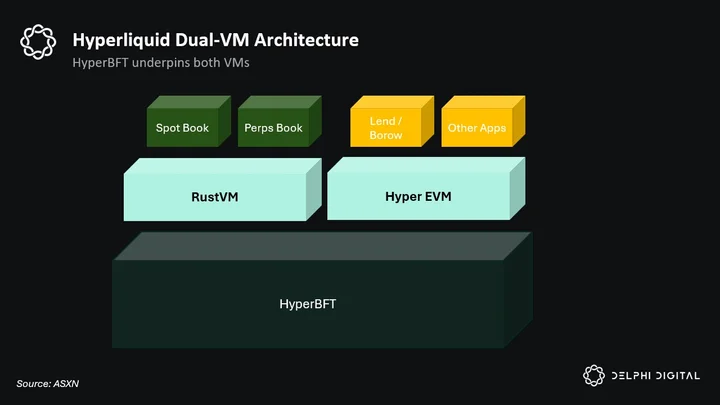
This dual-VM design suggests that the value of $HYPE can be reduced to three fundamental value drivers: (1) perps product (2) spot product and (3) HyperEVM. Given this unique topology, the following analysis will employ a sum-of-the-parts approach that values each respective value driver independently.
However, before analyzing the core value drivers, let’s first unpack the current state of the perps and spot DEX market and speculate the broader headwinds and tailwinds DEXs will face going forward.
Macro Overview
At time of writing, the ratio of perps and spot DEX to CEX volume grew to 7.9% and 19.2% respectively. In my view, this growth is not downstream of ideology (i.e., people using DEXs because they are “decentralized”) but rather it is a symptom of three structural advantages unique to DEXs:
- Access: DEXs offer unparalleled access by allowing users to circumvent jurisdictional prohibitions. In other words, almost anyone anywhere can use DEXs without having to KYC.
- First-mover advantage on token launches: While CEXs have lengthy approval processes, DEXs are able to support spot and perps assets much quicker. Consequently, DEXs get a first-mover advantage on nearly all token listing.
- Scope of tradable tokens: Given the permissionless nature of spot DEXs and more liberal listing process of perps DEXs, these venues inherently support a much broader scope of tokens.
Intuitively, each of these structural advantages become increasingly pronounced as demand to trade longer-tail assets increases. This is also consistent with the data as the DEX to CEX ratio across both spot and perps venues has inflected upwards following the growth of memecoin trading and more recently the launch of TRUMP and MELANIA. Therefore, when forecasting the growth of the DEX to CEX ratio, in my view, the principal variable you are underwriting is demand to trade lon
Read the full report
This report is part of Delphi Pro.
- 800+ Pro reports across every major sector
- Talk directly with our analysts
- Private community of funds and builders
Already a Pro member? Log in
0 Comments