
The Halving Cometh
The halving is upon us. In approximately 320 days, Bitcoin’s block rewards will be halved from 6.25 BTC per block to 3.125. The halving reduces the new supply of Bitcoin entering the market and is often viewed as a market-wide bullish catalyst. It is reasonable to assume that if demand remains the same and supply decreases, the price of BTC should go up. As Bitcoin is the largest coin by market cap, a strong Bitcoin often acts as a tailwind for the broader crypto market.
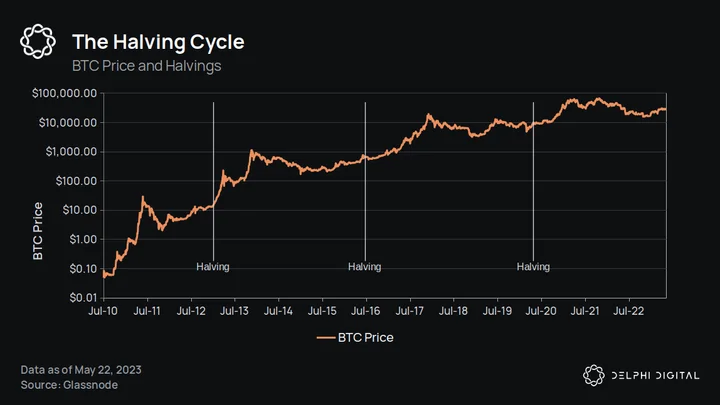
Of course, the past does not necessarily predict the future. The prior halvings occurred in a different macro environment when crypto was still a niche market and arguably so small that macro events like interest rates had little impact. Now, Bitcoin has entered the mainstream, macro events impact it, regulators grapple with it, and the future is a vast unknown.
That is where this report will focus — on Bitcoin’s future.
The Past Halvings
First, we want to see how Bitcoin has performed after its prior halvenings. As a refresher, Satoshi designed Bitcoin to pay miners both transaction fees and block rewards. Block rewards were initially high — 50 new BTC were issued every 10-minute block. But the block rewards halve every 4 years, from 50 to 25 to 12.5, to 6.25 and so on. The idea here is that as the network matures and more users join, transaction fees can replace the block rewards, and eventually BTC inflation decreases to zero.
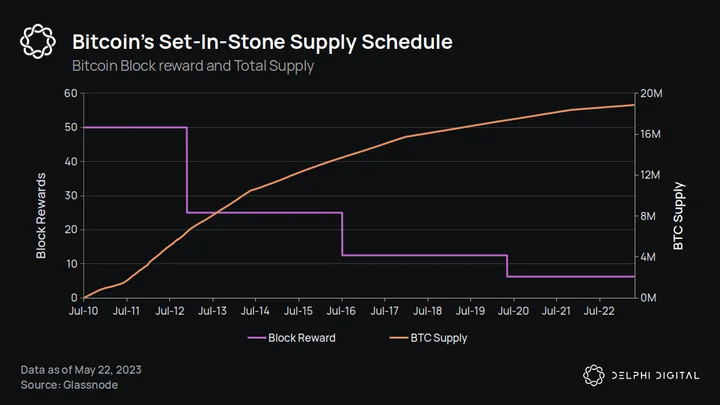
Bitcoin halvening events have historically signaled a substantial increase in the price of Bitcoin. This makes sense — if demand for BTC remains stable or increases, the price should go up while the supply decreases. We see this trend generally holding true in Bitcoin’s past. Post-halvening, Bitcoin experiences strong tailwinds and price appreciation.
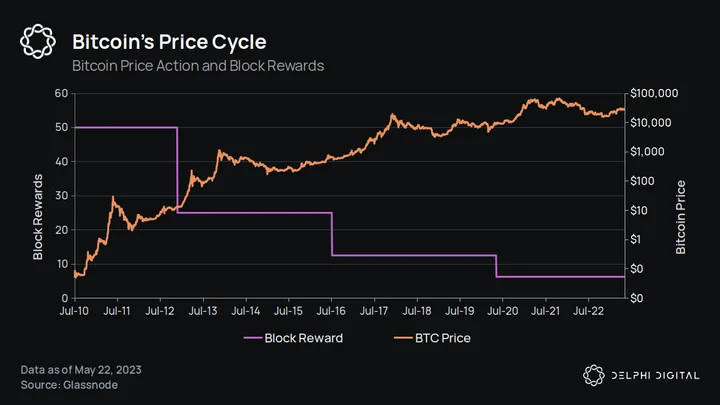
We can see from the above chart that a halvening has coincided with Bitcoin’s price increase — although not immediately.
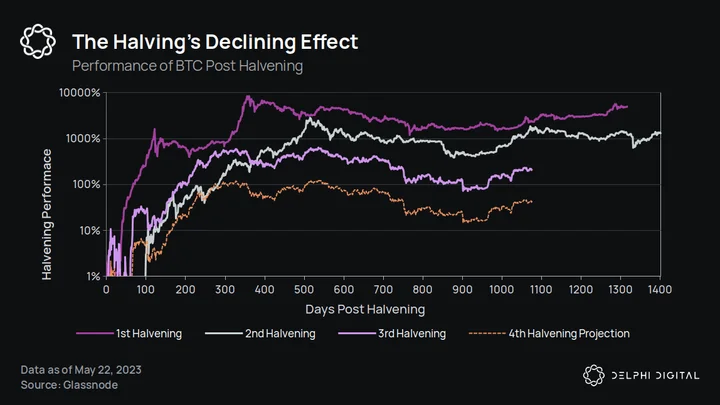
When we look at the performance of Bitcoin post-halvening, we see that the price of BTC has gone up. An initial glance at these charts tells us that halvenings positively affect Bitcoin’s price. However, there is some critical nuance to looking at Bitcoin’s post-halving performance.
The first halvening had the best performance. Bitcoin went from $13 to $674 (5,000%) in roughly four years post-halving — and peaked at a price of $1134 (8398%). However, each halvening after the first has had a diminishing impact on Bitcoin. After the second halvening, Bitcoin went from $674 to $9,083 (1,261%), and the third from $9,083 to $29,000 (215%) – peaking at $19,587 (2835%) and $67,598 (636%) respectively. This suggests a halvening’s effect on Bitcoin diminishes 4x-6x with each successive halvening — meaning Bitcoin may only appreciate 35%-54% after the upcoming halvening. This is of course a guess, but it is apparent that each halvening has a declining impact on the price.
Secondly, there have only been three halvenings in Bitcoin’s past, and as such, very little historical data to go off of. There is no guarantee that the upcoming h
Read the full report
This report is part of Delphi Pro.
- 800+ Pro reports across every major sector
- Talk directly with our analysts
- Private community of funds and builders
Already a Pro member? Log in
0 Comments