
Bitcoin’s 2022
2022 was a rough year for crypto. Numerous blowups and deteriorating macro conditions led to a brutal price decline. BTC handled the year better than most coins — as is to be expected — but the macro situation still hit the asset hard.
Bitcoin has been rather unloved from a narrative perspective in the broader crypto market. Tech upgrades to Ethereum, new chain launches, and application-layer innovations have dominated headlines and attention. As such, this is an interesting time to look back at what’s gone on with Bitcoin.
The past year was a tumultuous one for Bitcoin, with usage stagnating and miners facing increasing pressure. But there were positives as well, like the introduction of Taro. In this memo, we aim to turn back the clock and analyze Bitcoin’s 2022 to infer what it means for 2023.
Notable On-Chain Trends in 2022
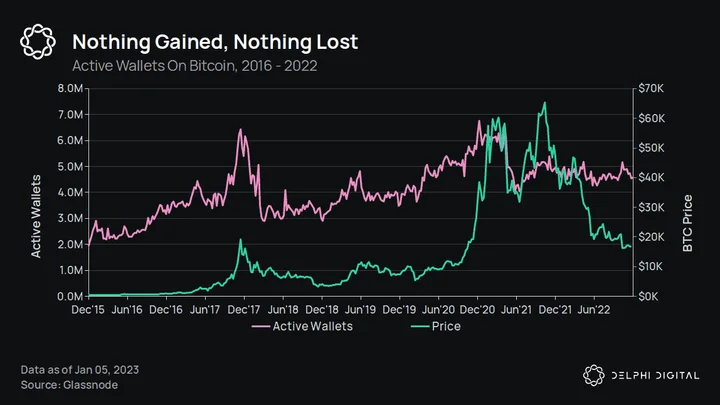 Despite bearish BTC price action throughout 2022, activity on the Bitcoin network has remained stable. The number of active Bitcoin wallets was flat in 2022, at ~4.5M — inline with the numbers from the past four years. Looking at a four year cycle, the active wallet count is even trending upwards slightly.
But at the same time, it’s clear that active address growth has been stagnant since roughly Q1 2021. That’s not what you would like to see given what market conditions were like in 2021. Active address levels have found a higher base than in the previous cycle, so we haven’t seen a significant exodus of users from the Bitcoin network. But we haven’t seen significant growth, either. Instead, we’ve seen active wallets on Bitcoin remain relatively flat throughout all of 2022. Even when they peaked in 2020, they barely surpassed the prior high from 2017.
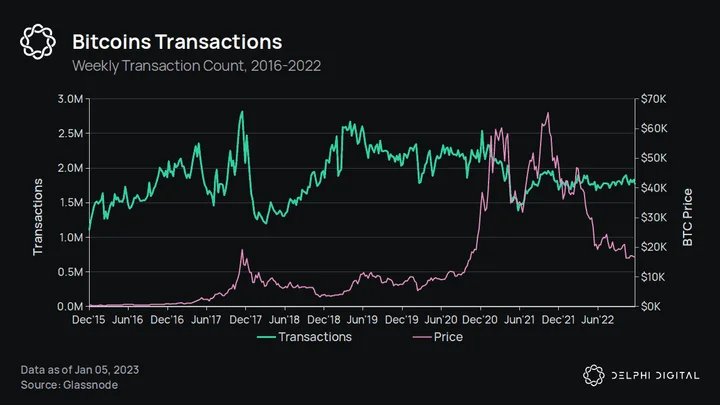 Transaction counts were relatively stable throughout 2022, but have declined overall since the peak of the 2021 bull market. Notably, Bitcoin’s transaction count has failed to surpass its peak from 2017. The lack of growth could be partly due to the influence of the hodl narrative — people buying Bitcoin, sending it to cold storage, and never spending it. The lack of growth could also be caused by Lightning taking up some of the demand. Or, more concerningly, the stagnant growth could be Bitcoin failing to maintain its relevance in a market that is constantly producing new technologies and narratives. Either way, the lack of transactional growth in Bitcoin between 2018 and 2023 is a cause for concern.
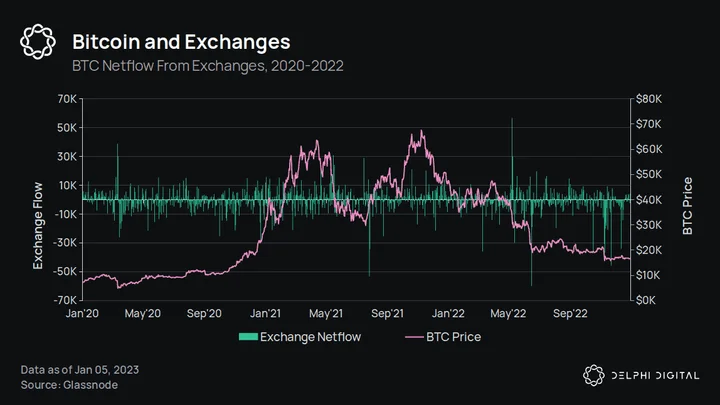 Throughout 2022, we have seen Bitcoin flying off exchanges. The trend we see for Bitcoin and CEXs is that holders have been taking BTC off exchanges and into self-custody — especially after the collapse of FTX.
Self-cust
Read the full report
This report is part of Delphi Pro.
- 800+ Pro reports across every major sector
- Talk directly with our analysts
- Private community of funds and builders
Already a Pro member? Log in
0 Comments