
A New Token on the Block
BRC-20s are one of the newest token standards in the crypto ecosystem. Exploding into popularity during the recent memecoin craze, BRC-20s surpassed their humble origins as an experimental idea and briefly grew to a market cap of more than $700M. The market for these Bitcoin-native tokens is still extremely nascent, but BRC-20 enthusiasm already significantly impacts Bitcoin.
However, despite their popularity, BRC-20s have still primarily gone unnoticed by many market participants who have written Bitcoin developments off. Additionally, the documentation surrounding BRC-20s and BRC-20 projects is not the greatest. So understanding BRC-20s and experimenting with them is often an expensive lesson in trial and error. That is where we hope this report can help.
In this report, we analyze the BRC-20 token standard. On the surface, it seems to be something akin to the much more popular ERC-20 token standard. However, there are significant differences between the two that people should be aware of. The report also analyzes the BRC-20 market and its impact on Bitcoin. BRC-20 trading has been around for about three months. What trends have emerged in this time? How is it affecting Bitcoin’s chain?
Using the growth pattern of ERC-20, we built a simple model to simulate BRC-20 growth. Despite the misgivings of some in the Bitcoin community, BRC-20s are here to stay. As such, we are extremely curious to see what BRC-20 growth would look like and how it would affect Bitcoin. For the first time in a while, there is a significant demand for Bitcoin’s blockspace thanks to BRC-20s, and we are curious to see how this demand will affect Bitcoin if BRC-20 growth mirrors that of ERC-20s.
Finally, we will highlight some growth areas for BRC-20s. BRC-20 technology is very rudimentary — both a blessing and a curse. On one hand, the tech is so rudimentary that there is little to do with the tokens and they are quickly hitting their limit. On the other hand, however, their primitive and early nature means that if they grow, there is still a ton of potential upside that enthusiasts can capture as new projects build out new use cases. For the first time in a while, betting on a growing digital Bitcoin ecosystem could be attractive.
BRC-20s Under the Hood
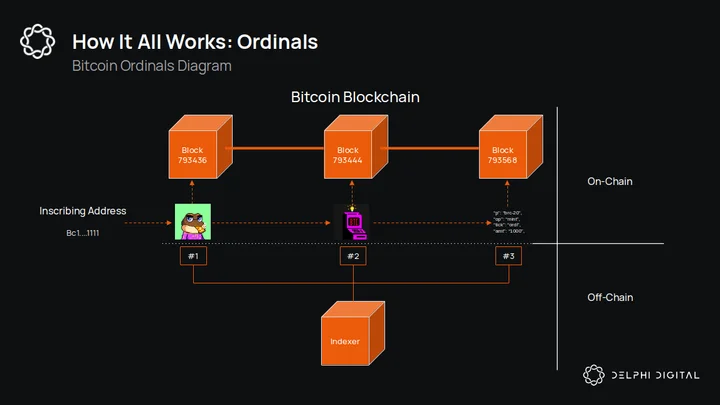
BRC-20s are the next evolution of Bitcoin’s Ordinal technology. Ordinals, as a refresher, allow users to inscribe data to specific sats on Bitcoin. Ordinals then use off-chain indexers to serialize the inscriptions and index the data. Serializing the inscriptions with indexers allows other sites or wallets to access and read the data on the site and report which address owns it. Without indexers, finding the inscribed data would be like finding a needle in a haystack. Indexers allow users to query the chain to see the data quickly. Bitcoin users initially used Ordinals to inscribe mostly images and PFPs to Bitcoin as a quick copy-cat market to Ethereum NFTs. However, BRC-20s have quickly overtaken this initial use case and now account for over 90% of Bitcoin inscriptions.
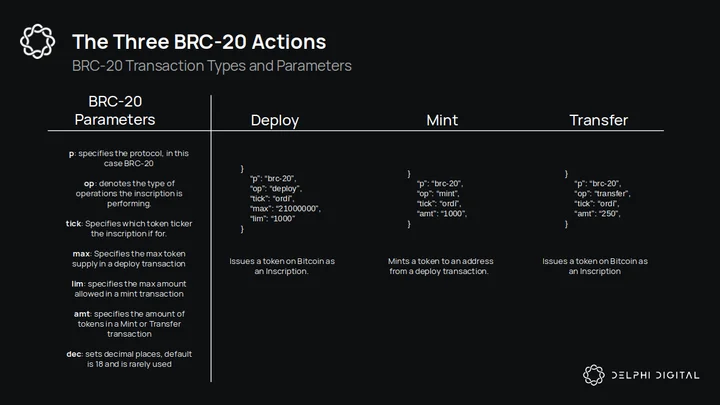
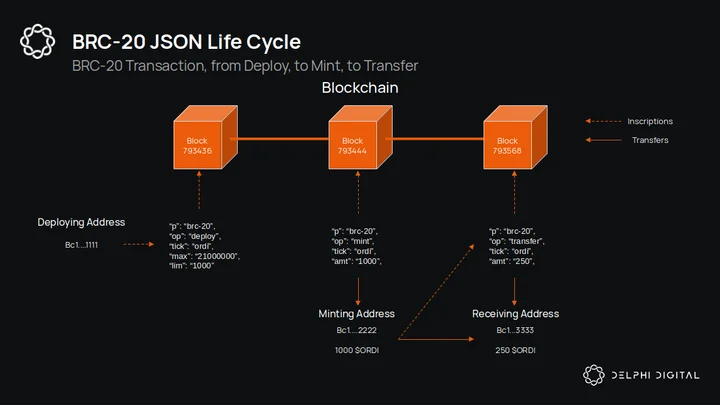
A pseudonymous Twitter dev, Domo, ran with the Ordinal idea and decided to create an experimental token standard using Ordinal theory on Bitcoin. Called BRC-20s in imitation of the ERC-20 standard, BRC-20s have brought fungible tokens to Bitcoin L1. Unlike ERC-20s, users do not mint BRC-20s through smart contracts; BRC-20s are just text JSON data that inscribes a token ticker, amount, and other data to a sat. BRC-20 inscriptions have three initial operations: deploy, mint, and transfer. BRC-20s have exploded to a market cap of hundreds of millions from these humble three operations.
From the original mint inscription, users can inscribe JSON data that records the transfer of these tokens. As indexers serialize inscriptions, wallets and devs can ascertain wallet balances by simply querying the most recent inscriptions for tokens. Verifying that tokens are legitimate is as simple as tracing the BRC-20 transaction back to the original mint inscription.
The ERC-20/BRC-20 Difference
It should come as no surprise that BRC-20s lack many of the usual functions we have become used to with tokens. ERC-20s have a much broader range of functions than BRC-20s. The additional functions of ERC-20s give them distinct technical and flexibility advantages. The differences are something that readers should be aware of.
Social Consensus
One of the largest differences betwee
Read the full report
This report is part of Delphi Pro.
- 800+ Pro reports across every major sector
- Talk directly with our analysts
- Private community of funds and builders
Already a Pro member? Log in
0 Comments