BreederDAO is pioneering the concept of economic specialization in the Metaverse. Their specialty is in-game asset manufacturing, buying, and selling. Additionally, they offer the best-in-class, play-to-earn analytics platform PlayCore. The elephant in the room? Their survival depends on the success of play-to-earn gaming, which, amongst other problems, has faced challenges with unsustainable economics to-date.
In this report we examine the problems BreederDAO aims to address with their specialized skillset, their analytics dashboard PlayCore, BREED token mechanics, BreederDAO’s in-game asset manufacturing activities to-date, and what they have in store for the future. We also explore some very tangible risks faced by BreederDAO such as the current sustainability challenge of play-to-earn games broadly, the possibility of guilds moving towards in-house in-game asset manufacturing, and formidable competition in the data analytics space.
Economic specialization is not a revolutionary idea, and it’s certainly not unique to the Metaverse. It’s simply the idea of participants adopting a focused role within an economic system. In fact, specialization is highly characteristic of modern economies. Today it’s common for someone to occupy a specialized position (analyst), in a specialized department (research), for a specialized company (Delphi), within a specialized niche (gaming), of a specialized industry (crypto). It’s layers atop layers of specialization. This narrowing of focus means going deeper in a chosen field, amounting to a more comprehensive understanding. A greater degree of specialized knowledge, making the individual or entity more uniquely valuable. More chances to practice and iterate in the same area, resulting in faster development of expertise. Simply put, specialization fosters greater proficiency in select areas.
What Problems Is BreederDAO Solving?
Underutilization of scholars and funds by guilds:
In the world of play-to-earn guilds there appears to be a supply glut of individuals eager to secure their place as a scholar and start earning (as seen in low utilization rates). Guilds generally have an abundance of capital largely due to investor funding. They have ample supply of eligible potential scholars. What they don’t have is the staff resources or capacity to breed, craft, manufacture the necessary NFT game assets in large enough quantities to service their entire communities. As guilds continue to grow, this challenge only becomes more of an issue. The table below shows some statistics on major play-to-earn guilds.
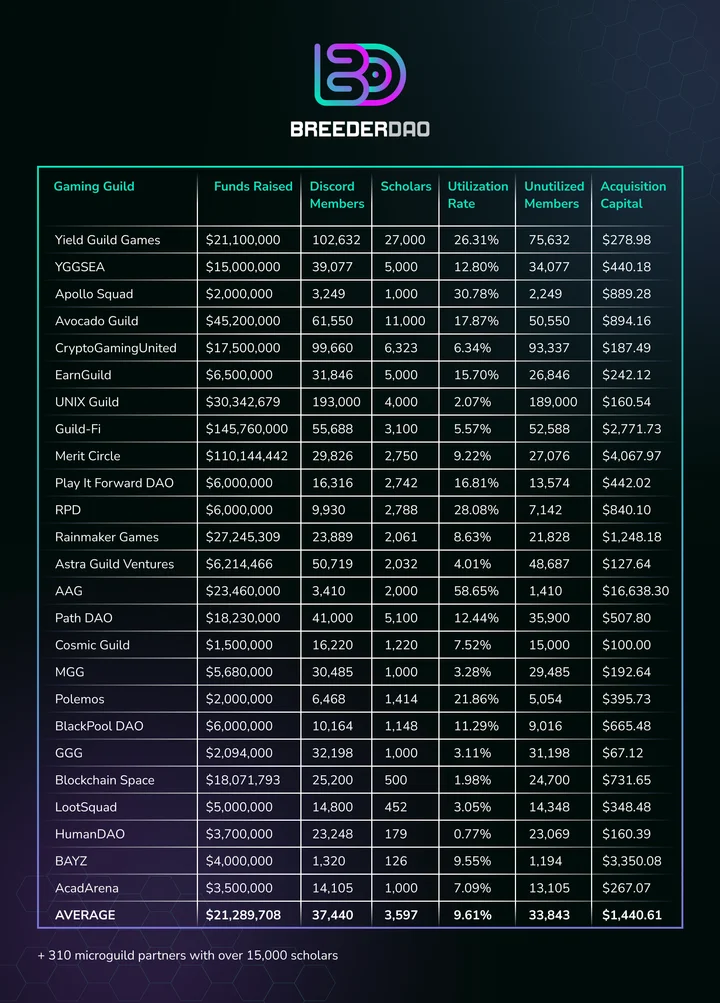
As you can see above, sc
Read the full report
This report is part of Delphi Pro.
- 800+ Pro reports across every major sector
- Talk directly with our analysts
- Private community of funds and builders
Already a Pro member? Log in
0 Comments