
🌅 Welcome!
Following an attack, Aave has temporarily suspended markets for assets with low liquidity and high volatility. Elsewhere, the Bahamian government has launched a criminal investigation into FTX.
Today, we take a look at a volatility-based indicator for BTC and our Research team examines how electrical costs influence the behavior of BTC miners.
This is the Delphi Daily. Let’s dive in.
🚨 In Case You Missed It
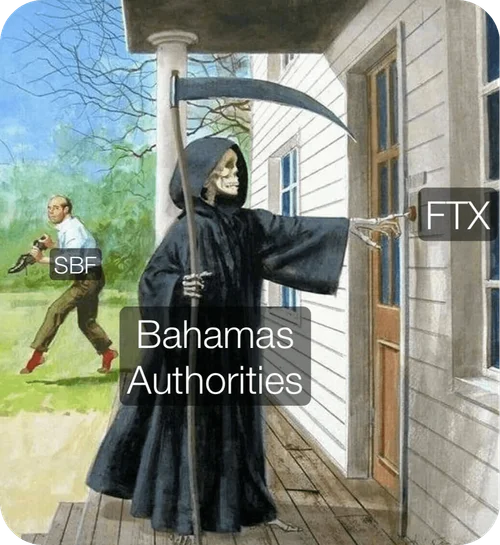
- Attorney General of The Bahamas says that there is an active criminal investigation into FTX.
- Aave has passed a governance vote to temporarily freeze markets on v2 for assets with low liquidity and high volatility.
- Russian President Vladimir Putin calls for a blockchain-based payment system that is independent of banks.
- Belgian regulators say that BTC and ETH are not classified as securities.
- Amber Group’s co-founder Tiantian Kullander has unexpectedly passed away in his sleep on Nov. 23.
📊 BTC Volatility Contracts as Market Awaits Clarity
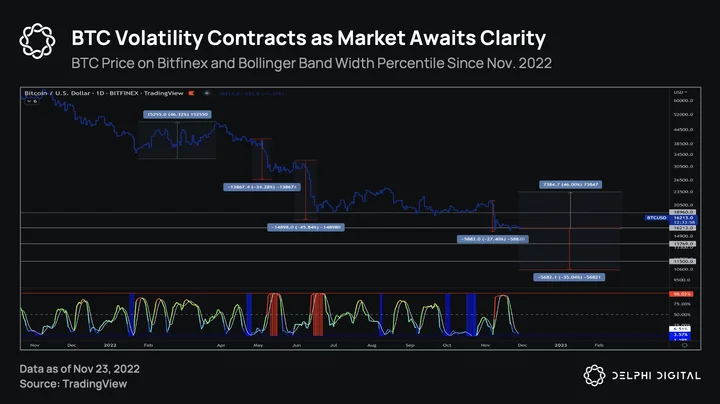
- Between Nov. 5-10, BTC price fell by over 27% as it traded below its summer range. This is largely due to the FTX collapse and the resulting contagion. This decline was coupled with the Bollinger Band Width Percentile (BBWP) indicator reaching 3.57.
- The last four instances of similar moves in the indicator have led to one upside move of 46% and three downside moves of -35% on average. Such a downside move from current price levels takes BTC price to $10.5K.
- The BBWP is a second-order derivative of the Bollinger Bands, a volatility-based indicator made of three lines. The middle line is the 20-day simple moving average, and the upper and lower lines are two standard deviations away.
- While the fallout from the FTX collapse spreads, BTC finds itself in limbo. In case of a significant price move, the BBWP indicator can set expectations and provide important context.
⚡ Monthly Chartbook – Inflation Cooperates, But Is It Enough?
-
Bitcoin miners’ behavior will always be linked to their operating costs. More specifically, the electrical cost associated with BTC mining is the primary driver behind miners’ base expenses and profitability.
-
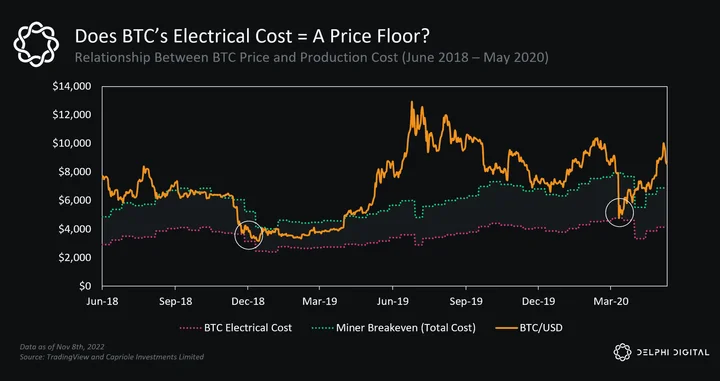
Interestingly enough, the electrical expenditure to mine 1 BTC has historically represented a dynamic price floor for Bitcoin since its inception.
-
In fact, Bitcoin’s price has only matched the raw electrical cost of production (denoted by the red-dotted line in the charts above and below) 5 times over the past 5 years: December 2018, March 2020, June 2020, June 2022, and most recently this November.
-
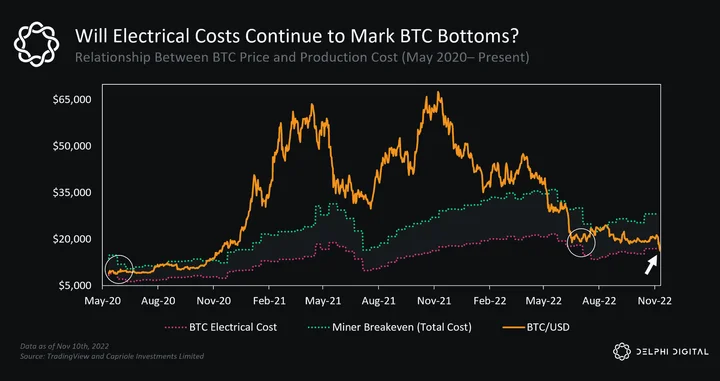
Throughout the month of October, BTC’s price started to inch back down toward this historic floor price.
-
Furthermore, with the recent sell-off caused by FTX contagion, BTC actually traded beneath its current electrical cost of ~$17k (estimated based on research from Capriole Investments Limited).
-
Historically speaking, this rarely occurs, and hasn’t happened since the COVID capitulation in March 2020. To put it simply, BTC miners are now footing an electrical bill that exceeds the income generated from mining operations.
-
But that’s just raw electrical costs. When you layer in the other expense inputs such as hardware, bandwidth, wages, rent, insurance, etc., it is easy to visualize just how much pressure miners are currently under.
-
The green-dotted lines represent the estimated total cost of production, or where BTC’s price needs to be in order to be profitable. This estimate currently sits at ~$28k, with BTC trading beneath it since the beginning of May.
-
For more on this, Delphi members can read our Delphi Pro report here.
🐣 Notable Tweets
Upcoming Events in December
December fresh alpha, enjoy
On Frequent Batch Auctions
1/ Frequent batch auctions (FBAs) are a perfect nerd-snipe. They almost don’t exist irl, yet smart people can argue for hours if they can solve hft.
In this 🧵, I’ll explain why
1. the original FBA argument is likely flawed
2. their application in crypto is also problematic– Al N (@0x94305)

0 Comments