BTQ Technologies: Securing Crypto’s Future Against the Quantum Threat
DEC 03, 2025 • 28 Min Read

Report Summary
Summary:
“BTQ Technologies: Securing Crypto’s Future Against the Quantum Threat”
The report argues that quantum computing poses an imminent and existential threat to Bitcoin and all digital assets secured with ECDSA. Quantum computers—particularly when capable of running Shor’s algorithm—will be able to reverse Bitcoin’s public keys into private keys in hours or minutes, making billions of dollars of crypto vulnerable to theft. The threat is accelerated by real-world developments from IBM, Google, IonQ, and government-level investment into quantum hardware.
Bitcoin cannot upgrade quickly due to slow governance, political resistance, and massive coordination requirements. Over 4M BTC are already sitting in vulnerable addresses. Institutional actors like BlackRock, VanEck, Ray Dalio, and Vitalik Buterin have publicly warned about this risk.
BTQ (Bitcoin Quantum) is introduced as a “quantum canary network” — a parallel, quantum-secure blockchain designed to test, validate, and battle-harden post-quantum cryptography (PQC) in the real world. It provides a safe environment to stress-test PQC algorithms, UTXO migration, hardware wallet integrations, and institution-level quantum risk mitigation without touching Bitcoin’s mainnet.
BTQ uses hybrid post-quantum signatures (Dilithium, Falcon, SPHINCS+), offers algorithm agility, and introduces a quantum-native Proof-of-Work based on boson sampling, which leverages quantum physics for security and energy efficiency.
The broader thesis: institutions and individuals need a quantum migration playbook now—not after the first quantum attack. BTQ provides that infrastructure, creating a pathway to protect trillions of dollars in crypto assets while enabling the next generation of quantum-native financial systems.
Key Takeaways
1. Quantum computing is an immediate, not theoretical, threat
-
Estimates now place “Q-Day”—when quantum computers can break ECDSA—between 2028 and 2035.
-
IBM projects error-corrected quantum systems by 2029.
-
Public key exposure from any past transaction makes many Bitcoin wallets stealable.
2. Bitcoin cannot upgrade fast enough
-
Any cryptographic upgrade requires global consensus (developers, miners, nodes).
-
Bitcoin’s conservative governance makes rapid changes nearly impossible.
-
Over 4 million BTC are already quantum-vulnerable.
3. Existing mitigation proposals are insufficient
-
PQC proposals (BIP-360, hybrid signatures) face:
-
Signature size bloat
-
Hardware/wallet incompatibility
-
Community resistance
-
Delayed standardization (e.g., Falcon / FN-DSA)
-
-
Academic solutions lack real-world, adversarial testing.
4. BTQ provides a quantum-secure parallel network
-
Not a fork or a replacement—a testing and migration environment.
-
Uses multiple NIST-approved PQC algorithms:
-
Dilithium
-
Falcon
-
SPHINCS+
-
-
Supports threshold signing across multiple quantum-resistant schemes.
5. Introduces a quantum-native Proof-of-Work system
-
Uses boson sampling, where photons solve the cryptographic challenge.
-
Designed to be hard for classical computers but efficient on quantum hardware.
-
More energy-efficient than classical PoW.
6. Institutions need BTQ to meet fiduciary and regulatory duty
-
Quantum risk is currently uninsurable without mitigation.
-
BlackRock’s ETF filing already cites quantum as a major risk factor.
-
BTQ enables:
-
UTXO migration rehearsals
-
PQC wallet integration tests
-
Cost & fee modeling for quantum-safe transitions
-
7. BTQ becomes foundational infrastructure for DeFi
-
Ethereum is equally vulnerable; BTQ tools extend to stablecoins, smart contracts, and DeFi.
-
Demonstrated through the Quantum Secure Stablecoin Network (QSSN).
8. Roadmap
2025–2026:
-
Hybrid signature migration
-
Network testing, PQC rehearsal, core implementation using ML-DSA
-
Support for quantum-safe stablecoin pilots
2027–2028:
-
Rollout of quantum-safe financial primitives
-
Exchange and wallet integrations
-
Secure multi-sig, escrow, complex DeFi structures
2029+
-
Quantum-native value systems (one-shot signatures, no-cloning-based assets)
-
Full transition into physics-secured digital money
9. The deeper thesis
Quantum computing will not “break Bitcoin overnight,” but the risk ramp is accelerating. The real danger comes from:
-
Harvest now, decrypt later attacks
-
An uncoordinated global Bitcoin migration
-
Institutional hot-wallet compromises
-
A quantum-accelerated 51% attack
BTQ’s purpose is to prevent a catastrophic, sudden collapse by offering a safe, live environment to test quantum migration strategies—ensuring Bitcoin’s long-term survival.
-
Introduction
The mathematical security that guarantees Bitcoin’s integrity is facing an irreversible crisis from an emerging technology: quantum computers. These machines don’t just calculate faster than today’s supercomputers. They exploit quantum mechanics to solve problems computationally impossible for traditional machines.
The enduring promise of the crypto revolution was never just about decentralized assets. It was also about reclaiming digital ownership of our lives, free from the grip of banks or governments. It’s a truly radical idea that has fundamentally changed the concept of digital property: money that doesn’t require trust in a third party, but instead is secured by complex mathematics, cryptography, and a large decentralized global network.
Yet, this foundational promise, built on the certainty of math, is about to face its most profound existential threat. And many holders have no idea it’s coming.
Crucially, they pose a threat to the two main pillars of Bitcoin’s security: the Elliptic Curve Digital Signature Algorithm (ECDSA) and the SHA-256 hash function. This threat is no longer distant speculation. The clock is ticking for every crypto holder. The cryptography that makes your private keys unbreakable today will be trivial to crack within the next decade, not by hackers or governments, but by malicious actors who successfully harness the raw power of quantum physics itself.
This looming threat creates a fundamental mismatch: the slow, consensus-driven upgrade cycles of decentralized networks versus the exponential pace of quantum development. Bitcoin, by nature of its design, is unlikely to adopt critical, structural changes with the urgency required, making it prone to reactive, patchwork responses when the threat finally materializes.
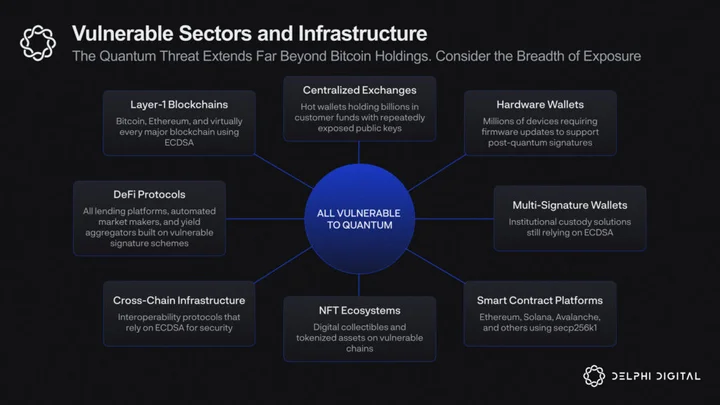
Unbeknownst to most, the vulnerability isn’t limited to Bitcoin holdings. It’s embedded in the ECDSA cryptography that secures exchange hot wallets, DeFi protocols, smart contracts, and cross-chain bridges. This puts every layer of infrastructure at risk.
Enter Bitcoin Quantum (BTQ) – the strategic bridge to a quantum-safe future.
The value proposition of BTQ is simple. Consider Bitcoin like a massive aircraft carrier. It is powerful, but slow to turn. Any upgrade requires years of debate, consensus among thousands of nodes, and backward compatibility considerations that make rapid changes impossible.
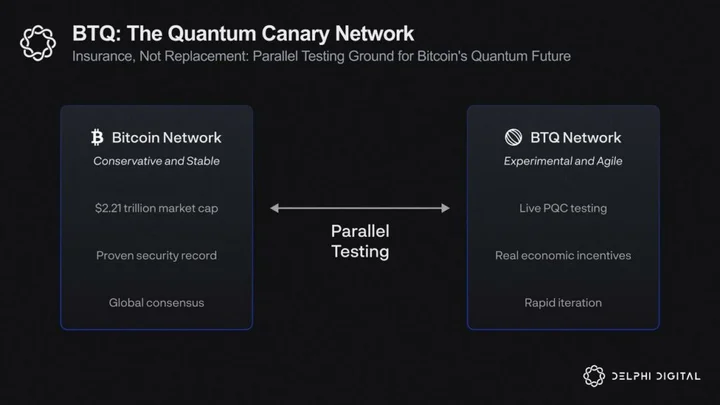
BTQ is the quantum-secure parallel network that delivers an immediate and complete cryptographic overhaul to the Bitcoin architecture. It is not merely a testing environment, but a crucial, live implementation of the next generation of digital asset security. It allows for aggressive experimentation with post-quantum cryptography (PQC), consensus mechanisms, and new financial primitives without ever risking Bitcoin’s stability. No hard forks. No contentious community splits. No gamble on untested code. This represents a practical milestone: proactively re-building all vulnerable cryptographic components to secure a $2 trillion asset class.
It’s the ideal testing ground for what matters most: real world validation. BTQ can stress test post-quantum algos under actual network conditions, measure the performance of new signature types, and identify vulnerabilities before they become exploits.
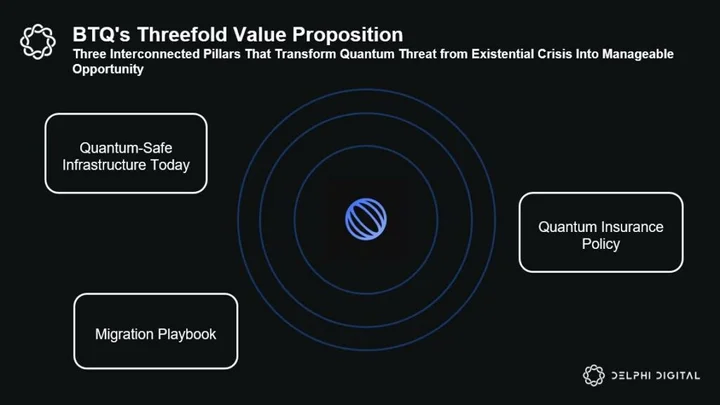
By creating a migration playbook for the crypto ecosystem, BTQ establishes tested procedures and quantum-resistant infra that Bitcoin and other networks can eventually adopt.
Quantum: Immediate Threat, Not Theoretical Problem
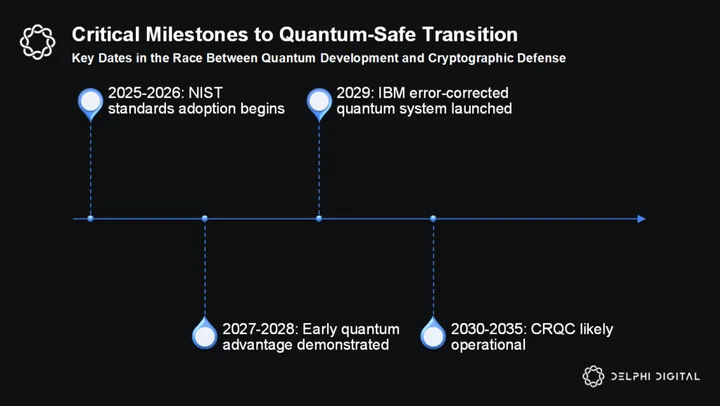
The risk timeline is shrinking. While conservative estimates from academic consensus place the threat horizon around 2030-2035, the aggressive estimates from commercial quantum companies push that window up to 2028-2030.
Even technology giants like IBM project having their first error-corrected quantum system, a critical step towards a threat-level machine, by 2029. Cryptographers have fast-tracked the timetable for migration, recommending that any critical security infrastructure must begin migrating now.
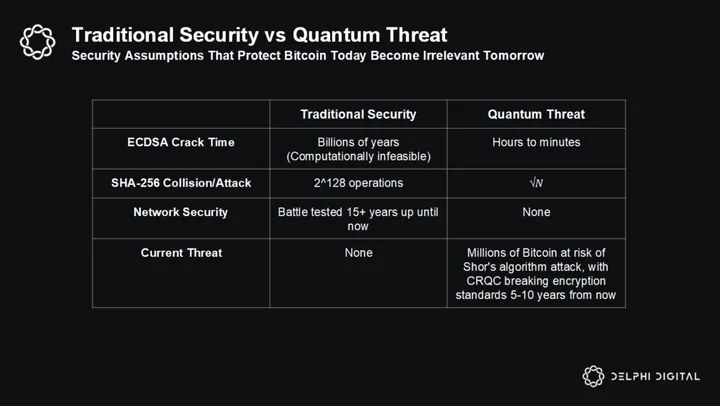
The sheer scale of a potential attack, which could lead to the theft of billions of dollars in dormant and active funds, demands immediate preparation. A quantum machine using Shor’s algorithm can efficiently break the ECDSA (the core digital signature scheme used to verify Bitcoin transactions). This capability allows a quantum computer to efficiently calculate a user’s private key from their public key.
A regular computer would require billions of years for this task. A quantum machine could accomplish it in a matter of hours, or even minutes. This single capability enables complete theft. For any Bitcoin address that has signed at least one transaction, the public key is already exposed on the blockchain. This immediately makes the corresponding private key vulnerable to the “Harvest Now, Decrypt Later” (HNDL) threat. This is a critical distinction that most holders miss: an adversary doesn’t need to break the key today. They merely need to collect the exposed public key data now, store it indefinitely, and wait for the quantum hardware to mature enough to break the encryption and steal the funds. This looming time bomb is precisely why a fresh, clean, and quantum-safe protocol is vital.
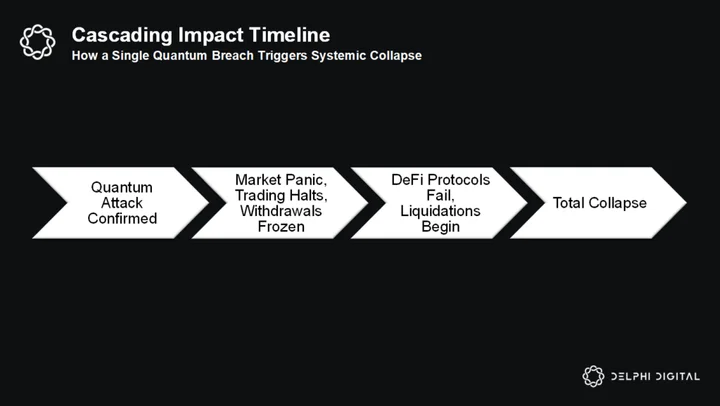
The collapse won’t be gradual. Once a quantum attack is confirmed, the dominoes fall in rapid succession. Crucially, we may not even know it’s happening right away. The actors with the capability and malicious intent will not sound the alarms prior to taking action, meaning any warning to the public will be too late.
Bitcoin’s security hinges on a complex, global consensus. Rapid structural change is nearly impossible. The network’s conservative, slow, and deliberate development culture prioritizes stability over adaptation. This inertia threatens Bitcoin’s long-term function as a secure store of value.
The time to prepare was long ago. Institutional finance has already begun to acknowledge this risk. In a signal that the quantum threat is no longer science fiction but a fiduciary concern, BlackRock flagged quantum computing as a risk to Bitcoin’s long-term security in its recent Bitcoin ETF filing this past May.
Furthermore, one of the world’s most famous hedge fund managers, Ray Dalio, has explicitly stated that quantum computing is a threat that could eventually allow Bitcoin to be “controlled” or “hacked.” He cites this as a potential structural limit on its viability as a long-term reserve asset. Echoing this concern, the CEO of asset manager VanEck, Jan van Eck, has openly questioned whether Bitcoin’s current encryption is robust enough. He said the firm would reconsider its position if the asset’s core protection were fundamentally compromised.
This move elevates the quantum threat from a niche academic topic to an enterprise-grade concern. A topic all crypto institutions and, by extension, the entire market must address. All the while, quantum readiness is being driven at a fast pace by a global, multi-billion dollar “arms race” between nations and corporations.
As major world powers like the EU, USA, and China pour unprecedented capital into securing this future technology, simultaneously, tech giants like IBM, Google, Intel, and pure-play leaders like IonQ are racing to scale their systems. IBM is already deploying large-qubit processors and releasing long-term roadmaps stretching into the 2030s. This urgency was further emphasized recently by Ethereum co-creator Vitalik Buterin, who has publicly warned that quantum computers could break the network’s cryptography within a four-year window.
This underscores the necessity of a defined PQC migration plan now. The myth of a long “quantum winter” has been definitively replaced by the reality of current progress curves. Waiting for certainty means waiting until it is far too late to upgrade.
How Your Crypto Stays Secure Today – And Why It Won’t Tomorrow
To understand what quantum computers can do to Bitcoin, we need to grasp the cryptographic principles that secure its operational infra. Think of Bitcoin’s security like a two-lock safe.
The first lock, and the most critical target for a quantum attack, is the ECDSA signature (Elliptic Curve Digital Signature Algorithm). This is the proof of ownership that lets you spend coins. As established, the security of ECDSA is vulnerable to Shor’s algorithm.
The second lock is the SHA-256 hashing, used in Proof-of-Work (PoW) mining and for Bitcoin addresses. This hashing lock is relatively safe, for now. The relevant tool here is Grover’s algorithm. Instead of inverting the hash function, Grover’s algorithm provides a quadratic speedup. Breaking a 256-bit requires the quantum computer to perform roughly the square root of the operations a traditional computer would need. While this is a significant advantage, it can be mitigated by doubling the key size.
The urgent threat, therefore, comes from Shor’s algorithm and its ability to compromise the private keys secured by ECDSA.
When Quantum Computers Break Crypto
Once a sufficiently large and stable quantum computer can run Shor’s algorithm, Bitcoin’s security faces an existential threat. This algorithm is designed to solve the factoring problem and the discrete logarithm problem, the very mathematical problems that ECDSA security relies upon, in polynomial time.
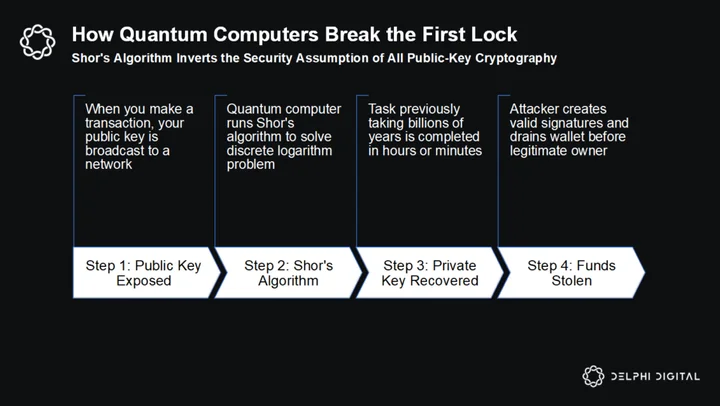
Recovering a user’s private key from their public key would take a regular computer billions of years. A quantum computer could do it in only hours or minutes, inverting the security assumption of all public key cryptography.
Any Bitcoin address that has revealed its public key by signing a transaction becomes vulnerable, because a quantum-capable attacker could steal its private key instantly.
This private key theft is an immediate threat to current crypto holders. However, a second serious risk scenario exists. A single or small handful of miners could gain access to a powerful quantum computer that can outperform the rest of the traditional network. This would allow a malicious actor to conduct a 51% attack with a fraction of the physical hardware, threatening the integrity of the entire PoW system. If quantum machines become the de facto mining infrastructure for everyone, the quantum advantage disappears and the network stabilizes, but the path to that “safe scenario” is a dangerous quantum “arms race” in itself.
Bitcoin’s Quantum Defense Attempts – And Why They’re Not Enough
The Migration Nightmare
The issue with hardening Bitcoin is not a lack of technical solutions. The National Institute of Standards and Technology (NIST) has already standardized PQC algorithms. The issue is decentralized global coordination.
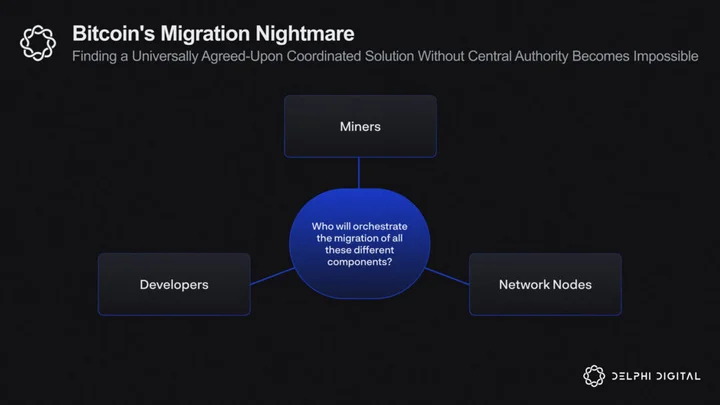
Proposals exist to protect Bitcoin, such as migrating all funds to new, quantum-resistant addresses. However, this transition requires all three major cohorts – developers, miners, and network nodes (participants) – to agree upon and execute a universal migration solution simultaneously. Migration is a massive coordination problem. In Bitcoin, this process is formalized through Bitcoin Improvement Proposals (BIPs), similar to past major upgrades like SegWit and Taproot.
The existing governance model, conservative by design, makes this necessary level of coordination and urgency impossible. The difficulty of reaching social consensus on any structural change, let alone one of this magnitude, means the network will remain exposed until a crisis forces its hand.
This risk is amplified by the fact that over 4 million Bitcoins are vulnerable due to address reuse or use of older address formats. These keys are exposed and sitting ducks, awaiting a quantum attack.
Recognizing the threat, the Bitcoin community has proposed various technical solutions. While these attempts demonstrate a clear understanding of the challenge, the unique constraints of the Bitcoin protocol and its governance model mean these proposals fall short of the agility required to meet an existential threat.
Current Post-Quantum Proposals in the Wild
Developers have been floating proposals to adapt Bitcoin. Proposals like BIP-360’s “pay-to-quantum-resistant-hash” address types suggest a hybrid signature approach. This would require transactions to be signed by both the old ECDSA key and a new quantum-resistant key (like one of the NIST finalists).
The idea is that if an attacker only breaks one, the funds are still secure. It’s a backward-compatible safety net. More recent upgrades, such as Taproot, offer hidden spending conditions that could potentially be used to facilitate a quantum-safe migration. Such a move allows funds to be moved using an alternative, quantum-resistant signature only if certain network conditions are met.
But the true obstacle isn’t the lack of good post-quantum algorithms. It’s Bitcoin’s conservative nature that prevents it from adopting quantum-safe solutions.
Technical Challenges
Even if the governance hurdle is cleared, technical roadblocks remain:
- Signature Size Explosions: The leading post-quantum signature schemes, like ML-DSA (Dilithium), produce signatures that are significantly larger than the compact ECDSA signatures Bitcoin uses today. Larger signatures mean larger transactions, which translates directly to higher transaction fees and a reduction in the network’s overall transaction throughput. This cost is borne by every single user, creating immense friction for adoption.
- The FALCON Dilemma: The FALCON algorithm, one of the original four NIST-selected PQC candidates for digital signatures, is currently delayed in its standardization (FN-DSA). The reason is complex but critical: FALCON uses floating-point numbers for signing. While faster, floating-point arithmetic is often optimized by compilers and processors in a way that can open side-channel attacks. A vulnerability where an attacker deduces the private key by analyzing subtle cues like the time a signature takes to process or the power consumption of the hardware.
The reality is this: to build the quantum upgrades the crypto world needs, we must find a place to do it without Bitcoin’s political constraints.
Where Traditional Solutions Fall Short
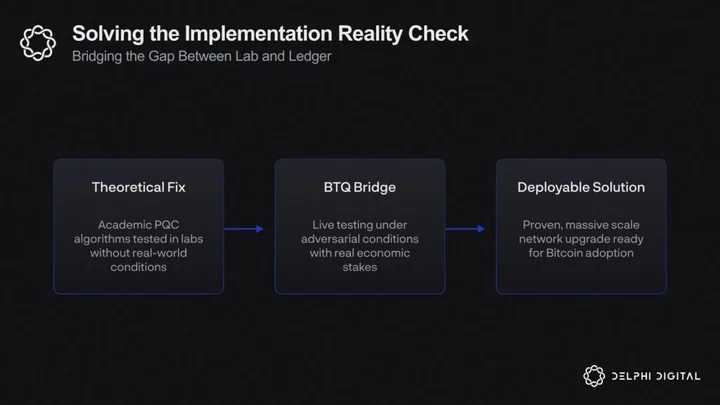
Traditional, academic, and governmental PQC efforts are focused on theoretical security and standardization. They lack the real-world, adversarial conditions of a public financial network.
Academic solutions are rarely tested under the fire of actual, sustained network fee pressure, global latency, or the intense adversarial economic incentives that define a multi-trillion-dollar ecosystem. Most PQC proposals are defensive, a mathematical patch to fix a broken key.
They lack the vision for quantum-native innovation technologies that move beyond computational assumptions and leverage the physics of the quantum world. Such a vision would create fundamentally new and stronger forms of digital value and security that are resilient not for decades, but for centuries.
BTQ: The Strategic Bridge to a Quantum-Safe Future
Technical Architecture That Works in Practice
The BTQ network is built from the ground up to solve the most critical technical challenges that trip up traditional proposals: signature agility, diversity, and real-world performance.
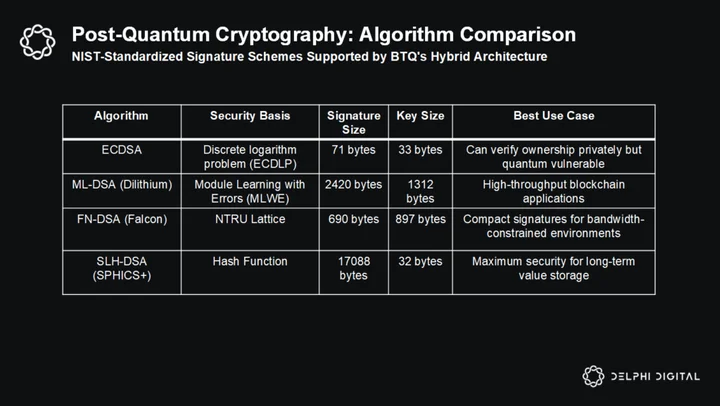
BTQ’s approach starts with the replacement of the vulnerable ECDSA signature by using a hybrid signature scheme model. BTQ allows users a choice in signing transactions through a list of NIST-standardized algorithms, including:
- Dilithium (ML-DSA): A lattice-based scheme that provides strong security. Suitable for high-throughput applications, offering balance between security and signature size.
- Falcon (FN-DSA): Another lattice-based scheme known for smaller key sizes and faster operations.
- SPHINCS+ (SLH-DSA): A stateless, hash-based signature scheme that offers excellent, conservative security based on the hardness of finding hash collisions.
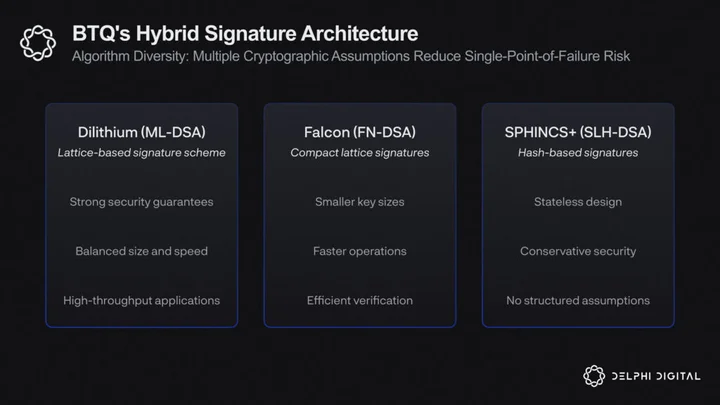
The above algorithm diversity is key. Since no one knows which PQC algorithm an attacker might break first, supporting multiple schemes based on different mathematical assumptions (lattices, hashes) reduces the risk of a catastrophic single point of failure.
On top of that, users can employ threshold policies. This requires a transaction to be signed by multiple different quantum-resistant schemes, further enhancing security.
Quantum-Native Proof-of-Work
Beyond digital signatures, BTQ also innovates on the energy-intensive PoW model, which faces its own quadratic speedup threat from Grover’s algorithm. This algorithm could potentially halve the effective security of Bitcoin’s current PoW consensus.
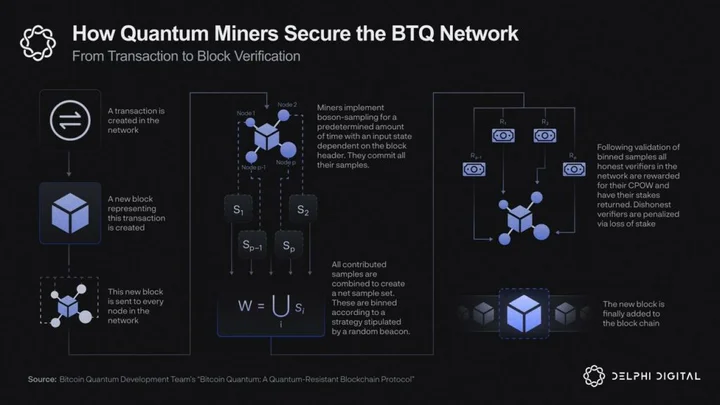
Here, BTQ proposes a novel quantum-native PoW consensus mechanism based on boson sampling. Boson sampling is a specialized form of quantum computation where photons (light particles) are sent through a complex network of optical components, and the system samples the resulting probability distribution of where those photons exit. This proposal is intended as the first practical PoW protocol designed to be verifiable by commercially available photonic quantum hardware. This type of hardware is basically computers that use photons as their fundamental unit of information (qubits) to perform calculations, often operating effectively at room temperature.
The crucial difference is in the cryptographic challenge. Bitcoin’s security rests on finding a single numerical hash through brute-force searching. The true cryptographic challenge for quantum PoW is instead to accurately predict the complex distribution of where photons exit the boson sampling circuit.
This prediction’s calculation is directly tied to the permanent of a large matrix.
While the permanent is structurally similar to the easy-to-compute determinant, it lacks the mathematical properties (like alternating signs) that allow classical computers to use efficient shortcuts. Calculating this permanent is considered a hard computational problem.
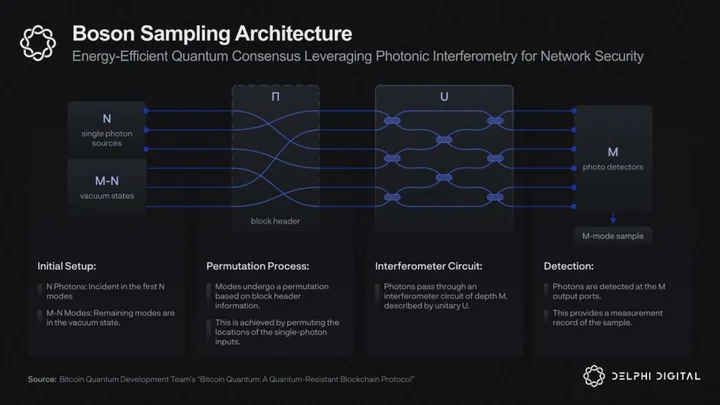 In more basic terms, it becomes harder for a classical supercomputer with every small increase in the size of the circuit. This is the computational wall that ensures the quantum PoW is secure against attackers.
Such a protocol is designed to be efficiently solvable on quantum hardware and scalable in difficulty, but computationally difficult for traditional computers. This is because the quantum machine executes the physical process (the photons are the solution), rather than trying to calculate the hard permanent. This approach is designed to resist pre-computation attacks and maintain the fairness and security of the mining process.
One of the benefits of the quantum PoW scheme is that it paves the way for high energy efficiency. This efficiency is due in no small part to quantum hardware’s capability to directly perform the physical boson sampling process. This is an inherently less power-intensive endeavor than brute-force calculations classical mining currently demands. If adopted, this protocol could go a long way to alleviating the massive energy requirements and power hunger of existing plans. Thus it would address the mounting environmental concerns associated with crypto mining. This would be a built in secure migration path for the entire mining industry, ensuring that the network remains secure and scalable even in the face of rapidly advancing quantum capabilities.
Why This Approach Succeeds Where Others Fail
Bitcoin Quantum solves the fundamental implementation reality check detailed earlier, the gap between a theoretical fix and a deployable, massive-scale network upgrade. BTQ provides the only way to test PQC under the adversarial, high-stakes conditions of a real public financial network.
Academic tests are limited. BTQ stress-tests PQC schemes under real fee pressure, global latency, and the immense economic incentives that define a multi-trillion-dollar ecosystem.
Developers aren’t guessing about the consequences of PQC. BTQ provides quantified results on key metrics: actual fee costs for different signature schemes, latency measurements across different quantum algorithms, and real-world hardware compatibility data. This set of data is the necessary prerequisite for any future, successful BIP.
Given such data, BTQ is designed for adversarial stress testing in a real production environment, built directly on Bitcoin’s core infrastructure. It allows developers to test “what if” scenarios, such as “What if Dilithium is found to have a flaw tomorrow?”. This rapid agility is impossible in the slow-moving Bitcoin Core development environment.
The Value of a Quantum Hedge
The quantum threat is not an institutional problem left to be solved by the institutions. It is an existential crisis that affects every single wallet holder. The risk is just as real to the individual whose funds sit in an address that has already broadcast its public key.
If a catastrophic attack happens, the institution may fail and recover, but perhaps more importantly, the individual’s sovereign wealth will be lost, too. The question for any institution holding, moving, or securing crypto assets has shifted from “Will quantum computers be a problem?” to “What is our quantifiable quantum risk strategy?” For individual holders, the question is equally pressing: “How do I protect my wealth from a quantum black swan event, and who is actively contributing to the development of robust solutions in this fast-moving technological race?”
Indispensable Security Infrastructure & The Quantum Premium
BTQ’s core value lies in providing the indispensable security infrastructure. The world’s most critical financial actors and the average individual need it to survive and to trust. Competitors, like Naoris Protocol, are pioneering decentralized, post-quantum security solutions for the broader Web3 and Web2 infrastructure. But BTQ is unique.
It is the dedicated quantum canary network focused on the strategic survival of the Bitcoin and digital asset ecosystem. It’s specifically built to explore the frontier of quantum money and evolve the foundations Bitcoin laid.
For institutions, the value proposition is far more critical and systemic. The moment BlackRock, the world’s largest asset manager, flagged quantum computing as a potential risk in its Bitcoin ETF filing, the threat moved from theoretical to fiduciary concern. Institutions have a duty to secure client assets, and neglecting the widely recognized, near-term quantum threat is a clear failure of risk management. BTQ offers a documented, auditable pathway to meeting this “quantum readiness” standard.
In a post-quantum world, quantum-safe assets will command a premium. Early institutional movers who integrate BTQ’s migration tools and infrastructure will capture value by being the first to offer clients verifiably quantum-safe custody and assets, effectively offering a risk parity asset in a fast moving quantum-uncertain environment.
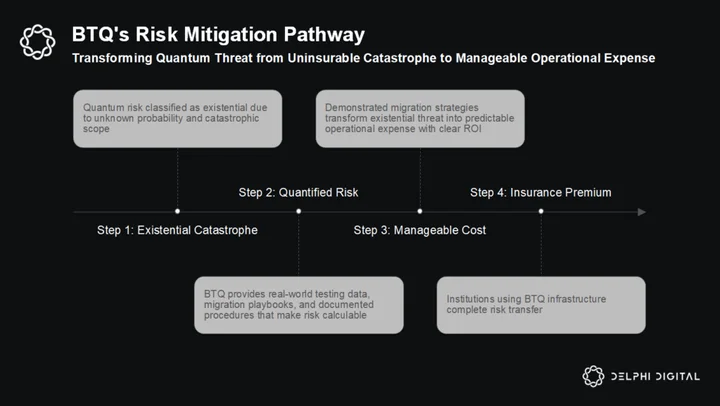
The insurance market is clear: quantum theft risk is currently uninsurable without demonstrable, aggressive mitigation. By providing a technical framework for migration and security, BTQ makes it possible for institutional custodians to eventually secure coverage, moving quantum risk from an uninsurable catastrophe to a manageable operational cost.
The Risk Concentration Problem
Institutions are disproportionately exposed to the quantum threat due to the high concentration of value in their custody models.
Right now, centralized exchanges hold billions of dollars in highly active hot wallets that routinely reuse vulnerable ECDSA addresses. These wallets are prime targets for a quantum attacker. An attack on one major exchange could trigger the quantum “Lehmann moment” mentioned earlier, leading to a system-wide collapse that impacts every institution.
In addition, current multi-signature and cold storage solutions, while excellent for securing against traditional theft, still rely on the same fundamental ECDSA cryptography. The quantum planning inadequacy in most legacy custody systems is a ticking time bomb. BTQ provides the necessary tools for custodians to upgrade their internal signing policies to threshold-based PQC schemes.
BTQ’s Enterprise Value Proposition
Before detailing the commercial activities and the value proposition, it is vital to distinguish between two distinct but connected entities. Bitcoin Quantum (BTQ) is the open-source, decentralized quantum canary network—the secure testing ground for the entire crypto ecosystem. The solutions developed here are for the public good and belong to the community. The publicly traded technology company supporting this effort through coordinated action is called $BTQ Technologies (The Public Company). They fund, develop, and commercialize applications built on the BTQ protocol. This report focuses primarily on the strategic importance of the open-source Bitcoin Quantum network and its technology.
BTQ is not offering a token or a theoretical fix. It is delivering the essential, institutional-grade infrastructure required for the entire ecosystem to navigate the quantum transition.
This isn’t a software patch. It is a full-scale, real-world testing environment designed to perform the security rehearsals that cannot take place on the actual Bitcoin blockchain. BTQ is building the tools necessary to move quantum risk from an uninsurable, catastrophic black swan event into a manageable, documented operational expense.
The core of this value proposition rests on providing institutions, such as exchanges, custodians, and large funds, with a complete playbook for survival. This begins with UTXO migration rehearsals. For an exchange holding billions of dollars across hundreds of thousands of customer addresses, knowing that a quantum upgrade is needed is not enough. They need a step-by-step, documented procedure for safely moving all those vulnerable coins into new, quantum-resistant addresses under real network stress and fee conditions.
BTQ provides the live environment to test these playbooks repeatedly, identify bottlenecks, estimate real-world cost and time, and document precise procedures before the quantum threat is imminent. This capability is invaluable.
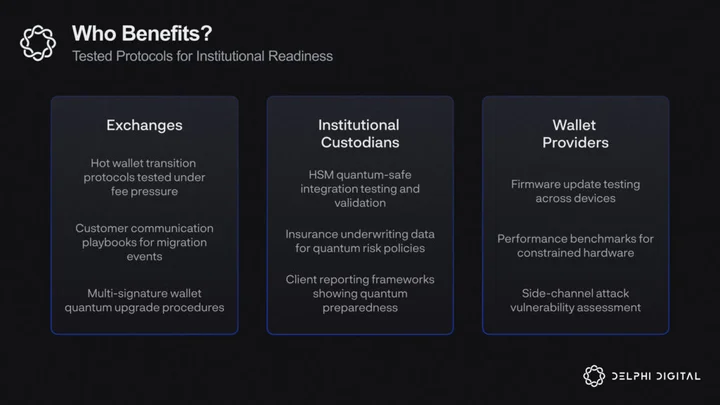
Furthermore, BTQ focuses on hardware wallet compatibility testing across diverse quantum signature schemes. The security of most crypto holders ultimately rests in the cold storage devices provided by manufacturers.
BTQ is the staging ground where these hardware companies can confidently test and validate their implementations of PQC. They can ensure that algorithms like Dilithium, Falcon, and SPHINCS+ work seamlessly and securely with the millions of devices in circulation. When the time comes to update, the new quantum-safe standards will be ready.
BTQ helps institutions design and stress-test these frameworks through adversarial simulations, running scenarios like “what if the new Schnorr signature scheme breaks tomorrow?”. The network functions as a laboratory for catastrophic risk, which allows institutions to build and validate their defenses in a low-stakes environment before the real crisis hits.
While the project is framed around Bitcoin’s unique stability requirements, its value is essential for the largest DeFi ecosystems as well. Ethereum, which uses the same secp256k1 ECDSA digital signature for transactions, is facing the exact same core cryptographic threat.
BTQ’s tooling is designed to apply to the broader digital asset space. Recently, this was demonstrated by a parallel commercial initiative: the Quantum Secure Stablecoin Network (QSSN). While QSSN is a product of the $BTQ Technologies public company, its existence showcases a real-world, high-value application of the quantum-safe architecture being pioneered on the open-source BTQ network Since stablecoins are the lifeblood of DeFi on platforms like Ethereum, the security and eventual post-quantum migration of these assets is a critical area where BTQ is positioned to provide necessary infrastructure and tooling.
Finally, the platform offers true cost modeling by providing real-world data on quantum upgrade expenses and timelines. The post-quantum signatures are mathematically larger than today’s ECDSA signatures, which means transactions will cost more in terms of block space and fees. Custodians need to know the actual cost implications of a mass migration.
By generating real-time data on quantum-enabled transaction costs, latency measurements, and hardware compatibility, BTQ allows institutions to accurately budget for their quantum transition years in advance. This strategic positioning establishes BTQ’s partners as the first movers in post-quantum crypto infrastructure. And as a result, allows them to capture a “quantum premium” from clients who seek the highest standards of security and regulatory compliance.
Is The Threat Overblown?
To fully grasp the significance of BTQ’s value proposition, one must understand the timeline not as a single, distant date, but as an accelerating series of security challenges that demand a phased response. The roadmap is designed not only to meet these challenges but to stay aggressively ahead of them.
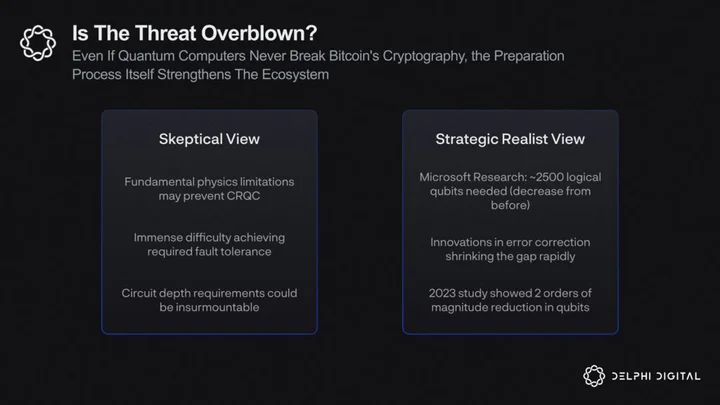
Before we move onto the roadmap, it’s critical to acknowledge a simple question that many might ponder: Is the threat overblown? It is important to acknowledge that major critics of the quantum threat argue that the timeline is exaggerated. These arguments suggest that a cryptographically relevant quantum computer (CRQC) would need thousands of high-fidelity logical qubits, which is a massive leap from today’s technology. Some experts believe that fundamental physics limitations or the immense difficulty in achieving the required fault tolerance and circuit depth will push Q-Day back to a decade or more.
However, this argument misses a key point: the walls are closing in from both the software and hardware side. The race to provide a useful quantum computer is essentially two opposing forces accelerating simultaneously. On the one hand, advanced theoretical work and innovations in error correction are finding new optimizations for Shor’s algorithm, decreasing the number of logical qubits needed to break Bitcoin’s ECDSA encryption. On the other hand, the hardware itself is rapidly advancing across multiple platforms (e.g., Neutral Atoms, Trapped Ion and Superconducting systems), continually increasing the raw number of physical qubits available while decreasing error rates. The quantum computing era begins the moment these two lines of progress meet.
We all know that Bitcoin’s migration issues make it near impossible for a global consensus on PQC in the near term. The physical barrier to entry for a malicious quantum attack is falling faster than the political consensus barrier required for Bitcoin to agree on and deploy a new cryptographic standard.
Looking Ahead: BTQ’s Roadmap
In the immediate future, the focus is on a critical, yet simple concept: hybrid signature security. Think of it as putting on your oxygen mask before the cabin pressure drops. Before the quantum event, institutions and savvy individuals must have an immediate risk mitigation tool. This involves signing every transaction with two digital locks: the current, familiar ECDSA lock, and a brand-new, quantum-resistant lock like Dilithium or SPHINCS+.
2025 – 2026
BTQ’s immediate work is to provide the network, tools, and best practices so that everyone can practice this “two-lock” procedure, rehearse migrating vulnerable assets, and ensure all systems are ready. This is the stage where the insurance policy is tested and implemented, neutralizing immediate risk and creating that necessary “quantum premium” for early movers who demonstrate provable security.
This includes securing the Bitcoin Core implementation by initially using NIST-standardized PQC algorithms. The goal is to secure the entire Bitcoin network by 2026. BTQ’s approach emphasizes crypto-agility, the ability to swiftly swap cryptographic primitives as new threats or standards emerge. They plan to achieve this by starting with a core implementation based on ML-DSA, and then quickly extending support to other complementary PQC primitives to enable that essential agility.
This phase also involves supporting external commercial entities, such as $BTQ Technologies. They will continue the launching of pilots for the Quantum Secure Stablecoin Network (QSSN) with leading issuers. This serves as a critical feedback loop. It demonstrates the real-world utility of the open-source network’s quantum-safe infrastructure.
2027 – 2028
Moving into the medium term, the platform will transition to Building New Quantum-Safe Infrastructure. The objective here is to make the entire complex ecosystem of DeFi and sophisticated ownership structures quantum-proof. Integrations with major exchanges and wallet providers will be a priority to protect retail and institutional holdings.
It’s no longer enough to move your single Bitcoin into a safe address. You need to know that your multi-signature wallet, your escrow contracts, and the whole mechanism of your automated trading strategy will continue to function securely.
The focus is on integrating quantum-resistant cryptography into more complex financial primitives. The bottom line: BTQ is creating a second generation of smart contracts that are resilient by design. It’s about moving from defending existing assets to actively building the next layer of crypto-financial tools on a future-proof foundation. The value proposition expands from providing a canary network for Bitcoin to building the quantum-safe rails for the entire digital asset economy.
2029 and beyond
The final strategic evolution occurs as the IBM error-corrected system is launched and the CRQC becomes operational. BTQ becomes a foundation for assets secured not by clever mathematics, but by the fundamental laws of physics itself. Drawing on the underlying research, this is where the possibilities of quantum-native value emerge.
Concepts like digital scarcity guaranteed by the no-cloning theorem (a principle of quantum mechanics that says you cannot perfectly copy an unknown quantum state) are becoming real. One-shot signatures that self-destruct after use are also moving from theory to practice. The goal is to create a digital store of value whose security is rooted in the principles of quantum physics. Such a design ensures perennial resilience that transcends the current technological horizon.
Conclusion
Bitcoin was designed to be resilient, but in its current state, can it survive the next few years or decades?
The existing cryptographic foundations are already compromised by the simple existence of quantum computing, and the timeline for a practical, signature-cracking quantum machine is rapidly approaching the point of no return.
As the quantum arms race continues to accelerate globally, the cost of being reactive (waiting for a crisis) is an existential risk that could wipe out trillions of dollars in wealth and destroy the core promise of digital decentralized ownership.
The only acceptable path forward is to be proactive. This requires a radical acceptance of the problem and the adoption of a solution that works outside the political and technical constraints of a slow-moving, stability-focused social consensus like Bitcoin’s.
This is where Bitcoin Quantum steps in, not as a replacement, but as the essential infrastructure for the quantum defense and evolution of the ecosystem. BTQ’s value lies in its role as the quantum canary network: a secure, live testing environment that allows the world’s most critical financial institutions to conduct their security rehearsals without risking the stability of Bitcoin itself.
In the most immediate sense, BTQ is a vital risk mitigation tool, helping companies meet their fiduciary and regulatory duties in a quantum-uncertain environment. It moves the risk from an uninsurable catastrophe to a manageable cost.
But the vision extends far beyond defense. By providing a stable platform for innovation in the quantum-native space, BTQ becomes a crucial growth enabler over time. BTQ is positioning itself as the strategic bridge to this entirely new economic paradigm. The company aims to ensure that the original promise of sovereign digital money is not only preserved but enhanced by the principles of quantum physics.
The developers who stress-test their protocols on BTQ now will be the ones whose bridges and DeFi platforms survive. And the holders who understand this threat will be the ones whose wealth endures.
The question isn’t whether quantum computers will break Bitcoin. The question is whether we’ll be ready when they do. BTQ could be the answer, not as a replacement for Bitcoin, but as the live testing ground that ensures the original promise of sovereign digital money survives the quantum transition.
The quantum clock is ticking. With BTQ, we stay ahead of it. Stay up to date with the upcoming testnet at bitcoinquantum.com, and follow @btq_quantum on X for ongoing research and updates.
0 Comments