Catalysts Stacking Up - Will Narratives Drive Fundamentals?
JUL 13, 2023 • 44 Min Read




Why Narratives Matter
Imagine meeting a friend in New York City. If you’re like me, you might invite them to your humble abode or local watering hole. Now, imagine meeting that same friend without any means of communication. Makes things harder, right? Instead of texting them the address of your penthouse suite or preferred speakeasy, you and your friend would be left to guess the spot the other is most likely to choose.
So where would you pick? Well, certainly not the hole-in-the-wall down the street. It’s more likely you would end up at a place like Grand Central, a prominent and well-trafficked rendezvous point that’s a natural fallback option.

Photo taken by yours truly while en route to my college internship
The vignette above comes from The Strategy of Conflict, a book by Thomas Schelling that’s best known for introducing the idea of “Schelling points.” These are concepts in game theory and philosophy that refer to solutions or choices that people tend to settle on in the absence of explicit communication or coordination. These choices are not necessarily the most rational or optimal, but they have a higher likelihood of being selected due to their perceived salience or prominence.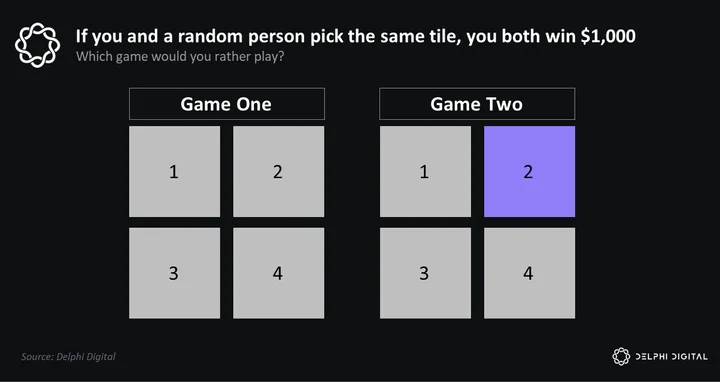
The key idea behind shelling points is that in the absence of explicit coordination, people tend to rely on shared knowledge, common sense, and social norms to make decisions. These decisions are often influenced by salient features, cultural conventions, or focal points that make certain choices more prominent than others. Of course, salience, like beauty, lies in the eye of the beholder.
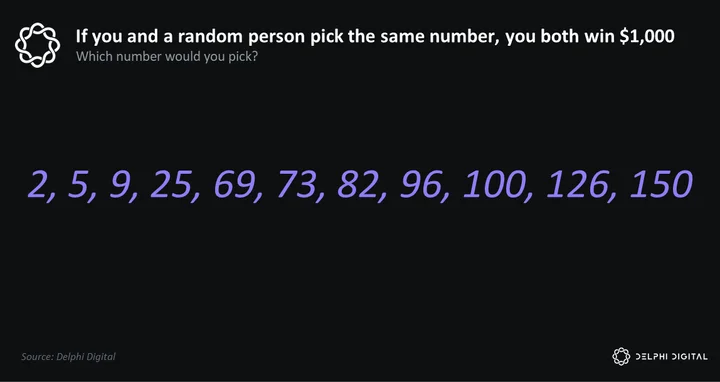
David Friedberg writes:
“Two people are separately confronted with the list of numbers [2, 5, 9, 25, 69, 73, 82, 96, 100, 126, 150 ] and offered a reward if they independently choose the same number. If the two are mathematicians, it is likely they will both choose 2 – the only even prime. Non-mathematicians are likely to choose 100 – a number which seems, to the mathematicians, no more unique than the other two exact squares. Illiterates might agree on 69 because of its peculiar symmetry – as would, for a different reason, those whose interest in numbers is more prurient than mathematical.”
Evidently, most people are not mathematicians and thus overlook the fact that “2” is the only even prime number in the series. And that’s okay! Diversity is a beautiful thing — it’s what makes a market.
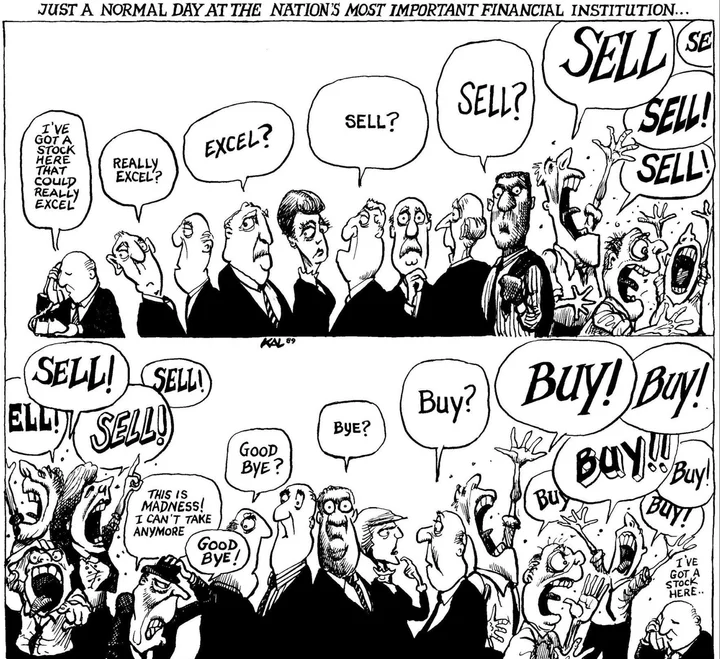 Markets are filled with divergent opinions, which makes for a messy affair. And that’s because humans are in the loop — and humans run on vibes, not numbers. So while academics speak of Schelling points, we usually just say: narratives.
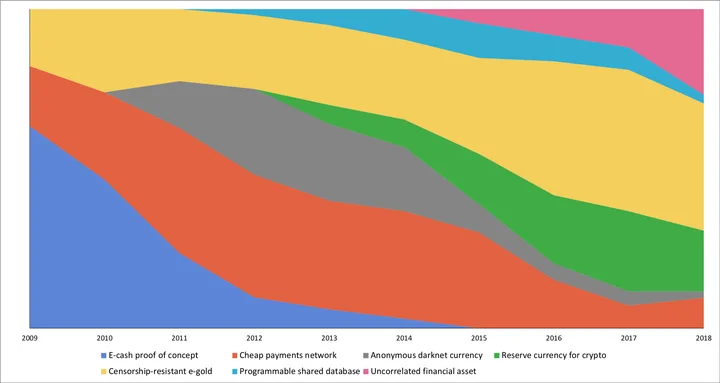
Nic Carter’s Visions of Bitcoin
Narratives are meeting places for minds. They are how we make sense of our confusing, intimidating, and seemingly random world. Humans have been inventing narratives since at least the time of ancient Greece. Back then, the Greeks literally ascribed the change of seasons to a jealous husband. The alternative is to admit that much of the world is run by math — math that, in many cases, lies beyond our comprehension.

We know the double-slit experiment exists, but we don’t know why
In practice, narratives allow individuals to find common cause, band together, and exert a “greater than the sum of their parts” force on the market. Here, the Gamestonk saga is instructive. Individually, Gamestonk investors stood no chance against the mighty Melvin Capital and the “evil short sellers.” But collectively, they overpowered the institutions and, indeed, moved the market. And unlike our earlier example of meeting a friend in New York without a phone — in the real world, people are constantly connected, which makes converging on Schelling points or narratives easier today than at any point in history.
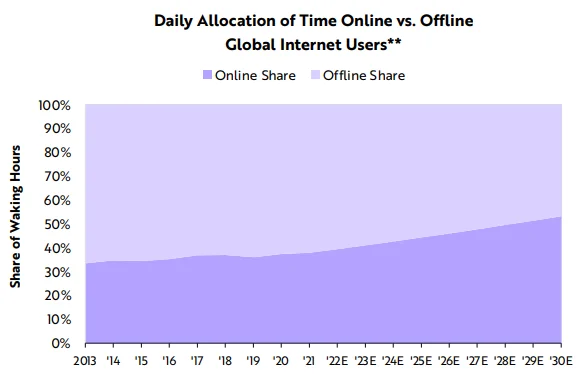
ARK Invest
However, just because narratives are, like, super important and stuff, doesn’t mean they actually matter all the time. In markets, narratives only matter sometimes. If you were a tech investor post-dot com bubble, no number of utopia-infused blog posts or viral threadboi “mental models” on Twitter would have saved you from the market’s 16-year wrath.
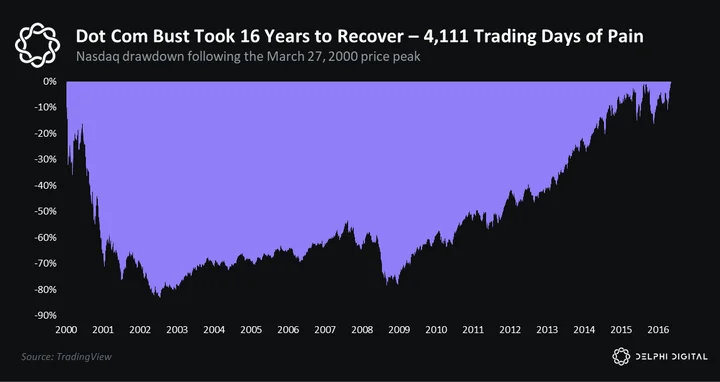
Meanwhile, if your first day as a tech stonk investor happened to be in 2016 — surprise! — you’re a genius. Every narrative you touch turns to gold. You can work at any fund you want. Life is good.
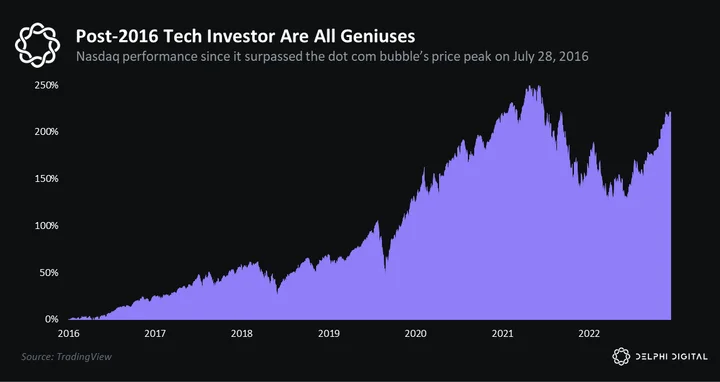
Here, an old aphorism rings true: “some [tech stonk investors] are born on third base and go through life thinking they hit a triple.” The truth is, investing comes down to a bit of luck, err, timing. Unless, of course, your name is Stanley Druckenmiller — the macro GOAT himself, who’s never had a down year — you probably depend on a few big things going your way. 2000s-era tech investors offer a cautionary tale. Many were sitting on future trillion-dollar category winners but didn’t know it for years — long after they puked the stonk and turned full-time bird app influencers.
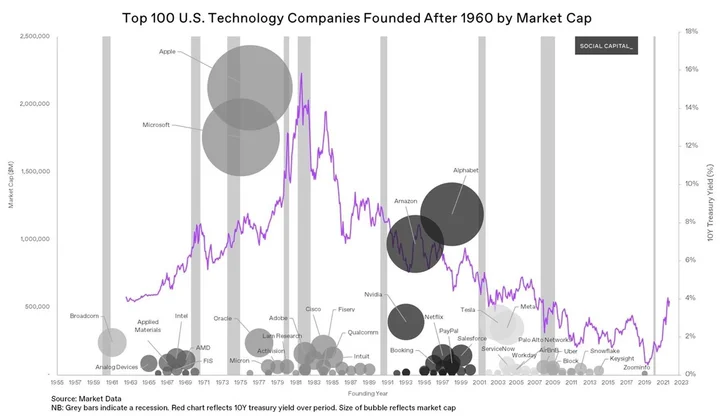
Realistically, how many people held AMZN in the early 2000s during its >90% drawdown? It was a soul-crushing span, one we couldn’t help but notice looks awfully similar to an emerging market we all know and love.
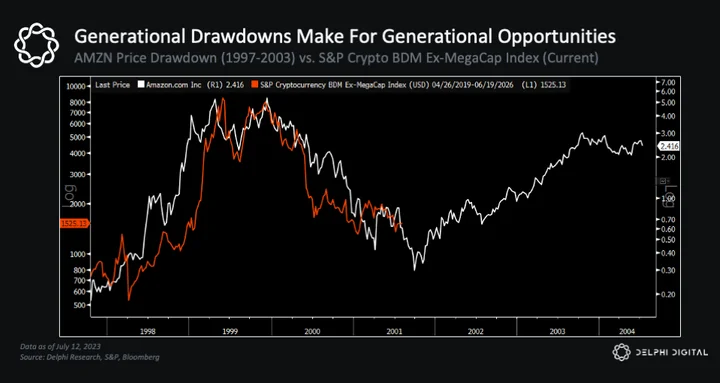 Much of the game comes down to correctly identifying big, secular trends dictated by “heavyweight narratives.” By heavyweight narrative, we mean top-down, structural forces that are absolutely inescapable across asset classes. Examples include thangs like Fed liquidity cycles…
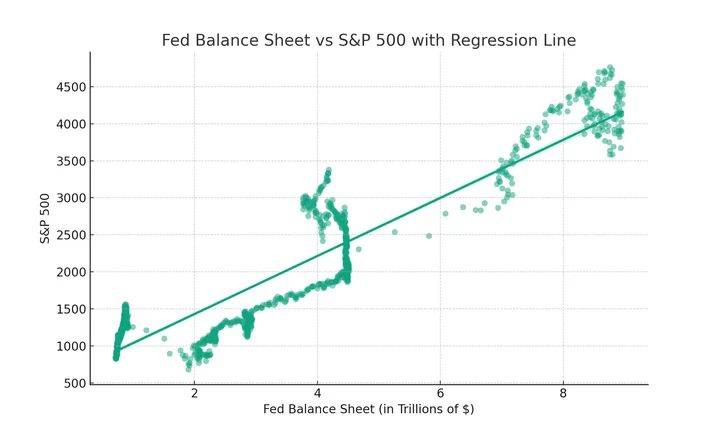
Don’t fight the Fed; its r = 0.923 is bigger than your “r,” anon. TradingView +chatGPT Code Interpreter.
Or war…
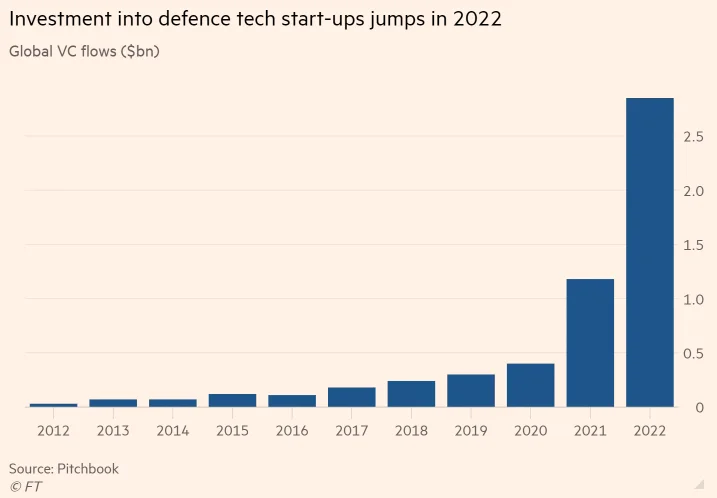
It took the largest war since WWII to remind Silicon Valley that defense tech is a thing. Financial Times.
Or even new government policies…
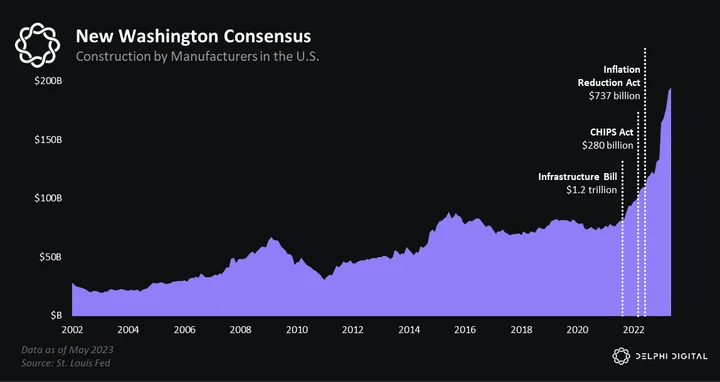 The list goes on, but the point remains the same — fighting heavyweight narratives is hard! And usually unprofitable, as crypto investors learned in 2022 when the industry collided with all three heavyweight narratives listed above — global CBs, war, and political persecution.
This kind of environment is suffocating — no lightweight narrative, no matter how salient, can survive in this climate. Lightweight narratives, which we’ll cover in the back half of this report, only thrive when the heavyweights aren’t actively trying to crush them.
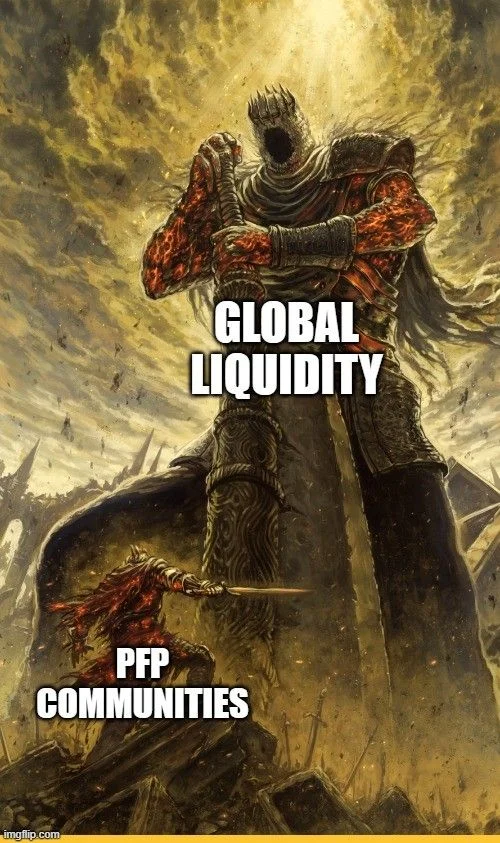
The remainder of this report will highlight how two heavyweight narratives — government policy and global liquidity — created huge headwinds in 2022; but now appear to be bottoming and potentially flipping to tailwinds. We’ll also discuss the subtle through-lines between the two, a dynamic we believe is underappreciated. Finally, in the back half of the report, we will discuss how to play the reverse of these heavyweight narratives via their lightweight cousins. So without further ado, let’s dive in.
Heavyweight Narrative #1 – Government Intervention
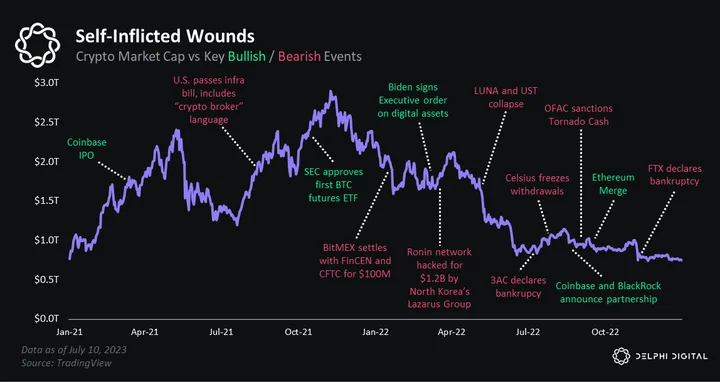
We start by turning our attention to perhaps the most consequential long-term heavyweight narrative with which crypto must contend: government intervention. Over the past two years, the relationship between crypto and the U.S. government has been contentious, to say the least. We give yee ole U.S.G. some well-deserved flak later on in this piece, but it’s worth acknowledging upfront that the crypto industry did little to stay in the government’s good graces over this period. The emotional rollercoaster below is probably all too familiar.
 Less familiar, and far more under the radar to most non-crypto investors, has been the bureaucratic actions taken by parts of the U.S. government against crypto. Collectively, this has been dubbed: Operation Choke Point.
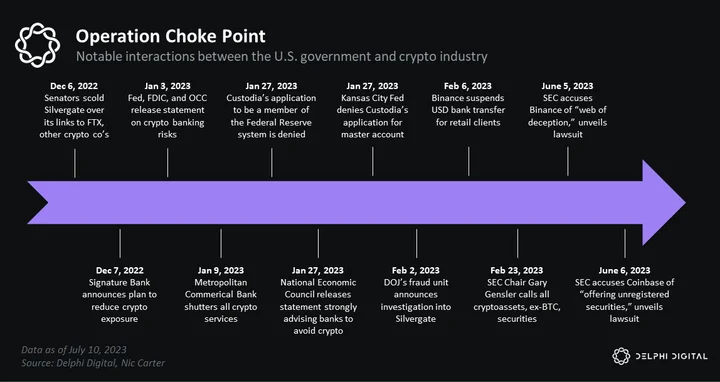 Nic Carter writes:
“What began as a trickle is now a flood: the U.S. government is using the banking sector to organize a sophisticated, widespread crackdown against the crypto industry. And the administration’s efforts are no secret: they’re expressed plainly in memos, regulatory guidance, and blog posts. However, the breadth
Read the full report
This report is part of Delphi Pro.
- 800+ Pro reports across every major sector
- Talk directly with our analysts
- Private community of funds and builders
Already a Pro member? Log in
0 Comments