The Recent Events
Lately, it seems like everyone on CT has turned bullish on $TIA. Naturally, that aroused my curiosity. Why is this happening? Is it just a coordinated cabal? Or are we witnessing the second wave of the modular thesis taking hold? Maybe both?
I’m still skeptical of the overly bullish takes painting the perfect Celestia outcome, but I’ll admit there’s a legitimate thesis to play here. So let’s revisit the facts.
$TIA is the business model, Celestia is the cool infra. That distinction matters.
That being said, I think Celestia is shipping, fast. zk accounts, interchain messaging, enshrined DAS, lazybridging… It’s basically Ethereum’s five-year roadmap, but live today: Short block times, big blocks without compromising decentralization, toaster-friendly light clients, SSF, low validator requirements. From a technical roadmap perspective, Celestia looks like the future.
But this isn’t a tech report. The real question is: Does any of this matter economically?
Throughout this report, we’ll analyze Celestia through the lens of both its business model and the core tech it enables. But since this often gets glossed over, let me say it upfront: For me, Celestia’s success doesn’t guarantee $TIA’s success. But $TIA can’t succeed unless Celestia does.
It’s the same million-dollar question CT has debated for years: Can Ethereum succeed even if $ETH does not?
I don’t know about ETH, but for Celestia, my answer is: Yes, but it’s nuanced.
Given this, just keep the following statement in mind as you read the report: Celestia ≠ $TIA. And good tech ≠ good business model.
Celestia isn’t fighting to be an execution platform, it’s fighting to become the bandwidth layer. It wants to be to L2s what AWS is to websites: fast, invisible, and everywhere.
That’s the whole $TIA bull case. If appchains go modular and scale independently, Celestia becomes their DA substrate, and $TIA becomes valuable by proxy. Not because users hold it, but because networks depend on it.
But there’s a catch.
Infrastructure only matters if it’s used. Celestia has the tech, but it doesn’t have traction, not yet. What it has is subsidized fees, ghost rollups, and a token that’s currently backed more by narrative and future expectations than real demand.
So this report asks one thing:
Can $TIA capture sustainable value in a market that doesn’t care who stores the data, as long as it’s cheap?
The Upcoming Upgrades / The DA Big Picture
Celestia’s roadmap looks impressive on paper: zk accounts, interchain accounts (ICA), packet forwarding middleware (PFM), enshrined DAS. But none of these features matter unless they lead to real usage.
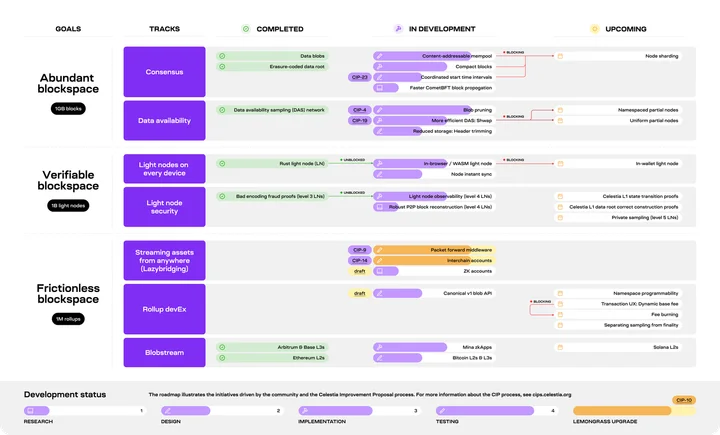
ZK accounts allow trust-minimized withdrawal verification from rollups, making Celestia more like an enshrined zkVM in Ethereum’s roadmap, and it removes the need for multisigs securing billions.
1GB blocks: While current blocks are capped well below 1GB, the long-term roadmap targets 1GB blocks. This would make Celestia the highest-throughput DA layer in the market by a wide margin. That’s a key unlock. If execution becomes cheap through zkVMs or fraud proofs, DA becomes the real bottleneck. Scaling it to 1GB+ is a direct bet on that future.
ICA and PFM improve interop in a Cosmos-style architecture, enabling actions and data routing between chains. This has the potential to turn Celestia into more than just passive DA storage, it could become a fast coordination layer between rollups.
Enshrined DAS is probably the most meaningful but boring one, as no one really cares. It improves light client usability, and embeds data availability sampling into consensus.
Celestia is what Ethereum wants to be in five years. But without usage, it’s just shipping into the void.
Celestia vs Ethereum: The Cold DA War
Ethereum is just refusing to play the DA game aggressively. Blobs are capped at 3/block currently, with plans to increase them to 6/9 in the next hardfork. Throughput is deliberately throttled to maintain decentralization.
Celestia offers bandwidth at scale. Ethereum DA is saturated by design and, of course, by social choice. Opposite to Celestia, in Ethereum, fees fluctuate with blobs demand, but the supply ceiling is hardcoded. Celestia, in contrast, plans to push out 1GB blocks, even if they’re filled with spam.
This distinction isn’t who stores more, it’s who’s optimized for scale. Ethereum defends scarcity (for now), while Celestia wants blockspace abundance.
Most of Celestia’s data is Eclipse spam, and no real economic activity is happening, for now.
The question is whether that cheap scale eventually attracts the right kind of demand, not just tapping games, but real applications. Until then, it’s all just potential.
DA Metrics
Most DA metrics are theater, to be honest. DA is hard to fairly measure, as there’s no holistic metric to analyze, because most data can be gamed and be artificially inflated (with spam, fake usage): data posted, fees paid, fees per MB.. they don’t show us the big picture, just snapshots.
Right now, Celestia leads data posted market-share over Ethereum with 90%. But out of that, it’s 90% Eclipse, which is spammed with a tapping game… that’s why I’m saying it’s easily gamed as DA fees are subsidized nowadays as Celestia fees are almost free ($0.06/MB)
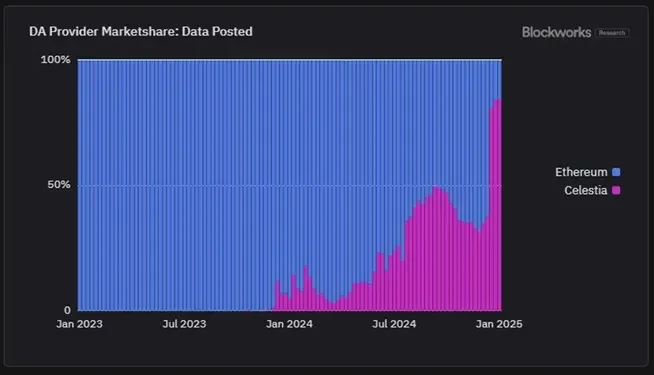
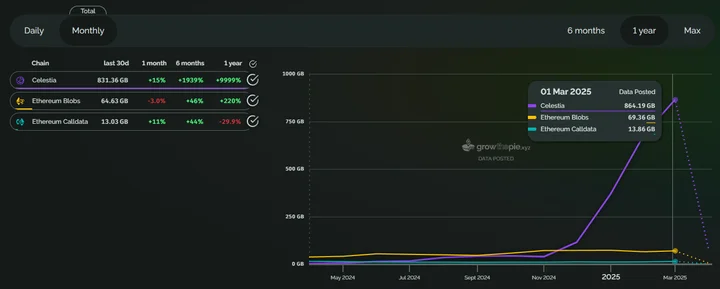
Ethereum’s blob usage is real, but it’s capped, and that’s why they can charge real DA pricing based on demand. Celestia’s blob usage is inflated, but it’s unlimited.
But, at the end, if data posted in Celestia is mostly spam and no real apps but it contributes a meaningful revenue paid with $TIA to Celestia, who cares? As long as it’s translated into revenue, it’ll be valid. But nowadays, this is not the case, and they have to subsidize fees to prioritize growth over revenue.
TVS (Total Value Secured) is a useful metric as it shows how much value is secured by a DA layer, so it can be interpreted as actual economic reliance on a network, not just marketing. Ethereum secures ~$29B, while Celestia secures $483M.
But as any other metric, it is not perfect because (1) It does not measure activity, since a rollup posting data to a DA layer with $50M TVL might have near-zero users or volume, (2) If a low-liquidity rollup (e.g. Manta Pacific) posts a token with artificially inflated TVL (e.g. valueless bridged assets), TVS goes up, but it’s not real economic weight, and (3) It does not give us the big picture as it can be heavily skewed by a single protocol as in the Eclipse case with the tapping game.
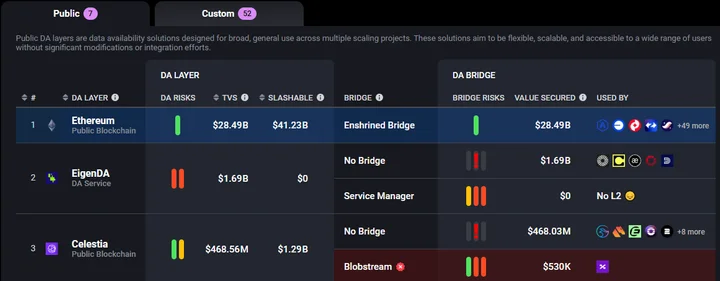
Are rollups using Celestia? Kinda, they have mostly just announced integrations: Initia, Movement, and Abstract migration, but they are not live yet.
Which ones are live? Eclipse, Manta, and Derive are the most significant ones, though none of them have blobstream deployed, which is the bridge that lets the originator chain natively verify that data was actually posted in Celestia. The only one with blobstream implemented so far is RARI, which only holds <550k TVL.
$TIA: Bull and Bear Cases
Let’s analyze the $TIA bull and bear cases point by point. I promise to try to be as objective as a human can be.
Bull Case
- Rollups need cheap, scalable DA.
Ethereum is saturated and blobs are capped, it’s politically messy with no coordination and will always run behind rollups’ blobs demand. Fees are volatile, and throughput is throttled to preserve decentralization. If you’re building a high-volume appchain (games, DePIN, social, micro-payments), Ethereum is expensive and slow to scale, hence does not fit your needs. Celestia’s value prop is: “We already scaled the L1. You don’t have to wait, come and use as much blockspace as you need”.
Through DAS and 1GB blocks, Celestia will offer horizontal scalability that no other L1 or DA provider matches. Even if Ethereum increases blob count and gets cheaper short term, they’ll just get re-saturated shortly after as rollups want to offer users higher throughput and lower fees.
So Ethereum is stuck in a dilemma: increasing blobs puts more resource pressure on nodes, reducing decentralization (which goes against Ethereum’s ethos).
If they don’t increase blobs, new rollups will opt for altDAs that better meet their needs, and possibly even existing rollups could switch over to cut costs and boost throughput.
Ethereum will al
Read the full report
This report is part of Delphi Pro.
- 800+ Pro reports across every major sector
- Talk directly with our analysts
- Private community of funds and builders
Already a Pro member? Log in
0 Comments