
Report Summary
Valuation Crash & Overhype in Crypto AI Agents
-
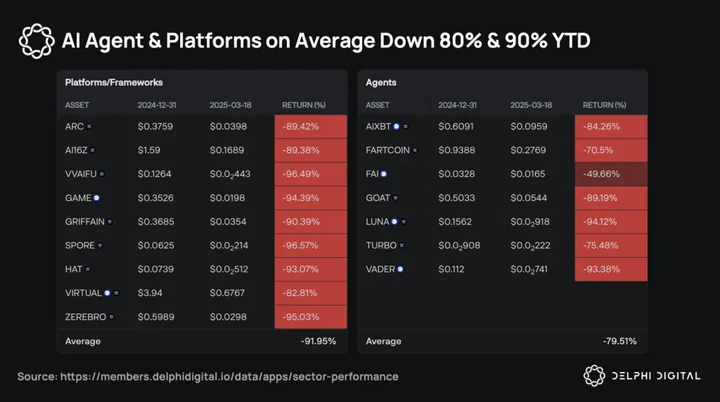
AI agent and platform token valuations have collapsed: ~80% drop for agent tokens, ~90% for platforms/frameworks since Jan 2025.
-
Most crypto-native AI agents were gimmicky wrappers with little real utility—“reply bro” agents rather than functional ones.
-
The broader, non-crypto AI agent landscape is much more utility-driven, with agents built for productivity, research, security, and more.
Limitations of Single-Agent Systems
-
Single agents struggle with multi-step decision-making, context management, and coordination.
-
To achieve real-world utility (e.g., an autonomous hedge fund), specialized agents must collaborate—requiring shared context and structured communication.
Covalent’s Infrastructure & MCP Integration
-
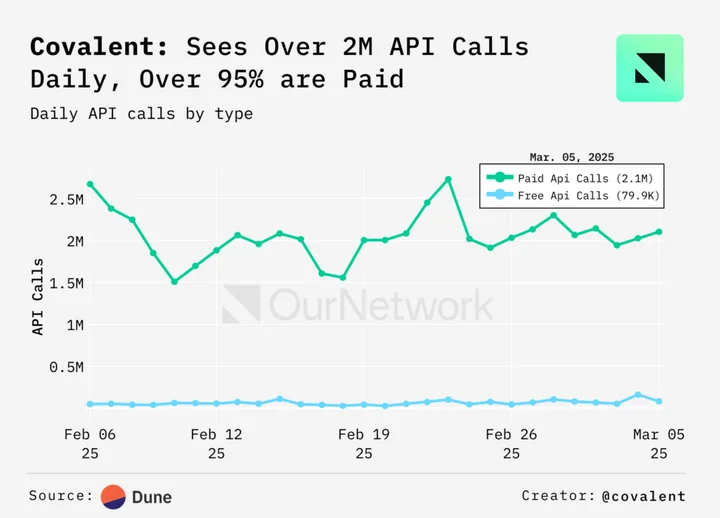
Covalent has indexed over 100 chains and serves ~2M API calls/day (95% paid).
-
Their flagship product, GoldRush, delivers structured, multi-chain blockchain data through a unified API.
-
Covalent’s Ethereum Wayback Machine (EWM) ensures long-term historical data availability.
-
They’ve launched GoldRush MCP Server to bridge AI agents and blockchain data using the Model Context Protocol (MCP).
Real-Time Streaming is the Future
-
With block times dropping to milliseconds (e.g., MegaETH at 10ms), agents must operate on real-time data.
-
Covalent added real-time streaming to MCP, giving agents a performance edge in latency-sensitive use cases like arbitrage.
From Automation to Agency: CoT, MAS, MCP
-
Chain-of-Thought (CoT) models allow agents to reason and verify step-by-step, instead of blindly automating.
-
Multi-Agent Systems (MAS) enable task specialization and collaboration.
-
MCP allows agents to access shared, consistent context—crucial for coherent workflows and avoiding hallucinations.
Zero-Employee Enterprises (ZEEs)
-
ZEEs are autonomous organizations powered by a swarm of collaborative AI agents using CoT + MAS + MCP.
-
AI Agent SDK (v0.2.0) enables ZEEs to:
-
Plan tasks (Planner Agent)
-
Dispatch them (Router Agent)
-
Execute via specialized agents (Primary, Support, Task Agents)
-
-
These agents operate on real-time, multi-chain data and invoke tools programmatically, with context-aware workflows.
Tools & Data as Competitive Moats
-
The effectiveness of a ZEE depends on the quality of tools and datasets it can access.
-
Verifiable operations and private coordination are enabled via TEEs, ZK, FHE, MPC, etc.
-
Use cases extend beyond crypto into areas like healthcare, biotech, and secure data processing.
ZEE Use Cases
-
Cross-Chain Arbitrage: Agents monitor and exploit price differences across chains.
-
DeFi Lending Optimizer: Agents dynamically reallocate capital based on yield and risk.
-
Portfolio Manager: Multi-agent systems manage and optimize DeFi yield strategies.
-
DevX Agent: Developer assistants analyze on-chain behavior and suggest product improvements.
-
Spam Token Detection: Covalent’s 10M+ spam token list can help agents flag malicious assets in real-time.
Conclusion
-
Most crypto AI agent projects lacked real use cases—hype without depth.
-
Covalent and ZEEs point to a more pragmatic, utility-first future for AI x crypto.
-
With CoT, MAS, MCP, and real-time data access, ZEEs could redefine work, on-chain coordination, and multi-agent AI systems.
-
State of AI Agents
The decline in AI agent and platform valuations have been stark since their peak. We are down 80% on AI agent tokens and 90% on platform/framework tokens on average since January 2025. In all honesty, this was no surprise. We noted in January that most of what we’re seeing in the crypto AI agents space were just gimmicky wrappers and reply bro agents.
The world of agents beyond crypto is much larger and more utility-driven. AI agents in crypto will be a fraction of the overall AI agent market/mind share that includes a dozen niches outside of crypto, like productivity/personal assistants, sales, research, security, coding, and more. And unlike most popular crypto AI agents, they are rooted in utility, even if some of them are just GPT wrappers. Most standalone agents today are built around single-step automation, making them ill-equipped to manage complex contexts, effective communication, and multi-step decision-making processes.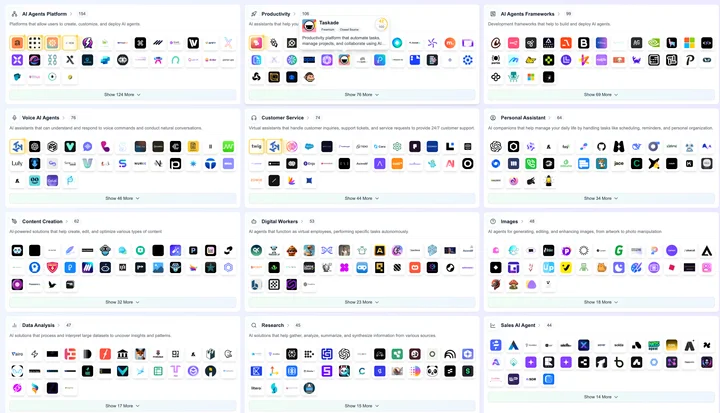
https://aiagentsdirectory.com/landscape
Limitations of Single-Agent Approaches
We need agentic systems deeply rooted in utility, and until AGI becomes fully capable, we should prioritize building agents optimized for maximum functionality and practical use. In our use of models, we’ve realized that standalone agents are good for specific tasks but fail to perform multi-step processes. But that is exactly where the real value lies. Why is this the case? To understand why this limitation matters, imagine creating an autonomous hedge fund.
What if we could have an autonomous hedge fund that trades across equities, crypto, and even commodities? You’d need one set of agents that source and curate alpha, another set of agents to execute trades by reasoning about the best routing algorithm, another set of agents to manage treasury and operations, and others to act as legal counsel and so on. What you have here is agents specializing in what they do best. Each of them would have varying architecture, models, and tokens. If this dream team hedge fund were to be truly operational, these agents would have to collaborate.
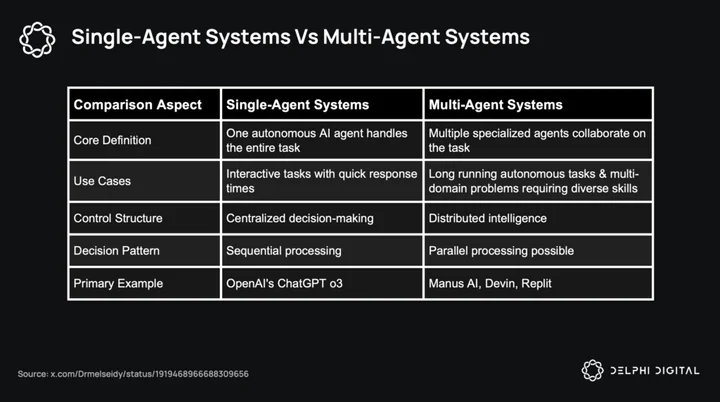
But the catch is that these agents would lose context, hallucinate, and lose track of who is doing what, and eventually fail to operate. That is where multi-agent frameworks, Model Context Protocol (MCP), and CoT (Chain of Thought) models come into the picture with ZEEs.
About Covalent
Before we dive into ZEEs, let’s talk about Covalent. They’ve scaled their indexing capabilities since 2020 to over 100 chains and have all major and emerging chains indexed. For the last year, Covalent API has been averaging 2M API calls daily, with over 95% of them being paid calls.
Covalent’s GoldRush is its flagship product, providing comprehensive, indexed blockchain data across multiple chains through a unified API. GoldRush offers structured access to wallet, transaction, and token data at scale, enabling developers to build sophisticated applications without dealing with the complexities of raw blockchain data.
To solve for long-term data availability, Covalent created the EWM (Ethereum Wayback Machine). It brings a verifiable method of accessing Ethereum’s historical transaction data. It consists of two core components, Block Specimen Producer (BSP) for extracting provable transaction data, and Block Results Producer (BRP) for re-executing transactions, providing reliable archival data without depending on RPC providers.
Covalent is now extending GoldRush’s capabilities with the GoldRush MCP Server, an open-source implementation of the Model Context Protocol. This server acts as a bridge between their indexed data and agent systems.
Real-Time Streaming: The Next Frontier
Blockchains are trending toward real-time operations. Blocks are now available in subsecond timeframes. MegaETH at 10ms, Base’s Flashblocks (250ms), Sui, Aptos (0.15ms). Traditional indexing solutions simply can’t keep pace and will inevitably fall behind.
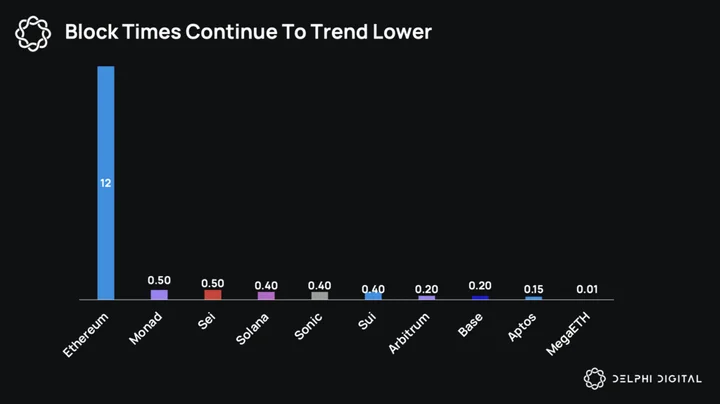
Covalent has added a real-time data streaming feature to its MCP. This allows Agents to operate on hot, streaming data without indexing delays and unlocks real-time possibilities.
The future of onchain agents is real-time. AI agents that rely on stale, indexed data will operate at a severe disadvantage compared to those leveraging streaming information flows. This is particularly evident in use cases like cross-chain arbitrage, where millisecond advantages translate directly to performance outcomes.
We will learn more about how Covalent’s data products tie in with ZEEs in the following sections.
From Automation to True Agency with MCP, CoT and MAS
Chain-of-Thought (CoT) models enable AI systems to break down complex problems into smaller steps, allowing each step to be verified before the final decision is made. This means an AI can reason over a problem in a way that is similar to human thought: it plans, verifies, and adjusts its approach if something doesn’t add up. When these CoT models are integrated into multi-agent systems (MAS), each agent not only performs a specific task but also carries its own internal reasoning process. This setup enables agents to push back against flawed inputs or unexpected results, rather than merely following simple automated instructions.
Even if agents can reason, they still lack reliable and consistent access to data or context. Without structured data and context, agents are as good as blind. This is where MCP comes into the picture.
MCP is a standardized method for AI models to access, process, and share contextual information without needing to train on new data. By integrating MCP with their GoldRush API, Covalent has created a unified protocol that enables agents to:
- Access consistent, structured blockchain data across multiple chains
- Share context between specialized agents without information loss
- Build a verifiable “smemory” that reduces hallucinations and ensures factual accuracy
- Maintain coherent reasoning across complex, multi-step operations
This setup helps agents push back against flawed inputs or unexpected results instead of merely following simple automated instructions. This is where we arrive at systems that have agency and reasoning and can push back versus a system that solely automates tasks.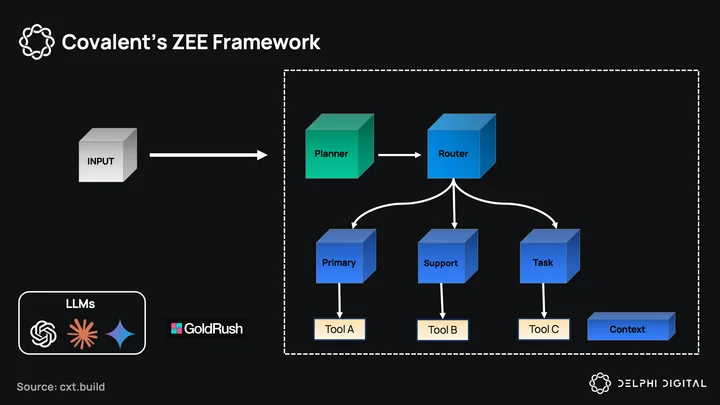
Covalent’s AI Agent SDK helps create ZEEs or Zero Employee Enterprises that leverage CoT, MCP, and a Multi-Agent System.
The next meta of onchain AI agents will be multi-agent systems.
Currently, a single agent takes inputs, performs actions, and expresses outputs (usually on Twitter).
Multi-agent systems enable AI agents to “spawn” other AI agents that specialize & communicate with each other. pic.twitter.com/rIYGxXu1Rn
— Jarrod Watts (@jarrodWattsDev) December 12, 2024
How ZEEs Leverage CoT, MCP, MAS for Autonomous Operations
ZEEs (Zero-Employee Enterprises) are built on the idea that a carefully orchestrated swarm of AI agents, each empowered by chain-of-thought (CoT) reasoning and designed for specialized tasks, can collectively complete complex, multi-step tasks with little to no human intervention.
Their AI Agent SDK (v0.2.0) leverages CoT models that “think” step by step, breaking down complex tasks into a series of intermediate reasoning steps. This built-in reasoning allows each agent to verify and refine its approach before delivering a final output, ensuring higher accuracy and resilience in decision-making.
At the same time, a multi-agent system framework enables agents to collaborate seamlessly. In a ZEE, different agents might be assigned roles such as managing trades, curating alpha, or handling cross-chain operations. Each agent specializes in its function while sharing a common pool of highly structured, verifiable blockchain data (via Covalent’s GoldRush APIs). This is quite a handy synergy that allows ZEE agents to leverage on-chain data across several chains with a single API.
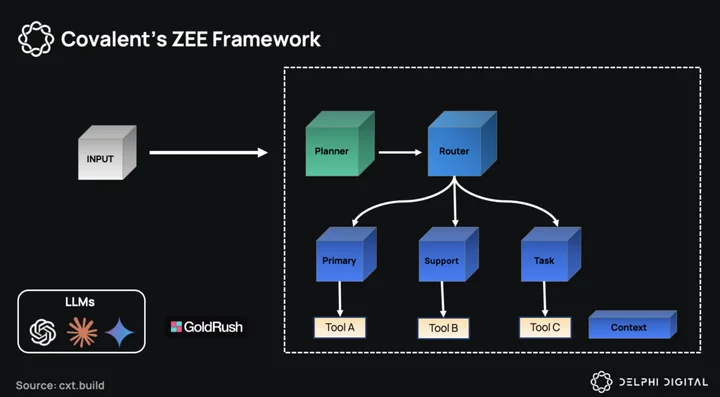
Detailed Breakdown of a ZEE Workflow
Input and Language Models
The workflow starts when some kind of request or data arrives (for example, a query, a business task, or a set of instructions). This input could come from a user, another system, or a scheduled process.
Each agent in this system uses LLMs (OpenAI, Google, or Anthropic) to parse instructions, generate text, and reason through chain‐of‐thought steps. The choice of LLM may depend on cost, performance, or domain specialization.
Planner Agent
The Planner Agent is responsible for taking the raw input and turning it into a structured plan. It analyzes the request, breaks it down into smaller subtasks, and figures out the logical sequence of actions needed to fulfill the user’s or system’s goals. Because it has chain‐of‐thought reasoning, the Planner can produce a stepwise outline of how to solve the problem.
The Planner’s output typically includes a high‐level blueprint: “Which tasks need to be done?” and “In what order should they be tackled?” It then passes this plan downstream to the router agent.
Router Agent
The Router Agent receives the plan from the Planner Agent and decides which specialized agent should handle each subtask. It acts as a dispatcher, matching each part of the plan to the agent(s) best suited to carry it out.
The Router Agent may look at agent capabilities (e.g., “This agent is good at executing trades, that agent is good at sourcing alpha etc.”). It also keeps track of the overall workflow state. Once tasks are assigned, it monitors completion and can re‐route tasks if necessary.
Primary Agent, Support Agent, and Task Agent
Each agent in the workflow has a distinct role: Primary Agent oversees core operations (such as finalizing transactions), leveraging specialized tools to carry out domain tasks; Support Agent supplements those efforts by performing additional services (like data cleaning or analytics); and Task Agent tackles specific subtasks (e.g., complex data transformations or bridging across systems). The Task Agent can also handle multiple requests in parallel, ensuring that specialized tasks are executed efficiently.
The Task Agent can spin up multiple parallel tasks or handle requests in a queue, depending on the system design.
Tools, Context with MCP
Each specialized agent uses domain‐specific tools or APIs to accomplish tasks. These could be:
- Tool A: On‐chain data ingestion library or transaction execution.
- Tool B: Data analytics library or ML pipeline.
- Tool C: Some bridging or cross‐chain modules.
- Tool D: Additional transformations, code generation, or custom business logic.
Tools are invoked programmatically by the agent’s chain‐of‐thought reasoning. The agent decides, “I need to call Tool A with these parameters,” or “Now I should use Tool D to finalize an NFT mint,” etc.
Then, most importantly, context is the shared knowledge or state that each agent can access. The context can store partial results, logs, or relevant environment variables so that each agent knows the bigger picture. With MCP, these specialized agents form a coherent workflow, communicating transparently and using shared context to avoid confusion and errors.
Tools & Datasets as Moats
A ZEE can only be as good as the tools and data it has made available for its agents to rely on. In practical terms, this means that the quality, exclusivity, and depth of datasets and tools directly impact the effectiveness and accuracy of an agent’s decision-making process and output.
Access to quality data sets across niches, whether it is off-chain data such as real-world price info, user-specific data, other industry-specific data sets (healthcare, biotech, access control, security, etc), high-quality, structured, on-chain indexed through Covalent’s GoldRush APIs—enables agents to consistently generate actionable insights, accurately model risks, and rapidly adapt strategies based on market conditions and function across chains.
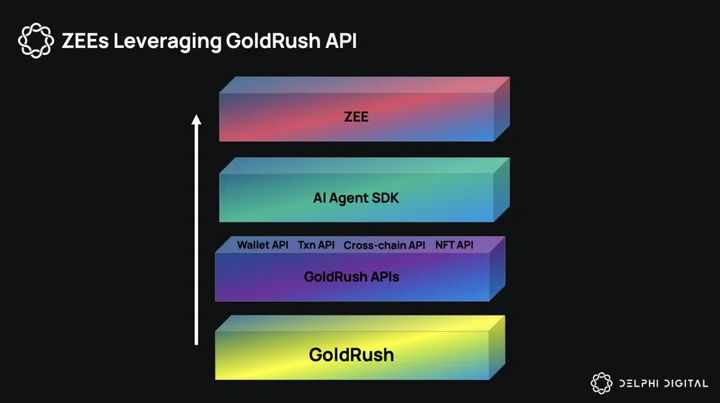
Tools can enable ZEEs to be verifiable and have increased functionality.
We have several cryptographic methods such as TEEs, ZK, FHE, and MPC that may help with verifiable/private operations. If the goal is to have the agent execute on behalf of the user, we’d also need some provable way to present users to the agent and agents to the users. That’s where zkTLS (Opacity), PoH from World, and other mechanisms that help verify a real human vs an agent come into the picture.
These tools may also enable private shared states. Agents would also have to collaborate over shared private states if we’re going to see continued unlocks for what agents can do. This is where programmable cryptography comes into the picture again. We have teams leveraging MPC, FHE, Garbled circuits, and other methods to enable coordination over shared-private state. The scope for this market extends beyond crypto into industries such as healthcare, with drug discovery and precision medicine, where models could work using private healthcare data coming from institutions and patients/retail. Inco Network, Seismic Systems, Gateway, and Nillion are some teams pushing on this front.
ZEE Use Cases
Cross-Chain Arbitrage Finder
In a ZEE framework, specialized agents collaborate to identify and exploit price discrepancies of digital assets across various blockchain networks. Monitoring agents continuously track asset prices on different exchanges, detection agents analyze these prices to spot arbitrage opportunities, and execution agents promptly carry out cross-chain transactions to capitalize on these discrepancies.
DeFi Lending Optimizer
A ZEE can optimize lending strategies within DeFi platforms by deploying a network of autonomous agents. Monitoring agents assess interest rates and lending terms across multiple chains, analysis agents evaluate risk factors and potential returns, and execution agents reallocate assets to maximize yields while maintaining acceptable risk levels. A multi-agent framework such as this allows lending strategies to be dynamically adjusted based on market conditions.
DeFi Investment Agent: Automated Portfolio Manager for Yield Optimization
Within a ZEE, a suite of specialized agents can manage and optimize a DeFi investment portfolio. Market analysis agents identify lucrative yield farming and staking opportunities across hundreds of protocols across several chains, risk assessment agents evaluate the security and reliability of various DeFi protocols, and allocation agents distribute investments to balance risk and return effectively. With such a framework in place, you have a multi-agent system with continuous portfolio optimization, allowing for real-time responses to market fluctuations and enhancing overall yield.
DevX Agent
A dev-focused “deep research” type agent that sources and learns from on-chain data to help developers understand what kinds of actions users do the most on a certain product (like a DEX, lending, perpetuals protocol), and then another agent takes a developer-centric approach in trying to explain to developers on how they can recreate this for the product they are building.

On a similar note, Covalent open-sourced a list of +10M spam tokens across 6 ecosystems. Now, this of course, can be used by agents to flag warning signs on the user front-end if they’ve come face to face with any of these malicious or worthless tokens or NFTs.
Conclusion
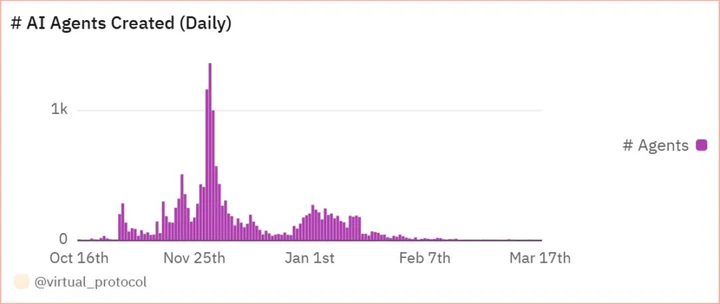
The recent sharp decline in crypto AI agent activity was largely driven by shifting narratives and fading attention, revealing the underlying reality: many crypto-native AI agents were superficial, lacking genuine, utility-driven use cases.
Most of what we see with AI agents in crypto is super frothy, but underneath all of the froth, there is no doubt about the tangible, utility-driven impact AI x Crypto has in store for us.
Covalent with the AI Agent SDK and ZEEs is a step in a more utility-driven direction than just gimmicks and technology just for the sake of it. ZEEs and similar frameworks can potentially change how we go about working as teams, and not just how we interact on-chain.
AI models and their capabilities have been evolving at a rapid pace. Adding no-code AI solutions to the mix, we expect ZEE-like multi-agent systems to augment complex, multi-step processes.
0 Comments