Report Summary
Overview
The report challenges the idea that options are outdated, arguing that crypto options may be the next major frontier for institutional adoption as regulatory clarity, infrastructure, and investor demand align in late 2025.
1. Traditional Options Remain Strong
-
The tradfi options market hit record highs in 2024, processing 3.8 billion contracts in the U.S.
-
Institutional use has surged, driven by structured products, volatility trading, and hedging strategies.
-
The rise of 0DTE (zero days to expiry) options mirrors crypto’s fast-paced, high-leverage culture.
2. Why Crypto Options Previously Failed
-
From 2021–2024, most crypto options DEXs collapsed (Opyn, Hegic, DopeX/Stryke) due to:
-
Regulatory uncertainty
-
Poor capital efficiency
-
Liquidity fragmentation
-
Technical complexity
-
Market correlation issues (death spirals during volatility)
-
-
Deribit, a centralized exchange, survived and still controls ~90% of all crypto options volume.
3. Institutional Dominance in Options
-
Institutions use options mainly for hedging, volatility harvesting, and structured yield products, not short-term speculation.
-
The institutional options market has grown faster than equities trading over the past decade.
-
Crypto’s volatility (3–5× VIX) offers highly profitable opportunities for these same strategies on-chain.
4. Institutional Migration to Crypto Options
-
Crypto derivatives volume reached $9T in 2025, representing ¾ of all crypto trading.
-
Deribit and CME dominate current institutional crypto options trading.
-
71% of institutional investors now hold or plan to hold digital assets.
5. Why Options DEXes Matter
Decentralized options exchanges (DEXs) offer unique institutional advantages:
-
24/7 global trading (vs. limited TradFi hours)
-
Programmable settlement and automation via smart contracts
-
On-chain transparency for audit and compliance
-
Composability with other DeFi protocols for yield and collateralization
-
Self-custody and reduced counterparty risk
-
Improved capital efficiency through innovations like portfolio margining
6. Technical Edge: Pricing & AMM Models
-
Traditional Black-Scholes models fail in crypto’s volatile markets.
-
New models like Kou (for BTC) and Bates (for ETH) better account for jumps and variable volatility.
-
AMM and CLOB innovations (e.g., Lyra’s hybrid architecture, Premia’s hybrid model) now enable institutional-grade precision and risk management.
7. Current Leading Players
a. Derive (formerly Lyra) – The leading decentralized options DEX
-
CEX-like performance with portfolio margining and structured products.
-
Integrations with Ethena, Synthetix, GMX, and others.
-
Token: DRV (market cap ~$43.6M, FDV ~$76.6M).
b. Rysk Finance – Focused on structured yield and covered calls
-
Dynamic hedging vault and customizable strategies.
-
Upfront premium payouts and flexible exits.
c. Synquote – RFQ-based options and perps platform
-
Deep liquidity and low slippage for large trades.
-
No token yet but backed by Coinbase Ventures — potential airdrop play.
d. Deribit – Centralized market leader
-
~$1T in 2024 volume; recently integrated stablecoin-settled options.
-
Institutional benchmark for liquidity and execution speed.
e. Kyan (Premia V4) – New CLOB-based hybrid model
-
Unified margining across perps and options.
-
Advanced risk engine and institutional-grade execution.
-
Built to compete head-on with Deribit-level performance.
8. Why 2025 Is the Turning Point
-
Regulatory clarity via GENIUS and CLARITY Acts and SEC–CFTC joint support.
-
DeFi infrastructure (L2s, oracles, margining) now matches TradFi standards.
-
Institutions need better on-chain hedging tools for tokenized assets and RWA markets.
-
The moment parallels the 1973 launch of CBOE options, marking a similar inflection point.
Conclusion
Crypto options are not a relic but a rising institutional frontier.
After years of false starts, regulatory clarity, technological maturity, and institutional appetite have aligned to make 2025 the year decentralized options finally go mainstream.
The next Deribit—or the “volatility layer” of DeFi—will emerge from this wave.-
Options, options, options…
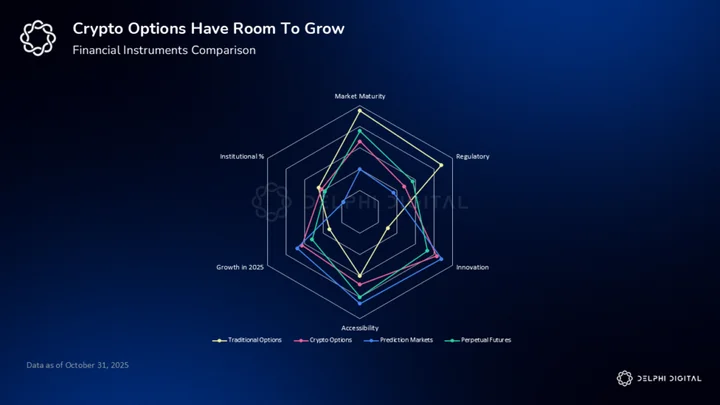
Options have become a sort of “taboo” within the crypto sphere. Time and time again, many protocols and teams have attempted to create a crypto options dex, only to fail and leave investors upset, poorer, and turned off from the instrument altogether. In fact, recently, many have been calling for perpetuals and prediction markets to fully replace options, labeling options as an incumbent dinosaur of financial instruments that will inevitably become a fossil of time.
While not an options trader myself, I understand why options are so powerful and widely used in traditional finance markets, and why they might come to own a significant portion of the pie in crypto as more institutions begin to come on-chain. In fact, the global derivatives market has arrived at an unprecedented crossroad. With more and more institutional capital flowing into digital assets (such as through BlackRock’s Bitcoin ETF), one significant question emerges: Will options be replaced by perps/prediction markets, or are crypto options the most overlooked next frontier of crypto from an institutional upside lens?
Today, my humble degenerate self will attempt to answer that very question. Furthermore, I want to highlight the best areas to look for crypto options, as farming these protocols may very well be far more lucrative than PvPing on the Nth perp dex. But first, we must start by examining why traditional options have been such a resilient, lucrative incumbent in the markets.
A Boomers Tool: The Resiliency of Options with Record Growth
Unprecedented Momentum
The tradfi options market has repeatedly defied calls for its death and decline, achieving its sixth consecutive year of record-breaking volume. In the US, options processed 3.8 billion contracts in 2024, with a daily average volume nearing 15 million contracts, a true testament to the utility of options often overlooked by retail audiences.
That being said, 0DTE options (Zero Days to Expiry) have indeed revolutionized how we trade; these instruments alone account for half of the SP500’s index options volume. This shift towards short-term speculation is a direct mirror of crypto today, with instant gratification 100x perps dominating the space. This massive shift shows the “TikTokification” of financial markets more broadly, a trend in which crypto has always been at the forefront.
Even with a more degenerate crowd becoming naturalized in tradifi, institutional adoption has grown far beyond simple volume metrics. Professional hedge funds and asset managers increasingly use options for their structure and volatility harvesting aspects. The rapid emergence of the prosumer ilk of traders has birthed a hybrid class that requires connecting institutional performance with retail accessibility. With that in mind, it’s no surprise that infrastructure continues to expand, with 18 U.S. options exchanges currently operational and two more on the way. At first glance, one might think that would create fragmentation, but in actuality, it has bred more competition and specialization, leading to better depth/experience in specific niches.
The Curse of Crypto Options
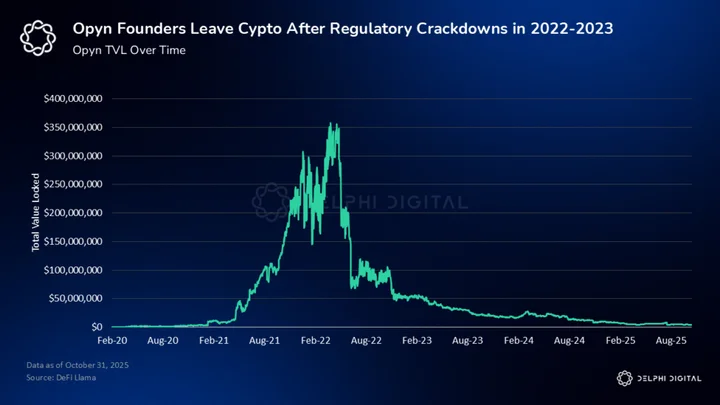
It’s no secret that most CT participants have PTSD about crypto options. From 2021 to 2024, crypto options protocols died quite spectacularly. Opyn died after a CFTC fine of 250k, causing the founders to quit crypto altogether. Hegic lost 80% of its 1 billion TVL, and DopeX narrowly avoided shutdown amidst reports of 26 security vulnerabilities. Meanwhile, CEX-based crypto options like Deribit maintained a 90% market dominance, continuing to process billions in options while Dexes largely imploded one by one. However, this trend is beginning to change. In September of 2025, the SEC and CFTC issued a joint statement enabling spot crypto asset trading on regulated exchanges. This was immediately followed by the beginnings of the GENIUS and CLARITY acts, passing with notable bipartisan support. Additionally, 85% of institutional investors are now signalling intent to allocate towards digital assets.
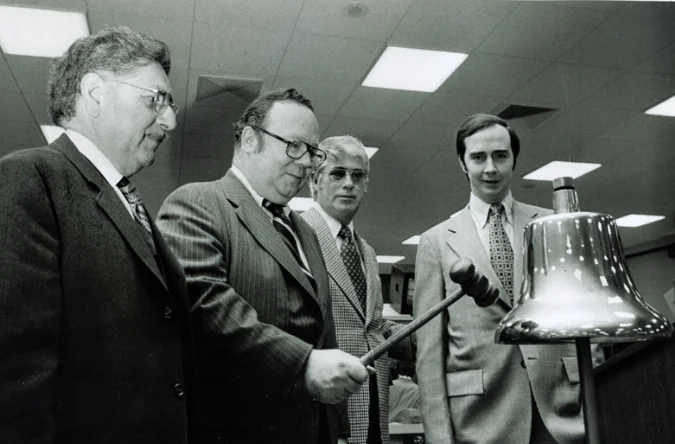
This convergence of regulatory and price catalysts mirrors the events of 1973, when the CBOE first launched standardized options with SEC support and Black-Scholes pricing, a move that has grown from just 20k daily contracts to over 500k SPX options per hour.
Most notably, crypto now has its own Black-Scholes adaptations (called the Kou and Bates models), its robust clearing infrastructure (blockchains/smart contracts), and finally its own regulatory clarity (Bye Gensler).
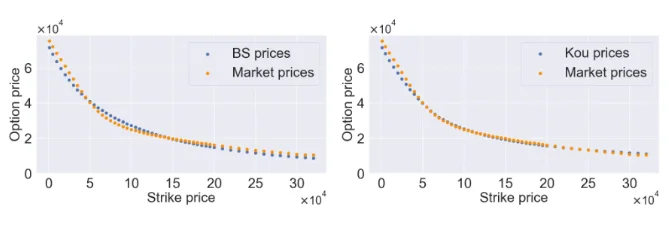
Fantastic research by Julia Kończal showing a comparison between the BS model and Kou adaptations. (Wrocław University of Science and Technology)
Many Options Dex Protocols have spent years trudging and iterating through failures and regulatory blocking to build portfolio margin systems that can match the standard set by their tradfi equivalents. Finally, institutional-grade functionality with DEX transparency for options is here, just like Hyperliquid enabled for perpetuals.
Lessons from the Crypto Options Protocol Graveyard
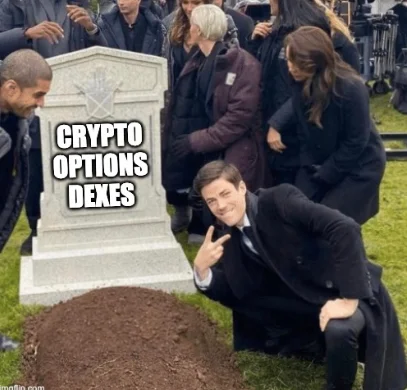
The path to a viable options DEX is littered with skeletons warning of the fundamental challenges in bringing such a complex instrument on-chain. Between January of 2021 and February of 2022, TVL across options dexes lost 24%, individual protocols suffered even worse fates, with some losing over 80% of their peak TVL.
In many cases, platforms were just too early, as regulatory laws had not caught up. For example, Opyn, the leader at the time, got charged by the CFTC in 2023 for operating as an unlicensed derivatives exchange and offering an options product, Squeeth. The CFTC stated that Opyn needed a legal registration as a swap execution facility, which they lacked completely. Opyn attempted to band-aid a solution by geo-blocking restricted IP addresses, but the CFTC wouldn’t budge. Opyn further failed to implement proper KYC/AML under the Bank Secrecy Act, and just two months later, both founders quit crypto entirely, stating: “After the regulatory action against Opyn, we have made the decision that we are leaving crypto. This is honestly really emotional for me and Alexis. We thought we were going to be in crypto for the rest of our lives.”
The technical vulnerabilities that plagued DopeX in 2023 revealed how smart contracts can create potentially catastrophic attack points. An audit from Code4rena uncovered 9 high-severity and 17 medium-severity vulnerabilities across DopeX’s infrastructure. For example, the ReLP slippage calculation used the wrong price quote (RDPX/ETH instead of ETH/RDPX, WOOPS!), which would cause users to receive amounts 8,000x+ less than intended. Additionally, price oracle precision errors assumed 1e^8 precision, whereas the RdpxEthPriceOracle actually returned 1e^18, enabling mass value fluctuations across core contracts. While, thankfully, no major exploit actually materialized, the audit exposed how an options dex requires magnitudes more sophisticated architecture than a simple defi primitive.
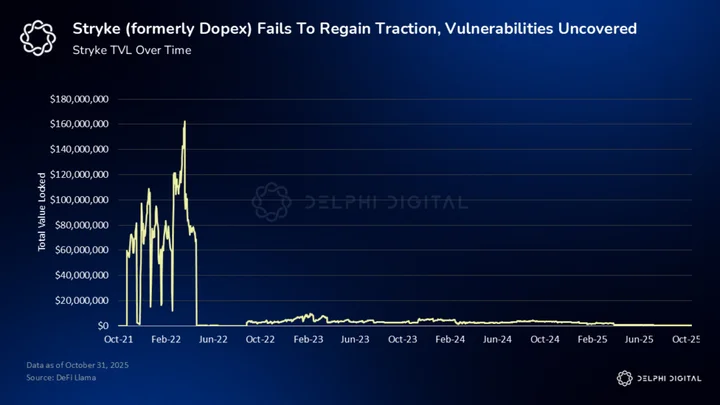 (Dopex rebranded to Stryke)
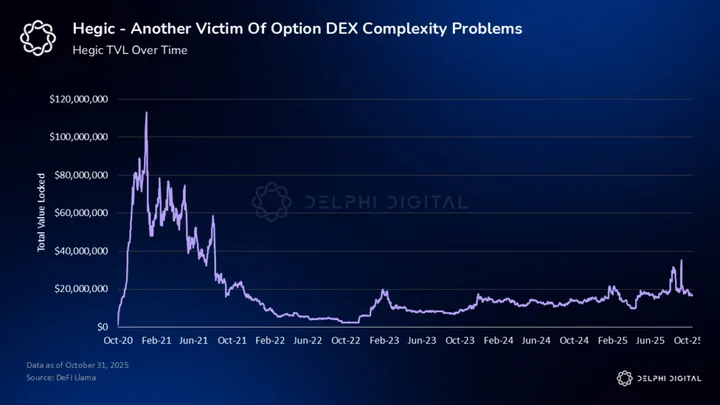
Hegic’s (perhaps one of the very first of this sector) decay illustrates the classic death spiral that options DEXes face during increased market volatility and stress. Hegic’s design exposed LPs to the unlimited risk inherent in options selling, while a further 14-day lockup created an environment that drove LPs to withdraw en masse. Hegic’s manual exercise requirements for all ITM options meant users continually lost profits if they forgot to exercise, which is a major UX disaster for more retail audiences. Ultimately, the ETH crashed from 4800 to 2200 in 2022, causing a cascade of LP withdrawals, highlighting the vicious correlation problem that options protocols face: They are simultaneously most useful and most vulnerable during high volatility.
The core theme of all of these failures, however, is central to the very nature of options:
Options convexity limits the TAM to purely sophisticated prosumers and institutions.
Options are not as attractive a retail product in the same way as perps are; thus, a successful options dex would have to cater primarily to institutional capital.
With that being said, five systemic failure patterns emerge in this graveyard, which any viable future options must address:
- Regulatory uncertainty is an existential risk: although things have continually looked more promising for exchanges in the US, one must still ensure complete compliance, especially when dealing with institutional customers.
- Capital inefficiency creates a structural disadvantage: leverage attracts professional market makers, and to have leverage, one needs enough liquidity.
- Liquidity fragmentation: Having liquidity spread across hundreds of different option types could spread already thin capital to the near breaking point. A single ETH options series may require liquidity for 4 expirations, 10 strikes, and 2 types, totalling 80 instruments.
- Technical complexity: Options pricing requires incredibly sophisticated calculations, Greeks management, IV surface construction, and time decay tracking. Each added feature grows the potential attack surface for a DEX.
- Market correlation: Death spirals occur when a bear market triggers LP exits at the time when options experience the highest demand. Furthermore, 35% of crypto transactions occur on weekends, but retail users run for the hills during crashes, and institutions wait on the sidelines.
Why do Institutions dominate Options?
The massive institutional share of tradfi options volume is not by accident. Options have very fundamental structural advantages for those sophisticated enough to take advantage of them. Last year, the tradfi options market had another record-breaking volume year, with options volume growing 317% over the past 8 years, compared to equity trading volume’s 221% growth. Retail traders still cluster heavily in sub $0.25 priced contracts with trade sizes of 1-10 contracts. At the same time, institutions currently execute blocks of 1k+ contracts using OTC desks and algorithms via API, bypassing public exchanges entirely. This massive institutional demand stems from different use cases than those of the average retail trader, such as hedging, volatility trading, yield enhancement, and much more.
Institutional hedging strategies treat options as a form of portfolio insurance rather than speculative instruments. For instance, a pension fund holding 1 billion dollars in equities might purchase SPX put spreads to cap losses during a market correction. In this instance, they would only pay the % premium instead of risking naked downside exposure. Such protective puts act as insurance policies during sell-offs, with collar strategies combining protective puts and covered calls to provide both downside protection while still capturing some upside. For institutions managing billions of dollars across time zones with fiduciary duties and mandates, options are the only practical way to implement tail risk hedging. The insane volatility in crypto (see recent liquidation cascade) has created parallel demand for institutional crypto hedging as traditional finance players buy more and more digital assets.

Volatility trading also represents a more sophisticated use case where institutions can treat volatility as a tradeable asset class rather than just an indicator. Volatility premiums exist because the implied volatility is usually greater than the realized volatility. This enables systematic options-selling programs to harvest the premium over time. Institutions deploy various strategies to profit during market panics, while short volatility strategies can sell premiums during dead periods. In crypto, the premium is even more pronounced. Bitcoin implied volatility is 3-5x higher than the VIX, creating some very lucrative opportunities for volatility harvesting (cough, cough, hello Marty). Institutions use Black Scholes pricing models, Greek analysis, and advanced analytics to identify mispricing and capitalize on it.
Structured products combine debt securities with options to create customized risk-return profiles that are impossible with standard instruments. Capital protected products allocate around 90% to bonds, which guarantees principal at maturity, while spending the other 10% on call options for upside participation. This makes them attractive to risk-averse pension funds and endowments. Yield enhancement products like reverse convertibles can pay high coupons in exchange for potential conversion to stock, offering much higher yields than bonds but putting principal at risk. Participation products use options to boost returns while managing the risk through complex multi-leg research. Traditional structured notes markets exceed 2 trillion globally, and blockchain structured products offer a 1-5% annual cost reduction by leveraging smart contracts and automatic settlement.
Thus, yield boosting through covered call strategies has grown exponentially in institutional adoption. A covered call involves selling call options against existing spot holdings to generate some additional income. In fact, the JPMorgan equity premium income ETF has grown to over 36 billion AUM while also boasting an 8.4% yield. Covered call ETFs represent about 16% of all US ETFs, and the derivative income category added 34 billion just last year, totalling 110 billion in AUM. The tax advantage of covered calls is also appealing, as option premium income receives lower capital gains treatment than normal income under Section 1256.
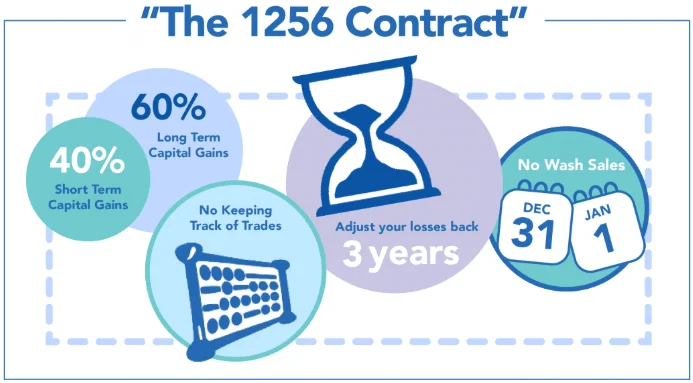
https://www.rcmalternatives.com/2015/04/4-ways-futures-accounts-get-taxed
The foil of how institutions and retail approach options further highlights why institutions dominate so heavily. Firstly, institutions take long-term positions using multi-leg spreads and delta-neutral strategies in trade sizes easily exceeding 1k contracts. They execute through algorithms and block trading platforms, focusing on volatility risk premium harvesting and quantitative models. Retail, on the other hand, engages almost purely in short-term bets on simple puts/calls in 1-10 contracts, often closing 81% of their positions within less than a day in crypto markets. Almost 90% of all retail options order flow comes from Citaldel, Wolverine, and Susquehanna via payment for order flow arrangements. Institutional orders bypass those firms entirely and trade directly with APIs or algorithms. Thus, the gap is very structural, institutions employ teams of quants, engineers, and risk managers with regulatory compliance, while retail just likes to YOLO into 0DTE calls.

The Institutional Migration to Crypto Options is Accelerating
Monthly crypto derivatives volume reached almost 9 trillion dollars in 2025, representing ¾ of total crypto trading volume. Market infrastructure has evolved to institutional-grade standards, and Bitcoin options OI exceeded 4 billion on CME in Q2 of this year. Globally, exchange-traded crypto derivatives reached 20+ billion contracts in September 2024, with OI reaching record highs of $80+ billion in late May of this year. Perhaps most interestingly, according to EY Parthenon and Coinbase 2025 surveys, 71% of institutional investors have now invested in digital assets, with 41% holding spot and 46% planning to invest in vehicles owning underlying crypto within 2-3 years.
Deribit commands about 90% of crypto options trading volume, meaning 9 out of every 10 Bitcoin options trade on the Dubai-based institutional-grade Coinbase subsidiary. Deribit offers European-style cash-settled options on BTC and ETH, as well as linear altcoin options via a paradigm integration. Institutionally minded features include colocation services in LD4 datacenter, portfolio margin models, block trades, combo orders, multicast data feeds, and proof of reserves procedures, all of which attract the best of the best currently.
CME Group is then the primary regulated venue for the US institutional crypto options access. In January 2024, they processed $94+ billion in total crypto derivatives volume, the highest since 2021, with Bitcoin futures contributing $73 billion and Bitcoin options adding $1.57 billion monthly. The CME products include BTC + ETH futures and options, as well as micro contracts for smaller sizing. Weekly options are available Monday through Friday for standard contracts and Tuesday through Thursday for micro products. CME, being heavily regulated by the CFTC, provides the most transparent price discovery with margin offsets between futures and options. Most of the institutional bid centers around hedging during uncertainty, arbitrage opportunities through basis trading, and portfolio allocation, providing institutional-grade access without crypto custody agreements. Paradigm (Different paradigm, not the VC!!!) actually operates the leading institutional OTC liquidity network, serving roughly $400 billion in cumulative volume since 2016, which is 17% of BTC and ETH options activity on Deribit as of May 2024. The platform captures ⅓ of Deribit’s monthly volume and serves over 700 institutional clients from family offices to hedge funds. By utilizing the RFQ (request for quote) function, it aggregates liquidity from
multiple venues through a unified markets feature and then provides anonymity for the trader. But with all these great centralized options for crypto, why do we need crypto options dexes?
Institutional Structural Advantages of Options Dexes
With the dominance of Deribit and the CME group offerings, it’s not crazy to wonder if there is really a market for an options dex. However, DEX architecture has unique benefits that align with institutional priorities in risk management, operations efficiency, and position strategies, in areas where centralized counterparts can’t compete.
Firstly, continuous 24/7 market access is a massive unlock for global institutions that must manage risk across the world and across time zones. With 35% of crypto transactions occurring on weekends (Copper Research), instruments must then be able to trade even after US markets close. After all, crypto is not like US equities because they do not have a geographical home and thus trade globally in a way that has not been seen before. When macro shocks strike markets, crypto markets continue trading even though tradfi markets remain closed. We saw this just recently with the liquidation crisis as Trump announced 100% tariffs on China during the weekend, but walked it back before the market opened on Monday. Coinbase derivatives were the first CFTC-regulated exchange offering 24/7 access to BTC and ETH futures in May 2025, explicitly stating the importance of around-the-clock access:
CME Group has also announced plans to offer 24/7 access to crypto/options trading in 2026, stating that client demand for it has grown.
Programmable settlement with automation via smart contracts gives DeFi projects operational edges that traditional finance rails can’t match. Blockchain settlements occur in seconds instead of the business-day times in Tradfi, with atomic transactions ensuring zero settlement risk for peer-to-peer encounters. BlackRock’s BUIDL fund is an example of a real-world application for tokenized treasuries with programmable settlement, allowing 24/7 access to liquidity, borrowing, and deploying capital without selling underlying assets. Furthermore, more complex multi-entity workflows can help automate operations that would typically require large amounts of in-office staff, like automatic payments to suppliers, transactions with atomic settlement, and options settlement with automated profit delivery based on oracle price feeds. Smart contracts enable cheaper, faster, more composable, and more robust means of hosting financial instruments.
Greater transparency via on-chain verification gives institutions greater auditing power and risk management capabilities. The blockchain is a public ledger, eliminating information asymmetry between market participants and the opaque internal matching and custodial systems that are so common in traditional exchanges. Caroline Crenshaw, the SEC commissioner, stated that while “DeFi removes intermediaries that perform important gatekeeping functions,” its transparency creates brand new capabilities. For risk management of institutions, on-chain rails provide real-time monitoring of exposure and collateral. Compliance and auditing benefit from easily accessible records, and front running is reduced due to deterministic smart contracts safeguarding against manipulation. Of course, the trade off of those upsides would be MEV attack exposure, though much of that can be bypassed via encryption now.
Additionally, the composability with established DeFi protocols creates product creation that would be impossible in Web2. Much of DeFi is open source and can act like “Money Legos,” allowing projects to comingle and integrate. For example, right now you can go and stake on Aave, borrow against your collateral, provide liquidity to a DEX, and then stake your LP for even more yield, all within an audited and composable ecosystem. For products geared towards institutions, decentralized options vaults could provide automatic yield generation via options strategies, while yield aggregators could further optimize returns across all protocols. Blockchain-based structured products can offer up to a 5% cost reduction annually for operations, composability in customization, improved access beyond institutions, and real-time pricing and settlement (Accenture).
Self-custody solutions eliminate counterparty risk while maintaining top-level security. Major custodians like Fireblocks, Anchorage, and Coinbase Prime now offer institutional infrastructure. For DEX trading, self-custody enables far lower counterparty risk, complete control and sovereignty, and zero rehypothecation risk. Chainlink’s very own Sergey Nazarov has stated that “DEXs reduce counterparty risk… (and) can also reduce some of the systemic risks of the blockchain industry by reducing the amount of capital concentrated in the wallets of a small number of centralized exchanges.” If you had practiced self-custody, you would have avoided the FTX implosion, and if you had traded purely on decentralized exchanges, your KYC info wouldn’t have been leaked via Coinbase privacy breach. Crypto’s very ethos was founded on the principles of self-sovereignty, and we should not be forced to compromise on that. On top of its security benefits, as DEX infrastructure matures, its capital efficiency is becoming far more advantageous. DeFi initially required overcollateralization, but platforms like Synquote now allow LPs to trade with as little as 1/10 the underlying value for short-dated naked calls. This creates a huge unlock for capital efficiency on-chain. With leverage, flash loans, and concentrated liquidity models, traders can be highly efficient with their capital.
Advanced pricing models and sophisticated AMM designs separate winners from failures
The number one hindrance to success for options is the technical sophistication required for pricing. Advanced models incorporating jumps and stochastic volatility reduce pricing errors by 40-60% versus naive Black-Scholes implementations (Konczal). While Black-Scholes provides a foundation, aka using spot price, strike, time to expiry, risk-free rate, and volatility to price European options, its assumptions fail in crypto markets. It assumes constant volatility (crypto has clustered volatility), log-normal returns (crypto is very fat-tailed), and no jumps (frequent massive moves are widespread in crypto). Bitcoin implied volatility is 3-5x that of VIX, and oracle latency creates frontrunning opportunities, and skewed return distributions invalidate the classic Gaussian assumptions for tradfi option pricing.
In March 2024, comparative research was published that examined BTC and ETH futures options across eight maturities, revealing significant differences in model performance. For Bitcoin, the Kou model emerged as the clear winner across maturities. The Kou model works by assuming that prices will sometimes have “jumps” and thus captures Bitcoin’s sharp volatility better than the other models. On the other hand, the Bates model won the ETH battle. In the Bates model, two elements are combined: volatility that changes over time and occasional price jumps, making the model more realistic and accurate. Overall, models that included both changing volatility and sudden jumps were far more precise than the classic Black-Scholes approach, which creates a competitive advantage that will separate institutional-grade platforms from retail-minded protocols.
Another such advantage for institutional-grade platforms is found in their implied volatility surface construction. Constructing an implied volatility surface, a 3D map that shows how option volatility changes across strikes and expiries, is a highly complex process requiring perfect precision.
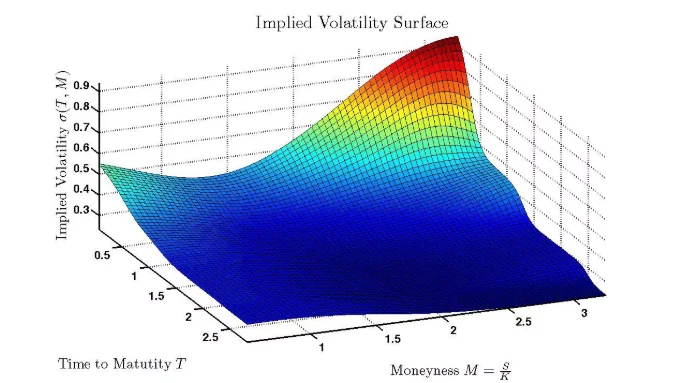
IV Surface Construction requires:
- Data gathering across strikes/maturities
- Removing illiquid options (>2 standard deviations)
- SABR model fitting with four parameters:
- α: overall volatility level
- β: volatility scaling with price
- ρ: skew between calls/puts
- υ: surface curvature/”smile”
- Interpolation for gaps, careful extrapolation for far OTM
Crypto IV surfaces differ markedly:
- Sharp volatility smiles for short-dated options
- Pronounced put skews (higher downside IV)
- Term structure inversions during uncertainty
- Arbitrage-free constraints must hold
Three major AMM architectures for crypto options have emerged thus far, each with distinct trade-offs.
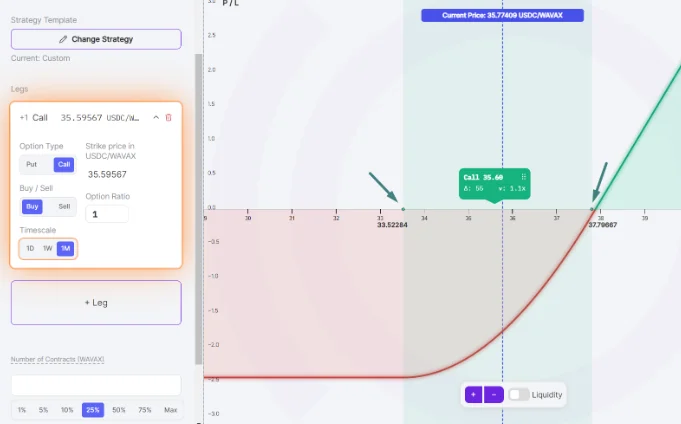
Firstly, Panoptic pioneered perp-options on Uniswap by converting V3 LPs into tradeable perpetual options, where the LP positions function as a short perp-option with a streaming premium paid over time. Fee accumulation thus depends on the realized volatility, time spent in the LP range, and the pool’s volume, with long positions created by borrowing and selling LP shares. The math looks a bit different with this model, as it has a constant gamma, no theta decay, and the streaming premium converging to the Black-Scholes expectation. The advantages of this design would be an oracle-free system, liquidation fee architecture, ERC-1155 compatibility, and width (of range) as a pseudo-time parameter. Obviously the downsides would be the liquidity fragmentation, complex UX (shown below), and the limitation to only Uniswap pairs (I don’t want to trade cbBTC or WBTC!!!).
Lyra (Now Derive), on the other hand, implemented a more traditional options AMM architecture with European options having fixed expiries, Market Maker vaults accepting USDC deposits, and automatic delta hedging via GMX or Synthetix perps. Pricing uses a modified Black-Scholes with real-time skew adjustments based on pool utilization. Liquidity provision occurs single-sided in stablecoins with a three-day cooldown on deposits/withdrawals, generating 8-40% APY depending on conditions. Risk management mechanisms include circuit breakers, maximum spread multipliers with a 10% minimum liquidity requirement, forced exercise for OTM longs, and liquidation for undercollaterized accounts. In 2024, Lyra (Derive) V2 implemented a CLOB with on-chain settlement, a dedicated app chain, portfolio margin, and spot + perps integration.
Lastly, Premia V3 pioneered the hybrid orderbook/AMM model, combining range orders (Uniswap V3 style liquidity with pro-rata fee splitting), a gasless limit orderbook on Arbitrum, an RFQ Network, and strategy vaults. This architecture aggregates up to 4 liquidity sources for every option order, with European options using standardized strikes/expiries, permissionless pool creation, multiple oracle support, physical settlement capability, and margin trading leverage. Capital efficiency can thus arise from the competition of numerous sources and sophisticated vaults, which do not require active management.
The Current Players: Crypto Options Competitive Landscape
With the three AMM structures laid out, it’s time to finally look into the current players competing for the top spot in decentralized options. Portfolio margin has become the key innovation separating institutional-grade platforms from purely retail ones, with DeFI enabling magnitudes greater capital efficiency. The protocols that combine portfolio margin with integrated perps, multi-leg strategies, and CEX-like performance will capture market share from their centralized exchange counterparts like Deribit:
Derive (formerly Lyra)
Derive stands as the leader in the decentralized options with over 630 million in 30-day Notional Options volume and over 75 million in TVL.
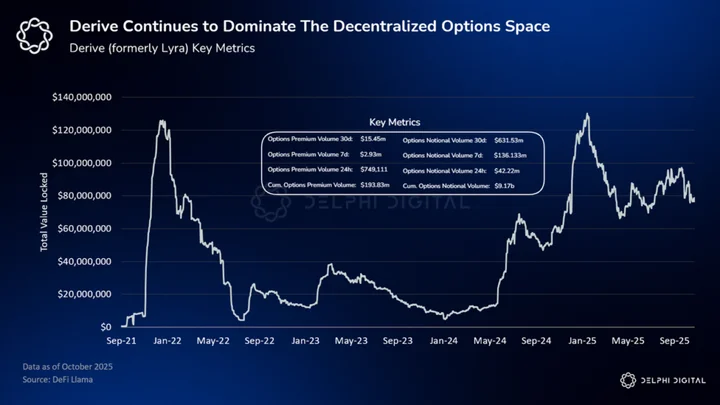
Derive was originally Lyra, but rebranded in August of 2024 to signal a new evolution from a simple options AMM to a full-suite derivatives infrastructure. Derive’s dominance seems to stem from being the first to market with a functioning options AMM in 2021, combined with continuous innovation through multiple iterations of the platform. The V2 architecture that they introduced in 2023 shifted the model from AMMs to a CLOB, allowing CEX-like performance while maintaining fully on-chain settlement.
Derive operates on its own OP stack EVM L2, which enables sub-second execution speeds that are nearly on par with centralized exchange performance. Their modular architecture consists of ERC-721-based accounts housing user assets with self-custody risk, risk managers governing margin requirements and liquidations, and asset contracts defining the derivative properties. This three-pronged separation allows the product to evolve rapidly without overhauling the entire protocol. Derive’s portfolio margin system is perhaps its best feature along with this modularity. Unlike a standard margin that treats each position independently, portfolio margin evaluates risk across all positions through scenario analysis, basically simulating the possible scenarios to calculate the maximum potential loss. Through this approach, hedged positions require less capital than the actual sum of their parts, which enables far greater capital efficiency compared to a normal isolated margin. Derive’s system thus continually monitors the internal and maintenance margin ratios, adjusting them dynamically as the markets change.
Derive’s liquidation system uses a reverse Dutch auction model where the liquidators bid for discounted portfolios, with the discounts increasing to find takers. This system reduces reliance on a traditional market maker liquidation system and allows Derive to implement partial liquidations, closing positions to restore margin health rather than completely liquidating the account.
Derive is not just an options dex; however, they also offer perpetual futures, structured products, and lending products that accept derivative positions as collateral. Derive allows for multi-asset collateral and most notably includes Ethena’s yield-bearing stables to enable users to earn yield whilst posting collateral. The cross-margin support allows a single collateral pool to back positions across assets and products, while the delta hedging integration with GMX and Synthetix offsets directional risk for LPs. Furthermore, the Market Maker vaults enable more passive LPs to earn fees from automated MM, with a 3-day cooldown that balances liquidity with the flexibility to withdraw.
Derive has had a slew of significant developments . In December of 2022, they partnered with Ethena, bringing multi-million dollar grants to the foundation and integration of Ethena stables. Ethena also executes basis trades on Derive’s perpetuals, providing consistent volume and order flow. In turn, Derive allocated 5% of its platform token, DRV, to sENA stakers to better align long-term incentives. Derive has also partnered with EtherFi, Swell, Kelp, and Lombard to integrate LSTs into the derivatives ecosystem. In January of this year, Derive linked up with Infinex for the DRV token launch to provide cross-chain Swidge integration, allowing 500+ assets to trade without bridge friction. Further partnerships with Amberdata (real-time analytics), Messari (Pro Ai trading platform), Falcon-X (Market-Making), as well as talent acquisition, like hiring the ex-CMO of Deribit, enhance its institutional appeal.

As mentioned above, Derive does have a token live called DRV. DRV was launched in January 2025 and was a 1:1 migration from the old LYRA token. As of writing, DRV sits at a market cap of 43.6 million and an FDV of 76.6 M, respectively. With Derive recently hitting record days for volume and the on-chain options pie expected to grow, DRV could be an attractive liquid bet.
Rysk Finance
Rysk takes a different approach, specializing in volatility yield via covered calls and cash-secured puts. As of October 2025, Rysk has achieved over 23 million in TVL, with notable explosive growth since its launch on HyperEVM.
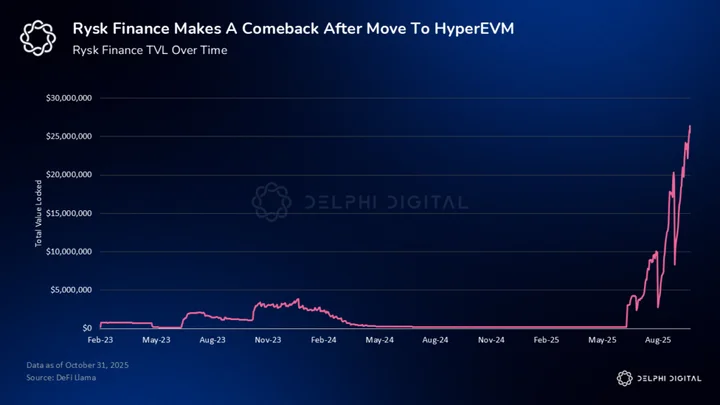
Rysk trades operate via an RFQ mechanism, wherein covered calls and cash-secured puts are priced through an auction to counterparties, where the best bid is then displayed to the user. Once a trade is made, premium immediately transfers onchain to their wallet, and collateral remains custodied in smart contracts with zero outsider access. Thus, Rysk has zero counterparty risk, as all capital remains directly in smart contracts that require no rehypothecation.
Via their new DeFi primitive, Rysk V12, they bring structured products entirely onchain end-to-end. With Rysk, options and volatility yield are far more accessible to a broader range of market participants, as no in-depth options trading knowledge is required.
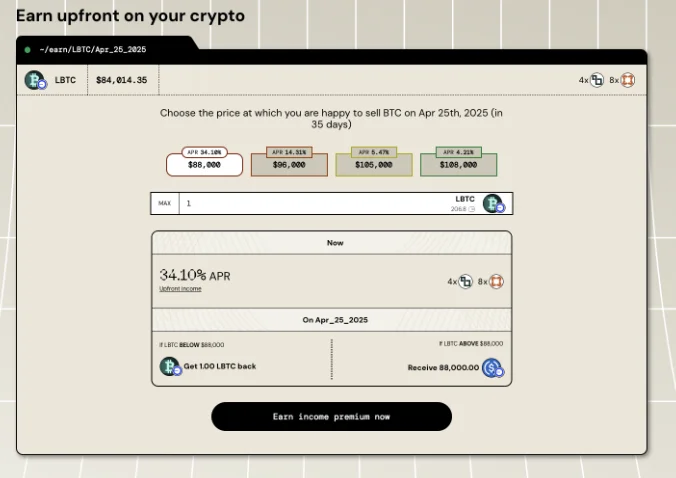
Users can open Rysk, select covered calls or cash secured puts, pick from a wide range of assets (including LSTs), choose an expiry with a target price, choose size via the RFQ system, and boom, you have received upfront premium instantly.
Their move to HypeEVM in August proved transformative for them, with 98% of their previous TVL migrating. Now, Rysk is the first primary options protocol on HyperEVM, giving it a significant competitive advantage in the growing ecosystem. However, the protocol does face competitive risks from other simple staking products and doesn’t allow users to trade their own options like a standard options DEX would. That being said, I do recommend playing around with Rysk, as it’s a fun and simple way to earn some yield.
Synquote
Synquote is a decentralized options and perps protocol that utilizes a hybrid RFQ system to connect traders directly with institutional market makers. Instead of an AMM, Synquote’s off-chain RFQ engine receives quotes from multiple MMs, which results in deep liquidity and very low slippage even for 7+ figure orders. Such a model skips past the liquidity fragmentation plaguing on-chain order books and AMMs, bringing a CEX-like experience to a DeFi product. Synquote is known for emphasizing simplicity with its products, similar to how Robinhood’s two-click options trading makes the platform more appealing to retail users than more complex competitors.
Synquote currently offers European options on 500+ instruments. By supporting a wider range of altcoins, Synquote can better tap into more illiquid markets and attract more users. The team also recently launched perpetual futures as well, seemingly looking to become a one-stop shop for all decentralized trading.
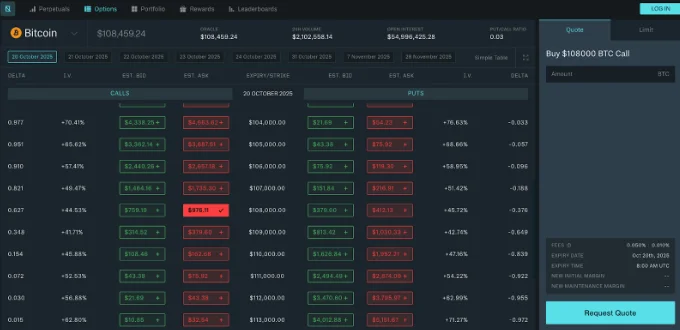
Synquote’s capital efficiency features for LPs are one of its most attractive features. Market makers on Synquote can sell options with undercollateralization, improving upon the 100% collateral requirements of previous DeFi options protocols and allowing LPs to allocate capital more freely. Their RFQ system manages this extra risk via a margining system and selective market maker program, mirroring the credit efficiencies of OTC trading but now on DeFi rails. This means better premiums and tighter spreads for traders, as MMs can better quote options orders without tying up capital. Although data for SynQuote is public, in May of 2024, they announced that they had done over 2B in options volume and over 100K trades to date.
It’s also worth noting that Synquote does not have a token, but it does have a points-based trader rewards program for users. This, along with their backing from Coinbase Ventures and Alliance DAO, among others, hints at a potential token down the line, so its definitely worth checking out and doing some volume.

Deribit
Although it might not be an on-chain options dex completely, nor is synquote, I want to cover Deribit more in depth as it is the dominant venue for crypto options right now. It is a centralized order book exchange and handles basically all of BTC and ETH options trading currently, boasting 60 billion in open interest in mid 2024 and over 1 Trillion in volume in 2024. Deribit pretty much pioneered BTC options back in 2016 and has been the go-to place for institutional traders ever since. Deribit actually just had a record month in July 2025 with $185 Billion in volume. Deribit operates via a CLOB with offchain matching, enabling sub millisecond execution speeds that DeFi protocols cant match currently.
Deribit offers a full suite of crypto derivatives, including European options on BTC, ETH, and a few altcoins, perpetuals swaps and futures with 50x leverage, and even volatility futures. In August 2025 Deribit also integrated stablecoin settled options for BTC and ETH, allowing stablecoin collaterals and profits. Furthermore, Derbiti also offers futures on a BTC volatility index, allowing traders to have a direct way to hedge or speculate on volatility.
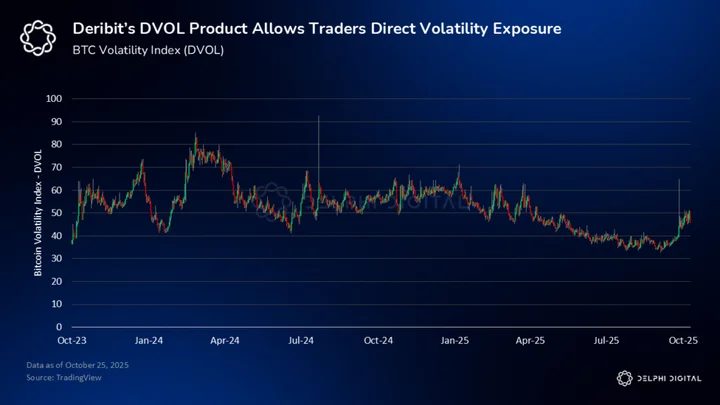
Deribit also offers multi-leg strategies through portfolio margin accounts. This normal CEX-style of flexibility makes it easier for traders to play with options as they can buy puts, calls, and futures all within one account. Their portfolio margin system is a key differentiator for them in this area. Rather than isolating margin per position, Deribit essentially evaluates the portfolio’s entire risk to set margin requirements. This significantly reduces collateral needs for hedged positions, where a long put could offset the risk of a long underlying position, thus decreasing margin requirements
Deribit also offers cross-collateral functionality for its products, allowing users to have flexibility about what asset they choose to post. Still, USDC does have a 0% haircut when used as collateral, allowing users to back their options without penalty. On top of the zero haircut, Deribit offers 4% APY on USDC collateral, thanks to Coinbase acquiring them. Deribit has a robust liquidation mechanism as well as an insurance fund to protect against massive flash crashes without socialized losses. The major downside of all this is, of course, the requirement of KYC and custody of funds, something Options DEXs can eliminate.
Coinbase’s acquisition of Deribit sadly means that a Deribit token will probably never happen, so for liquid opportunities and farming one would be better served to look elsewhere. I’ve included Deribit because it is the CEX that the options DEXs need to take market share from, just like Hyperliquid has been capturing market share from Binance, Bybit, OKX and more. Deribit remains the liquidity hub that decentralized options DEXs must measure against, and with Coinbase’s backing, it is positioned to tighten its grip on institutional demand.
Kyan (Premia V4):
Kyan, the new name for Premia v4, is a new evolution of DeFi options exchanges that seeks to close the gap between on-chain transparency and CEX performance. Kyan is a non-custodial platform for options and perpetual futures under one unified margin system. Unlike the earlier Premia versions that utilized AMM liquidity pools, Kyan adopted a central limit order book (CLOB) that enables a robust matching engine and low latency execution to attract professional traders and institutional capital. The idea is that trading on Kyan will feel just as fast as its centralized exchange counterparts, with features like support for FOK (fill or kill), IOC (immediate or cancel), market and limit order types. Kyan also has real time order books and employs an RFQ module for block trades that are beyond the order book’s depth. These RFQ orders connect you with professional marketmakers and are fully private, shielding you from adverse impact. Kyan is specifically designed to cater and attract institutional capital that dexes thus far have underserved due to high latency, poor liquidity, and AMM models.
Kyan has a comprehensive toolkit for derivatives, with its cornerstone feature being its Combo Trades multi-leg strategy builder, allowing traders to fully customize and execute the whole strategy in one atomic transaction.
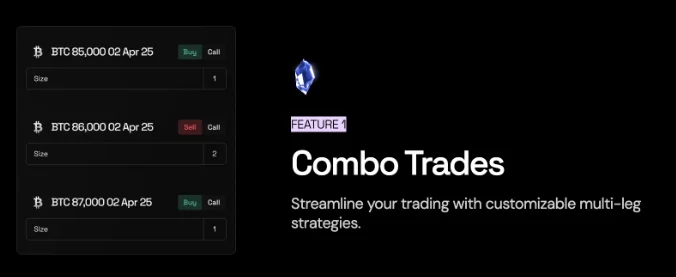
Through this feature, traders could buy a call spread or set up a straddle in a single click. Kyan will then bundle the legs and ensure they fill together, removing leg risk and saving traders fees. This feature is strengthened by the inclusion of perpetual futures offered alongside options, so strategies can evolve with delta hedging or leverage. Now, users can replicate complex options strategies in one transaction, something DeFi options dexes have sorely missed.
Another addition to Kyan is the inclusion of fully on-chain portfolio margining that is basically the same as Deribit’s. All positions in a user’s account, whether perps or options, are assessed holistically for risk, and margin requirements are then calculated based on net portfolio exposure.
In practice, this means users can get higher leverage on hedged or low-risk positions (like a covered call) and are then less likely to face liquidations due to one position’s isolated move. Kyans’ liquidation engine also mirrors the best practices of CEXes; rather than instant full position wipeouts, Kyan can perform partial liquidations to restore margin health. This preserves as much of the portfolio as possible for traders, and cross-product margining allows a short option to be offset by an inverse perpetual future position on the same asset, something unique to Kyan in the DeFi space.
To achieve this, they impose two live metrics: the initial margin ratio (IMr), which restricts additional risk past 100%, and the Maintenance Margin ratio (MMr), which triggers liquidation when it reaches 100%. When MMr exceeds 100% it first delta hedges the portfolio or liquidates the perp positions to reduce directional risk. If the risk remains high, it then decomposes the portfolio into simpler components and unwinds them in order of margin impact. If all of these fail, Kyan moves to complete liquidation, with an insurance fund absorbing residual losses. Kyan uses a grid of 43 market scenarios to evaluate portfolio risk to compute the worst-case PNL. This dynamic risk approach brings DeFi near on-par with the institutional risk models employed by CME and Deribit. It presents a better liquidation system than the blunt complete liquidations common on centralized exchanges.
To support its more sophisticated strategies, Kyan uses sub-accounts controlled by a single external wallet. Each sub-account functions like a separate wallet with independent margin requirements and risk parameters. Within each subaccount, portfolios are further segmented by asset, meaning a BTC margin call cannot affect an ETH position. In practice, this means traders can run many strategies simultaneously without any cross-risk.
I am very excited to use Kyan when it opens up to public Beta. It is very well thought out, and the team includes names like vxCozy, Marty, and others who have become very well-respected Crypto personas. With that said, Premia, Kyan’s predecessor, does have a token, which is currently at 14m FDV. I do not know to what extent Premia will play a role in the Kyan ecosystem, but as we gain more information about its use/conversion, it is a potential bid. In conclusion, I am excited to test Kyan and will be farming/using it once Beta releases.
Why It’s Finally the Time for Options Dexes
Your initial knee-jerk reaction to the title of this report was a grimace, perhaps even a flashback of all the money lost on various options dexes that failed to find footing, got exploited, or faded into obscurity. While such reactions are warranted, it would be foolish to use past failure as indicative of future failure. Almost every major protocol today was already done by someone else in the past, but initially failed due to poor execution, poor timing, or lack of traction. Just because many perp DEXs failed did not mean Hyperliquid was bound to fail too, correct? The same logic can be applied to crypto options dexes. As of late 2025, the macro, technological, regulatory, and behavioral stars have finally aligned. The time is now for options DEXs.

Every past options DEX had one foot in the regulatory grave, from Opyn’s CFTC charges to Dopex’s audit vulnerabilities to Hegic’s design flaws. All of these protocols lived and died during an era when everyone was scrambling to figure out what was permissible and what wasn’t.
That, however, has changed recently. Legislation like the GENIUS and CLARITY acts have created more explicit legal frameworks for crypto than ever before, and the SEC-CFTC joint statements in 2025 (mentioned at the beginning of this report) basically legalized all the rails needed for innovation within onchain financial instruments. Developers no longer have to build with Gary Gensler breathing down their neck, ready to strike immediately.

Legal certainty enabled the 1973 CBOE experiment to become the largest derivatives market in the world. The same inflection has begun on-chain.
Along with more legal certainty, DeFi infrastructure has finally caught up with its centralized counterparts. Now L2 rollups can achieve sub-second latency with deterministic settlement, on-chain unified margin can move collateral at institutional standards, and oracle sophistication prevents exploits and cascading liquidation loops (Binance?). DeFi rails are now TradFi grade.
2025 is the year of institutional appetite for crypto, tokenization, and derivatives at large. Robinhood’s outperformance, BlackRock’s tokenization pivot, and the embracing of securitization all point towards increased use of blockchain rails for large-scale infrastructure. In fact, 71% of institutional investors now hold digital assets, CME derivatives volume hit 94 billion per month, and Deribit processed over 1 trillion in options volume in 2024. This demand can’t, and won’t, stay centralized forever. Regulation mandates like transparency, proof-of-reserves, and auditable clearing are literally what on-chain venues already offer natively. Recent mass liquidation cascade black swans point to how too much perpetual OI and leverage can lead to disastrous outcomes. Institutions, protocols, companies, and market makers need better hedging instruments. DeFi is not for degenerate trading; it’s becoming the back office engine for global finance.
Not only is institutional appetite growing, but the volatility surface of global finance is converging into crypto timeframes. Bitcoin ETFs have normalized crypto exposure to institutions, bringing volatility hedging mandates on-chain. Global, 24/7 markets are becoming more normalized, with everyone around the world trading essentially the same basket of assets. Lastly, RWA tokenization means that all these treasuries, equities, and commodities will need options rails that can operate risk management on-chain.
Why hedge your on-chain equity holding on a centralized platform?
Not only does the timing make sense, but the options field is practically wide open for a DEX. Deribit owns 90% of the CEX flow and no DEX has cracked the institutional performance quite yet. The winner of the on-chain options war will be the volatility layer for all of DeFi, and whoever solves on-chain margining, cross asset risk, AND institutional access first will eat the pie.
We are standing in the global, permissionless, and transparent equivalent of when CBOE options launched in 1973. Crypto options may have been too early before, but now they are right on time. While everyone is farming the Nth derivative perp dex euthanasia rollercoaster, the real upside will be positioning into the option DEXs of tomorrow.
0 Comments