

If you’ve been paying attention to memes lately, chances are you’ve come across a red hat with an AVAX sign. In this post, I’ll tell the story of Avalanche so you can better understand the fundamentals behind that meme. I’ll start by explaining the consensus mechanics where I’ll cover its capabilities and limitations. Next I’ll acknowledge the vision of the Avalanche platform, before finally moving on to its token economics and burgeoning app ecosystem.
Much like Bitcoin, the Avalanche project started with the introduction of an anonymous academic paper describing a new family of consensus protocols called Snow. Academics at Cornell University further developed this protocol to create its real world implementation; the Avalanche Platform. The long-term goal of Avalanche is to become a platform-of-platforms which leverages the capabilities of this innovative consensus mechanism to its fullest in order to bring new financial primitives into crypto.
Appreciating capabilities of Avalanche requires a visit into the partly boring, yet partly exciting world of consensus mechanisms. Mainly, we will revisit the 2 major families that make up most of the crypto market today – Nakamoto and Classical.
Nakamoto consensus (heaviest chain & PoW) was not only a ground-breaking innovation in computer science but also a phenomenon that forever changed the status quo. The advantages of such an innovation are needless to mention. However, as sad as it may be, Nakamoto has limited scalability in that it can only process so many transactions at a time without sacrificing its decentralized ideology.
This is the main reason why 2nd generation projects in crypto such as Eth2.0, Cosmos/Tendermint, Polkadot, etc. decided to implement modified versions of classical protocols. Classical protocols can achieve much higher throughput (up to around 1000-1500 TPS) and lower latency than Nakamoto. However, they have their own limitations. By far the biggest limitation is that they don’t scale well in the number of validators. In these networks all nodes need to communicate with all other nodes in decision making and this all-to-all complexity becomes very hard to manage beyond 100-200 nodes. Networks that adopt classical protocols and want to achieve scale in validators mostly need a leader or other complex mechanisms to select & shuffle a sub-committee out of stakers to make decisions. Furthermore, because validations require votes from some percentage of “all” nodes, voters need to agree beforehand on the precise total number of active validators. Hence, they aren’t robust against changes in membership. These complexities act as bottlenecks and hinder performance of the network.
Key Highlights of the Avalanche Consensus
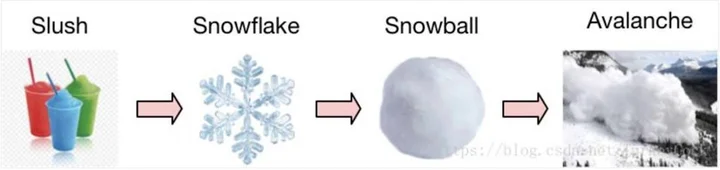
My goal in this following section will be to build an intuition for how the Avalanche consensus works at a fundamental level so the reader can appreciate its unique capabilities as well as becoming aware of its limitations. In doing so, I will try to keep it as simple as possible avoiding engineering complexities while remaining reasonably accurate.
At the core of Avalanche lies a process called subsampled voting. The big idea here is to enable any node to propose and vote on decisions without permission. Nodes repeatedly sample a small, constant number of random nodes (~20 nodes) to come into agreement. Anyone upon hearing a tx can initiate a poll to ask other nodes their preference on which tx they consider to be valid. In the first round, nodes vote with their initial bias and then switch their vote to that of the majority (quorum) of the sampled nodes. This process is repeated until nodes receive the same vote from so many subsequent rounds of sampling (decision threshold) to build enough confidence that the vote will not be reversed, and thus can be deemed as finalized. The process can be visualized in the simulation below taken from Ted Yin’s demo where little squares represent the current proposal of the nodes.

As you can see over time, with each round of sampling, nodes become more and more confident in their decision and the whole network eventually converges into an irreversible state agreed by every correct node. Notice that in this example the decision itself (orange or blue) is not important. What’s important is that everyone gets to agree on the same decision and that there are no two honest nodes in conflict. In a p2p payment application, we can think of orange and blue as two transactions that both try to spend the same UTXO. As long only one gets accepted the network will be safe.
Low latency, High Throughput and Decentralized Network
Notice how this process is completely leaderless; anyone without permission can participate in the decision making; meaning they can become a validator by staking AVAX. Nodes get queried by other nodes at a frequency proportional to their stake share. The more a node stakes, the more it gets asked. This way the network ensures that no subset of nodes can manipulate the network unless they stake a ton of AVAX into the network while giving everyone a say on decisions. Currently the platform has >880 validators who collectively have staked more than $8 billion worth of AVAX. Furthermore the network can remain robust against changes of membership because in subsampling no node needs to know the precise number of validators. Here is a snapshot from Nov 2020, comparing validator siz
Read the full report
This report is part of Delphi Pro.
- 800+ Pro reports across every major sector
- Talk directly with our analysts
- Private community of funds and builders
Already a Pro member? Log in
0 Comments