With the BTC ETF out and running and ETH ETF making its way, the possibility of institutional crypto adoption is ever stronger. But there’s a caveat. The extent of institutional crypto adoption may be hindered by the level of on-chain privacy they have. Arkham managed to track down the spot BTC ETF addresses of all 10 institutions.

https://x.com/ArkhamIntel/status/1752701573770477826
If we expect them to use the rest of what we have in Defi, that would necessitate some level of privacy on their part. For institutions, both from TradFi and crypto native, making large financial moves in the public has consequences. This is not new to DeFi and has been a pain point in TradFi as well. This is where private financial products such as dark pools come into the picture.
Before diving into the inner workings of blockchain-based dark pools, let’s set some context as to how dark pools came into existence, why they continue to operate, and to what degree they change the game.

Dark Pools in the 60s
In 1969, when computers were still large enough to take a room or two, and traders walked the trading floor shouting orders, institutional investors needed a better way to buy and sell their stocks without knocking off a domino effect in the market. Jerome Pustilnik pioneered electronic trading on Wall Street when he founded Instinet. Institutional investors could place orders, and Instinet would match and execute them. For something like Instinet to work, it would require significant volume on the demand and supply side of orders. So, what sweetened the deal for institutional investors? Confidentiality.
Instinet allowed the big guys to operate anonymously by concealing their identities and orders from other participants and the broader market. While this prevented their trades from affecting the market, it also meant a reduced risk of being front-run by other traders.
As of 2022, over 60 dark pools were registered with the SEC. Some are exchange-operated, like the NYSE or NASDAQ; some are broker-dealer-operated, like MS Pool by Morgan Stanley and SigmaX by Goldman Sachs; and some are independently operated, like Liquidnet or MatchNow.
The issue with operator-run dark pools is that the operators potentially have more incentive to misbehave than to work in a compliant fashion. The equation is simple: Profit from Corruption > Cost of Corruption. Operators could get away with more profits than they would ever have to pay in penalties. In 2018, the SEC fined Citi Group $12Mn for misleading their investors about operating their dark pool while they leaked confidential order information to High-Frequency Traders who executed orders worth more than $ 9Bn against Citi’s customers, profiting from them.
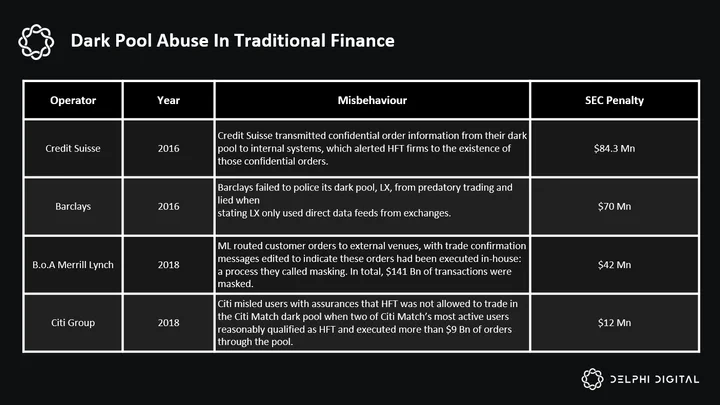 Traditional dark pool users run the risk of being played by their operators. It’s a heavy price they’ve had to pay for participating in a broken trust model. Since 2011, dark pool operators have paid over $340 Mn in penalties to settle allegations. A relatively small price paid compared to the profits they may have accumulated. Blockchain-based dark pools try to abstract away the need to trust an operator who could behave maliciously. But there’s a catch.
Mixers, Pools, and Everything in Between
Blockchains were initially designed to be fully transparent. While it promotes accountability, it is a double-edged sword. If you received a salary payment on-chain, anyone with your wallet address could see how much you were paid over the years and how much you would be paid in the future.
DEXs (Decentralized Exchanges) and wallets are subject to be tracked by wallet tracking and copy trading platforms which take it even further by allowing anons to snipe well-performing traders, complicating their trading strategies. Large orders also risk being front-run by searchers in public mempools.
Before we get into dark pools, let’s distinguish between them and mixers. Mixers are a subset of dark pools. Mixers like Tornado Cash mix tokens to break links between wallets and assets to make it difficult to trace the source of funds. Dark pools, on the other hand, not only break links between wallets and tokens but also help users trade amongst each other without revealing any information about the other parties.
Now that we’ve looked into the origins and motivations behind traditional dark pools and distinguished a mixer from a dark pool, let’s dive into blockchain-based dark pools that instill privacy in their base-level architecture with Balance models and PETs (Privacy Enhancing Technologies) such as Zero Knowledge, MPC, FHE and TEE.
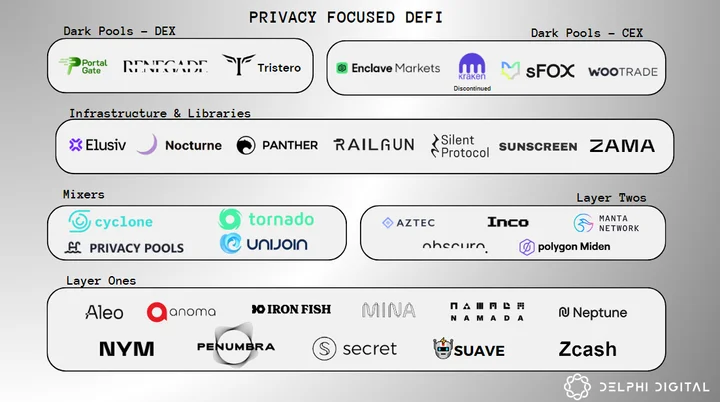
The market map may not be inclusive of all privacy and privacy-focused DeFi companies
As of writing this, dark pools like Singularity, Renegade, and Tristero are under development.
Privacy Architecture
Balance Models
Blockchains are state machines. The state is composed of accounts and transactions. As accounts transact, with
Read the full report
This report is part of Delphi Pro.
- 800+ Pro reports across every major sector
- Talk directly with our analysts
- Private community of funds and builders
Already a Pro member? Log in
0 Comments