
Introduction
There are a number of crypto projects that generate revenue and simultaneously reward their users and token holders. Sometimes they use the revenue to create value accrual, and sometimes users/token holders are rewarded with emissions.
For the uninitiated, you may have seen high APRs for staking a protocol’s token, and you may have thought it looks quite lucrative. But more often than not, the APY/APR being offered is unsustainable, largely because these yields are not a byproduct of protocol revenue, but are partly or entirely fueled by token emissions.
Some of these protocols have revenue but do not use it to generate value for the token. Most barely have any revenue but incentivize token holders to lock their assets in a staking contract purely through emission-based rewards. In this report, we focus on protocols with real revenue generation — the top 10 protocols by revenue over the last six months — to analyze their revenue relative to their cost of sales i.e. token emissions/incentives.
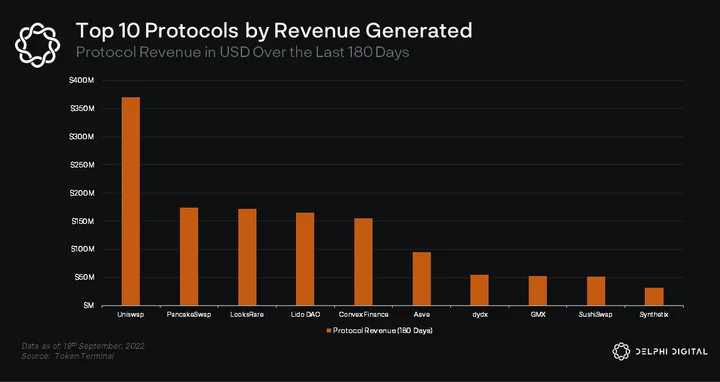
Accounting for token emissions is crucial because, keeping liquidity constant, the token rewards merely contribute to inflated supply numbers as everyone still owns the same percentage of the supply. For the most part, nothing is actually happening except for an increase in the paper wealth of holders. Using token incentives as a means of boosting revenue is a slippery slope, because everything falls apart when the tokens emissions stop or are reduced.
To evaluate sustainability, we look at the revenue/token emission ratio in USD for the top 10 projects by revenue. The token inflation here will not account for team and investor unlocks, but rather user incentive-driven emissions. The aim of this exercise is to look at the top revenue generators and evaluate how reliant they are on token emissions to keep their systems running. At the end, we look at the role fundamentals like these play in the holistic analysis of a token.
Without beating around the bush any further, let’s get right to it.
Protocol Revenue vs. Token Emissions
Uniswap
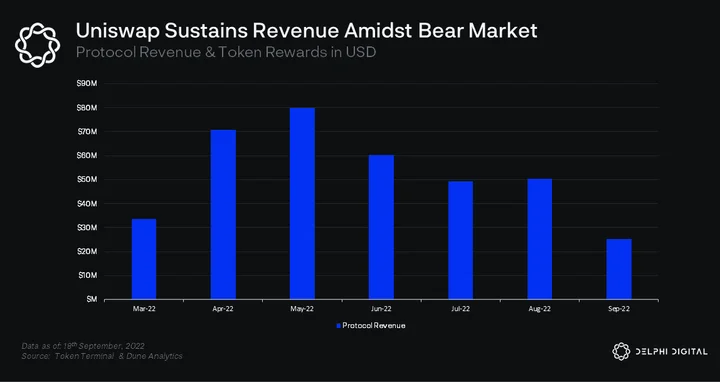
Uniswap has generated a total of ~$370M in revenue over the last 180 days — all of which was distributed to liquidity providers (LPs). There is a fundamental understanding that Uniswap generates this revenue because of LPs, and LPs deposit capital to the DEX knowing this fee-based revenue will accrue to them.
In terms of token rewards, Uniswap is unique as it does not reward its LPs with its own token (UNI). Instead, it solely relies on fees to incentivize liquidity provision. Over 50% of UNI’s token supply was retroactively airdropped to users, and the current circulating supply is ~76% of its max total supply.
All the revenue generated by Uniswap is organic and real. None of the generated revenue is due to token incentives, which suggests that the user base is sticky. However, since all protocol revenues go to LPs (and not token holders), one could argue the UNI token itself does not have an immediate value accrual
Read the full report
This report is part of Delphi Pro.
- 800+ Pro reports across every major sector
- Talk directly with our analysts
- Private community of funds and builders
Already a Pro member? Log in
0 Comments