Elixir: Democratizing Liquidity Provisioning in the Age of Orderbooks
OCT 29, 2024 • 14 Min Read

Report Summary
The report titled “Elixir: The Future of Order-Book Liquidity (Part I)” discusses the evolving landscape of decentralized exchanges (DEXs) and Elixir Network’s approach to improve liquidity provisioning on order-book-based DEXs. Here are the key takeaways:
- Evolution of DEX Liquidity Models:
- Initially, DEXs used order-book models similar to traditional finance but faced limitations due to high gas costs on Ethereum. Automated Market Makers (AMMs) then gained popularity by reducing entry barriers and enabling liquidity through simpler mathematical models.
- AMMs, however, suffer from inefficiencies like slippage and Loss-Versus-Rebalancing (LVR), which decrease profitability for liquidity providers (LPs).
- Elixir’s Approach to Order-Books:
- Elixir Network introduces an order-book model that enables decentralized liquidity provisioning, similar to how Uniswap democratized liquidity for AMMs. Elixir’s design offers a hybrid solution combining order-book efficiency with DeFi’s democratic ethos.
- Elixir targets multiple stakeholders: DEXs gain liquidity for underserved tokens, traders experience lower slippage, token issuers achieve better liquidity for mid/long-tail assets, and LPs receive improved returns.
- Architecture and Security:
- Elixir employs a Delegated Proof of Stake (DPoS) network where validators run a modified market-making algorithm. This algorithm optimizes liquidity and inventory risk management.
- Validators reach a consensus on bid-ask spreads and optimal prices based on data aggregation from multiple exchanges. Dispute resolution is managed on-chain, but the data aggregation layer remains a potential vulnerability in Elixir’s security model.
- Future Strategies for Elixir:
- Short-term: Focus on incentives to attract liquidity providers and grow stablecoin (deUSD) deposits.
- Medium-term: Retain users and create organic demand beyond token incentives while expanding to spot and perpetual market liquidity.
- Long-term: Build defensible, hard-to-replicate infrastructure by fostering network effects and deeply integrating its stablecoin into DeFi.
- Key Integrations:
- Elixir is already powering liquidity on platforms like Vertex, RabbitX, BlueFin, ApeX, and Orderly, with more integrations expected in the future.
In summary, Elixir Network presents a novel model for order-book liquidity that leverages decentralized validation to manage risk and promote capital efficiency. Its long-term success will depend on its ability to retain liquidity, create sustainable demand, and secure a competitive moat in the DeFi space.
- Evolution of DEX Liquidity Models:
Intro
The DEX landscape is quietly evolving. As gas costs continue to compress and the inherent flaws of automated market makers (AMMs) come to light, it seems we could be entering the early innings of a new paradigm. This emerging paradigm will not be dominated by AMMs but rather, order-books.
However, this evolution is not without tradeoffs. A heavy reliance on a handful of centralized market makers implicitly undermines the fundamental tenets that made DeFi unique and exciting in the first place.
Fortunately, an emerging protocol – Elixir Network – aims to preserve the democratization of liquidity provisioning that AMMs strive for. Importantly, rather than fighting this emerging paradigm with novel AMM designs, Elixir is embracing the inevitability of order-books.
In this report we will outline exactly how Elixir seeks to achieve this objective. We will also explore Elixir’s synthetic dollar asset, highlight the role that it will play within its ecosystem and importantly outline its risks. Lastly, we will explore the road ahead for Elixir and entertain the future defensibility of its products.
History of DEXs and the Evolution of Liquidity Provisioning
Before entertaining the future ahead of us, it is important to first understand how we got here.
Decentralized Exchanges (DEXs) have experienced a vast evolution. While the AMM was the first on-chain DEX design to find product-market-fit (PMF), it was not the first attempt at on-chain trading. Counterintuitively, the earliest DEXs closely mirrored more of an order-book model. At the time this seemed like an intuitive place to start. Why not take what has worked in Traditional Finance (TradFi) and apply it to crypto markets?
As we quickly learned, it is not this simple. The inherent gas costs associated with providing liquidity on an Ethereum-based order-book is simply uneconomical for market makers. Moreover, from the end-user perspective, the benefits of trading on-chain are quickly offset by the cost of trading on-chain. Taken to its logical conclusion, on-chain order-book DEXs would never compete with their centralized counterparts.
This led to the advent of the OG automated market maker: the constant function AMM (cfAMM). Instead of matching orders through complex proprietary market making algorithms, the cfAMM executed trades based on a simple mathematical formula (i.e., x*y=k). The deterministic nature of the x*y=k equation imposed inherent constraints on market makers. On the other hand, this considerably reduced the barrier to entry for providing liquidity. The cfAMM enabled anyone to spin up a trading pair and supply liquidity.
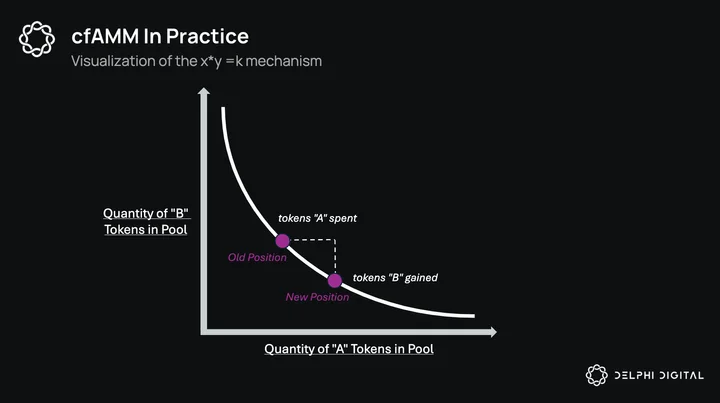
This had notable second-order implications. Importantly, retail participants have structurally different incentives from centralized market making firms. Unlike Wintermute or GSR, retail tends to have more of an appetite for emerging token incentives. Consequently, by tapping into retail capital, the cfAMM made it much easier to bootstrap liquidity. This enabled an efficient on-chain alternative for trading both major token pairs as well as long-tail token pairs previously left unmet by CEXs.
However, it quickly became evident that the cfAMM had its flaws. Namely, this model spread liquidity thin across an infinite price range leading to poor capital efficiency. This led to the subsequent advent of the concentrated liquidity AMM under Uniswap v3. This model extended the degrees of freedom that LPs have in providing liquidity. Instead of simply passively supplying liquidity, LPs now provided liquidity at specific “price ticks”. While this model was certainly more capital efficient, it simultaneously raised the level of sophistication necessary to provide liquidity. Accordingly, the concentrated liquidity model began to look more “order-book-like”.
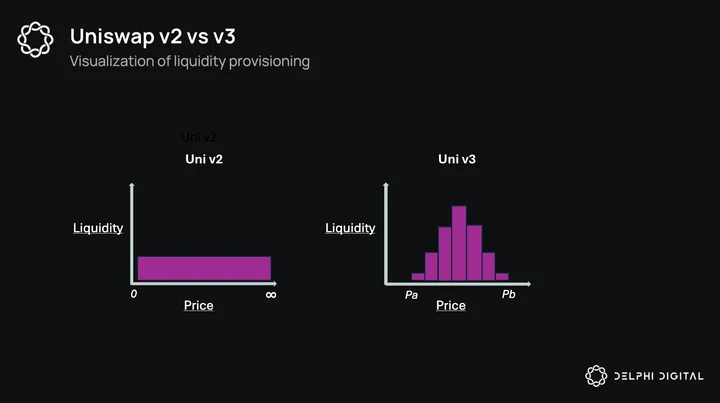
This model also suffered from additional shortcomings that seem to be inherent to all AMMs. More specifically, AMMs are subject to two symptoms of MEV: (1) slippage and (2) Loss-Versus-Rebalancing (LVR). While both concepts are beyond the scope of this report, it is worth briefly touching on them.
Slippage is value that is extracted from traders through frontrunning or sandwiching attacks. LVR on the other hand is the value extracted from LPs through CEX, DEX arbitrage. This is often referred to as “toxic flow”. Recent research suggests that due to LVR, LPs on AMMs may not actually be profitable. Given the importance of LPs to provide efficient execution for traders, reducing LVR has become the primary focus within the on-chain trading community.
There seem to be two different approaches to these problems. The first approach is underpinned by a collective ethos that believes preserving democratic liquidity provisioning is imperative. Those subscribing to this belief are working tirelessly to build out novel AMM designs that reduce LVR and return this value back to LPs. We will likely see more of these designs as “hooks” under Uniswap v4.
The second and less popular approach is conversely underpinned by a more pragmatic ethos. These individuals would say that market making follows an inherently oligopolistic resting state. No matter what, there will always be a handful of more sophisticated actors that find a way to extract value from less sophisticated actors. Therefore, rather than trying to preserve democratic liquidity provisioning, we should instead enable these more sophisticated market participants to compete with each other on giving the end user best execution. While slightly antithetical to crypto’s ethos, these individuals would argue that this may be the necessary approach in the short-term as the user experience appears to be stifling adoption.
Ultimately, these approaches can be distilled down to (1) those who are in favor of AMMs and democratic liquidity provisioning and (2) those in favor of RFQs, order-books, and best execution above all else.
Elixir, however, is introducing a third solution that aims to offer the best of both worlds. In the following section, we will explore how, if executed successfully, this embraces an order-book future while concurrently preserving democratic liquidity provisioning.
Enter Elixir
Elixir enables anyone to provide order-book liquidity. In the same way that Uniswap democratized access to liquidity provisioning via AMMs, Elixir wants to do the same for order-books. Not only does this help solve the aforementioned dilemma, but it addresses four key problems for four distinct stakeholders in the on-chain trading ecosystem:
(1) DEXs
(2) Traders
(3) Token Issuers
(4) Liquidity Providers
First, from the standpoint of both spot and perpetual order-book DEXs, it is currently difficult to recruit the centralized market-makers necessary to provide liquidity. Elixir solves this by serving as a modular primitive that order-book DEXs can plug into their exchange to tap into Elixir’s liquidity. This is especially useful for emerging DEXs that have yet to reach a liquidity/volume threshold to organically scale.
Additionally, Elixir makes it much easier to bootstrap liquidity for mid and long-tail tokens. While these tokens may be seen as either too risky or not lucrative enough (via lower volumes) for centralized market makers to provide liquidity for, Elixir’s retail LPs have structurally different incentives.
Tapping into retail capital therefore enables order-book DEXs to offer better execution for tokens historically left unaddressed by the order-book model while also allowing DEXs to add these new token pairs much faster. This benefits traders looking to trade these tokens with minimal slippage.
Additionally, Elixir is also beneficial for crypto projects and their tokens. Elixir can provide long and mid-tail crypto projects with the necessary liquidity to drive healthy price action. This can subsequently help drive attention and thus usage to the project itself.
Lastly, Elixir is, in theory, able to offer LPs, who are currently losing money through LVR, attractive risk-adjusted returns. Given order-book’s are inherently much more capital efficient relative to AMMs, market-making on order-books can be more lucrative for LPs. Put simply, each dollar of TVL is turned over more, and thus can generate more fees.
The net effect of this approach is that Elixir is able to embrace the inevitability of a more order-book-centric paradigm, while preserving the principles that made DeFi unique in the first place. Importantly, Elixir is able to do this while addressing numerous stakeholder pain-points simultaneously.
Elixir’s Architecture
So how exactly does Elixir function under the hood?
Underpinning Elixir’s design is a delegated Proof of Stake (dPoS) network of off-chain validators. Validators are responsible for executing the underlying algorithm and reaching consensus within the network.
When bootstrapping liquidity on orderbooks, a market maker’s two primary concerns are inventory risk and quoting an optimal bid-ask spread. The simplest form of market making sets bids and asks at an equal distance from market price. While this strategy can work well in sideways markets, it will lead to a skewed inventory during strong directional trends.
Consequently, to better optimize inventory risk during changing market conditions, Elixir validators run a very simple market making algorithm which reflects a custom version of the well-known Avellaneda & Stoikov algorithm.
𝑟(𝑠,𝑡)=𝑠−𝑞𝛾𝜎2(𝑇−𝑡)
s = current market price (between bids and asks)
q = quantity base asset / units to desired asset target
σ = volatility
T = closing time
t = current time (T is normalized = 1, so t is a time fraction)
δa, δb = bid/ask spread
δa=δb = symmetrical spread
γ = inventory risk parameter
κ = order book liquidity parameter
This formula enables the Elixir network to determine how far the current inventory is from the target inventory. Elixir is then able to adjust the bids and asks accordingly – with bids closer to mid, and asks farther away, or vice versa. Elixir in theory therefore won’t encounter a large asset inventory imbalance if the asset’s price begins trending in one direction.
In practice, Elixir’s market making flow looks slightly different on perpetual markets versus spot markets. For perp markets, Elixir takes in deposits, usually in the form of stablecoins (more on this), and builds liquidity on the orderbook by aiming to have net zero contract exposure to long and short contracts. For spot markets on the other hand, deposits are in the underlying assets (e.g. for an ETH-USDT spot market, deposits are half in ETH, and half in USDT).
Using the reserve price formula mentioned above, the strategy calculates an ideal market price to use based on the inventory target Elixir sets (i.e., as determined by the consensus of the network’s validators running Elixir’s algorithm). The formula then calculates the optimal bid-ask spread of a pair depending on the book’s depth. Finally, Elixir begins placing bids and asks based on the spread. Thus far, according to Elixir, the network has been able to quote some relatively tight bid/ask spreads with a high degree of capital efficiency.
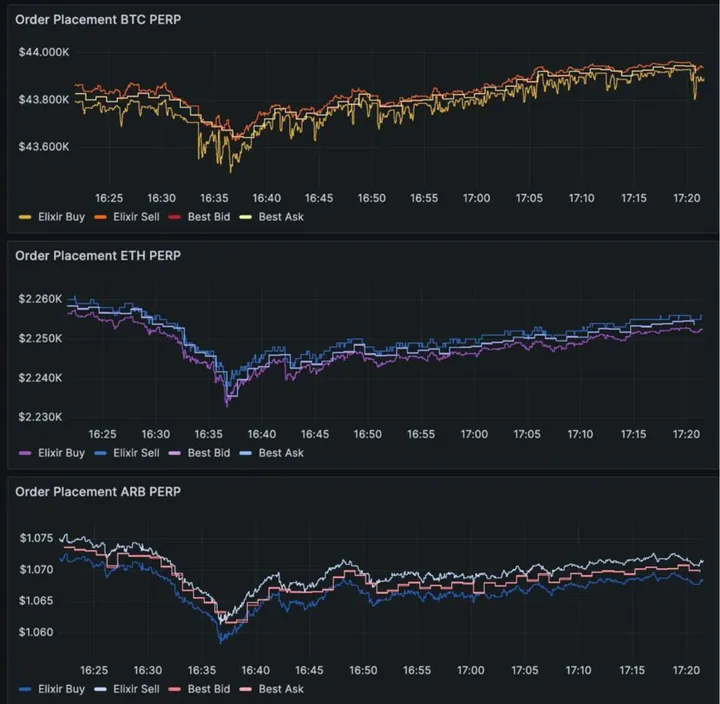
Given that the Elixir Network is fully transparent, it is crucial to protect against sophisticated parties gamifying the algorithm and passing toxic flow on to Elixir LPs. This is a similar dynamic to what is at the root of LVR in the context of AMMs. To prevent this, Elixir utilizes randomly generated components within the strategy, where instead of (T – t) linearly progressing to 0, Elixir randomly generates a value for this parameter. This value is calculated on an ongoing basis independently for each pair on each exchange. By introducing a degree of entropy, this makes it theoretically impossible to calculate future values given a set of input data for both the optimal bid/ask and the reserve price.
Running this strategy in a centralized manner, as most market makers do, is relatively straightforward. However, doing so in a decentralized manner introduces a lot more complexity. Elixir’s architecture can be broken into three core functionalities:
(1) Data sourcing (off-chain)
(2) Validation (off-chain)
(3) Dispute resolution (on-chain)
Elixir first sources real-time data through a “Data Aggregator”. The “Data Aggregator” collects data from multiple real-time exchange feeds and combines them into a deterministic data frame. This data is then signed and broadcasted to the validators enabling them to act upon accurate and timely data.
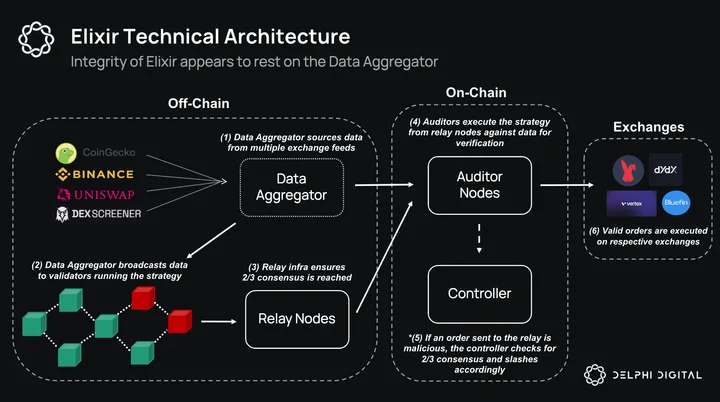
Once the data is broadcasted, 66% consensus is required from Elixir’s validator network. Elixir’s validator network is a Delegated Proof of Stake (DPoS) network. This means end users delegate their stake to validators who proportionally receive rewards. This helps align incentives and ensure those acting honestly are compensated accordingly. The Elixir Foundation will also run a Validator Delegation Program that delegates additional tokens to top performing validators with the expectation that delegates will participate in governance with the tokens. The goal of this program is to sufficiently decentralize the governance of the network and encourage validator participation in the direction of the network.
“Relay Nodes” then check if the validator network has reached 66% consensus. Assuming this is met, “Relay Nodes” sign the orders with the exchange keys to propose the transaction to on-chain “Auditor Nodes”. Importantly, Auditors simultaneously source the same data used to construct the transaction from the “Data Aggregator” to ensure that the proposal is in line with this data and thus validators have not acted maliciously. This effectively means that the data aggregation is the single point of failure given both validators and auditors base decisions off of the integrity of this data.
Assuming there is nothing inconsistent, the transaction is then submitted on-chain. However, if the auditor identifies some inconsistency, they are able to initiate a dispute. This dispute goes to the controller smart contract which manages staking, rewards, bond pools, and slashing. The controller would then check for 66% consensus among the active validator set and slash accordingly. The validators stake is then reallocated to the economically incentivized auditor.
This model is effectively akin to how fraud proofs work for Optimistic Rollups. However, it is worth noting that while Elixir seems to have multiple layers of added security throughout the transaction lifecycle, it seems the point of failure sits at the data aggregation layer. If this functionality is undermined for whatever reason, given each actor bases their decisions off of this same source, this could subsequently undermine the integrity of the entire architecture.
Lastly, by optimizing for a more decentralized architecture, Elixir implicitly makes compromises on latency. Presently, Elixir’s market making operations are subject to about one second of network latency. In the market making world, this is meaningful. Thus, Elixir is inherently unable to quote as tight spreads as traditional centralized market making firms without assuming more risk.
While Elixir has been able to successfully provide top of book liquidity on the major token pairs, we could see their product offering evolve to dominate mid-sized tokens typically left unaddressed by centralized market makers. This leaves a sizable and relatively uncompetitive market for Elixir to tap into.
Elixir is currently powering liquidity on Vertex, RabbitX, BlueFin , ApeX and Orderly. A handful of additional integrations have been suggested to be in the pipeline.
Looking Ahead for Elixir
Going forward, the future success of Elixir seems to rest on the protocol’s ability to execute on three near, medium, and long-term strategies.
First, in the near term, Elixir will need to continue to execute on their incentives campaign. Importantly, once tokens are emitted, they cannot be taken back. Thus, maximizing the return on each token invested through Elixir’s apothecary is of the utmost importance in the near-term. This applies to both incentivizing liquidity provisioning through Elixir’s primary product offering as well as incentivizing deUSD deposits.
Subsequently, in the medium-term, the success of Elixir will become less about onboarding users through incentives but rather, retaining these users and fostering more organic demand for Elixir’s products. Importantly, Elixir will need to find ways to both retain and onboard new capital in the absence of token incentives to prop up yields. It will also be interesting to see how well Elixir is able to execute on providing spot liquidity in addition to perps liquidity in the near-medium term.
Lastly, in the long-run, the competitive sustainability of Elixir’s products seem to hinge on its ability to cultivate properties that cannot simply be forked nor easily subsidized. Moreover, in an industry where forking a protocol is socially acceptable, and token incentives can be used as an effective user acquisition tool, defensibility is inherently more difficult to build out.
That said, for Elixir, increasing the ubiquity and utility of its newly launched stablecoin and deeply embedding this standard into the fabric of DeFi markets may be a means to a structural moat. Moreover, by owning the network effects between Elixir’s LPs and the order-books themselves, Elixir could foster additional defensibility at scale. A protocol trying to fork Elixir would not be able to fork nor easily incentivize these properties. Consequently, this could help Elixir better insulate themselves from competition.
With some key integrations on the horizon, as well as the recent release of deUSD, Elixir is a project to keep an eye on. We will dissect deUSD in further depth in our next report.
0 Comments