
Report Summary
Key Takeaways
-
Introduction of deUSD:
-
deUSD is a novel, yield-generating synthetic USD asset developed by Elixir.
-
It serves as a decentralized unit of account for providing liquidity across order books while earning yield from real-world assets (RWAs).
-
-
Core Innovation:
-
Elixir introduces Active Liquidity Vaults (ALVs) which connect on-chain assets to off-chain order book liquidity in centralized exchanges (CEXs).
-
These vaults allow users to provide assets like deUSD and earn real yield by backing market-making strategies.
-
-
Yield Model & Safety:
-
Yield is derived from market-making profits, with additional upside from RWAs and DeFi strategies.
-
Safety is enhanced through decentralized infrastructure, cryptographic verifiability, and smart contract constraints.
-
-
Mechanics of deUSD:
-
deUSD is overcollateralized, backed by yield-bearing assets (e.g., USDC staked in RWAs or DeFi protocols).
-
It’s issued when users deposit collateral into Elixir’s system, creating a mint/burn mechanism.
-
-
Utility of deUSD:
-
Used primarily as a funding asset for liquidity provision in CEX order books.
-
Offers stablecoin-like utility but with added yield, positioning it as a high-performance alternative to USDC or USDT.
-
-
Revenue Sharing:
-
Participants (users who deposit into ALVs or mint deUSD) receive a share of market-making profits.
-
The protocol takes a fee, aligning incentives across stakeholders.
-
-
Roadmap & Vision:
-
Elixir envisions deepening liquidity in crypto markets by enabling decentralized capital to compete with traditional market makers.
-
deUSD is central to that vision, acting as a decentralized, high-yield funding currency.
-
Summary
This report outlines how Elixir is revolutionizing order-book liquidity through the creation of deUSD, a decentralized synthetic dollar that earns real yield. By bridging the gap between DeFi and centralized exchanges using Active Liquidity Vaults, Elixir allows everyday users to participate in market making — an area traditionally dominated by institutional players.
The mechanism is both capital-efficient and yield-generating, with safety features baked into the protocol via smart contracts and overcollateralization. deUSD is not just a stablecoin, but a high-performance financial primitive with broad potential utility across trading and liquidity infrastructure.
-
Elixir’s deUSD
Elixir is a modular and decentralized network designed to power liquidity on order-book exchanges. Built on a Delegated Proof of Stake (DPoS) model, Elixir is cross-chain and composable, enabling DEXs to seamlessly integrate the protocol into their core infrastructure. In this article we introduce deUSD, Elixir’s synthetic dollar, which serves as preferred collateral within the ecosystem.
Presently, there are two primary ways that end users can participate in the economics of Elixir’s liquidity provisioning functionalities. First, users are able to provide liquidity directly to asset pairs. This can be done either through native Elixir integrations directly on exchanges such as Vertex or through Elixir’s front-end. Users are able to browse different markets, assess their respective APYs, and supply liquidity accordingly.
The second means of getting exposure to Elixir’s market making functionalities is through deUSD, a synthetic dollar asset akin to Ethena’s USDe with some nuanced differences. deUSD will serve as the preferred collateral within the Elixir ecosystem, accepted by nearly all of Elixir’s decentralized exchange (DEX) integrations. Users will have the option to allow their deUSD to be used as collateral for Elixir to run its market making operations on perps exchanges. This will offer users additional yield on top of deUSD’s native yield.
deUSD is minted by depositing staked Ether (stETH) as collateral, which is then used to open an equivalent ETH short perpetual futures position. Given both positions offset one another, this creates a delta neutral position insensitive to any price movements in the underlying ETH. Consequently, deUSD is able to capture both the yield generated by stETH and the funding rate for being short ETH-PERP.
Elixir’s principal goal is to ensure that its over collateralized insurance fund (OCF) is never fully depleted and thus no losses are eaten by the underlying principal balance of deUSD. To accomplish this, Elixir has the ability to unwind deUSD’s exposure to the basis trade and subsequently size into sDAI instead.
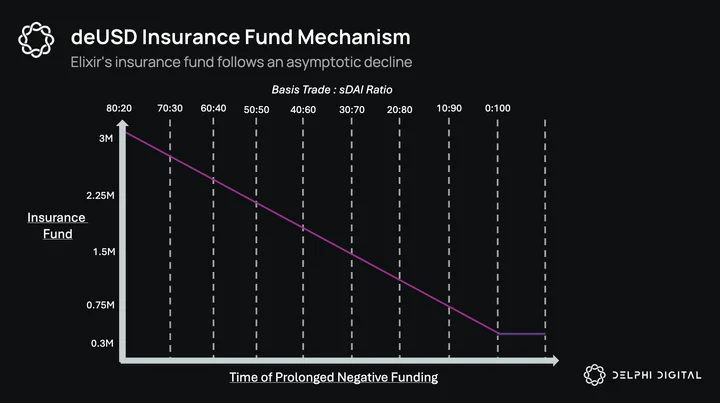
Let’s say for example that Elixir starts with $3M in the OCF (this is currently the target at time of writing). In the event that funding rates flip negative and the insurance fund starts to draw down, Elixir will begin to size into sDAI to protect the insurance fund. The ratio of basis trade to sDAI backing Elixir will ultimately be a function of the current size of the insurance fund. Elixir determines this ratio based on the following:
OCF 100% of high water mark:
deUSD composition:
80% -> long basis yield
20% -> sDAI / other yielding stables
OCF 90% of high water mark:
deUSD composition:
70% -> long basis yield
30% -> sDAI / other yielding stables
OCF reaches 80% of high water mark:
deUSD composition:
60% -> long basis yield
40% -> sDAI / other yielding stables
OCF reaches 70% of high water mark:
deUSD composition:
50% -> long basis yield
50% -> sDAI / other yielding stables
OCF reaches 60% of high water mark:
deUSD composition:
40% -> long basis yield
60% -> sDAI / other yielding stables
OCF reaches 50% of high water mark:
deUSD composition:
30% -> long basis yield
70% -> sDAI / other yielding stables
OCF reaches 40% of high water mark:
deUSD composition:
20% -> long basis yield
80% -> sDAI / other yielding stables
OCF reaches 30% of high water mark:
deUSD composition:
10% -> long basis yield
90% -> sDAI / other yielding stables
OCF reaches 20% of high water mark:
0% -> long basis yield
100% -> sDAI / other yielding stables
Importantly, instead of simply changing the deUSD backing as soon as the OCF reaches the aforementioned watermarks, the Elixir team has decided to instead use a 30-day rolling average. This is done to circumvent the risk that the OCF balance could teeter back and forth between the various watermarks under times of heightened funding rate volatility causing Elixir to constantly change the composition and possibly eat the slippage and fees associated with doing so.
As the OCF begins increasing again, it retains the same backing split, until the lowest percentage value of OCF over the course of a 6-month rolling window is greater than 100% of the initial OCF balance. In other words, let’s say the OCF starts at $3M. If it drains down to $1.5M, the deUSD backing would be 30% long basis yield, 70% sDAI / other yielding stables. In order for Elixir to start reallocating some composition to the basis trade, the OCF’s lowest value would have to be over $3M over the course of the 6 month rolling window. If that is the case, then every 2 months Elixir would shift the deUSD backing up the above tiers, one by one.
Elixir will initially allocate 100% of the aggregate PnL generated by deUSD to the OCF. The yield that users receive on deUSD will instead be subsidized by Elixir Potions.
It is also important to note that the OCF will also cover any trade execution costs. This is something we will discuss more in the risks section.
deUSD Architecture
From a market maker’s perspective, the initial mint/redeem mechanism will function similarly to Ethena. Authorized Participants (APs) will initially be the only ones with the ability to mint/redeem deUSD. APs will be onboarded with Elixir via a credible third party vendor to ensure sound KYC.
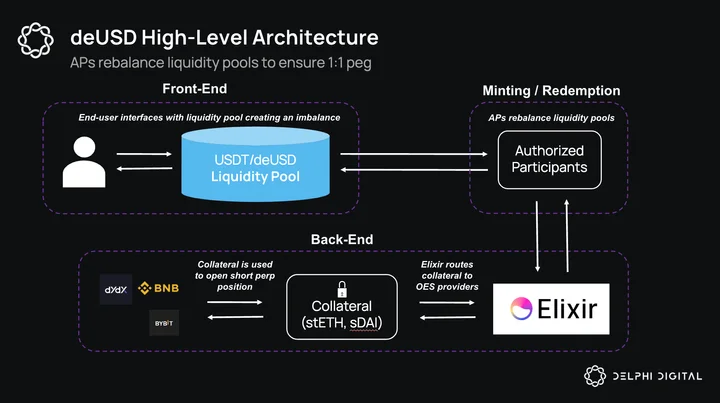
These participants mint/redeem deUSD by pulling an indicative quote endpoint API and submitting a signed message. Mints of new deUSD are done by depositing stETH. On the back-end, this stETH is paired with an equivalent short ETH-PERP position. Importantly, if deUSD at that point is backed by some percentage of sDAI, APs will execute swaps from stETH to sDAI on the back-end according to the targeted allocation. Similarly, when APs look to redeem, they will pull an indicative quote endpoint API, submit a signed message and receive the same allocation of stETH and sDAI in return.
Importantly, this will all be abstracted away from the end user. Most users will simply swap their USDT or USDC for deUSD on a Curve pool. When users swap USDT for deUSD, this will briefly cause USDT to trade at a marginal discount relative to deUSD, creating an arbitrage opportunity. APs can then mint fresh deUSD and swap it for slightly more USDT, thus rebalancing the pool and capturing the arb. In practice this is how deUSD will be minted.
Conversely, if users sell deUSD for USDT, deUSD would then trade at a marginal discount. Consequently, APs would buy the discounted deUSD and redeem it for slightly more dollar value. The net effect is that the structural incentive from APs to constantly capture arbitrage opportunities and rebalance the pool means that deUSD supply is directly tied to demand for deUSD. Liquidity supplied in Curve pools will also be heavily incentivized with potions, Elixir’s version of points, via Elixir Apothecary (i.e., Elixir’s incentive campaign).
It is worth noting that given the inherent lack of liquidity and open interest (OI) on DEXs, Elixir will initially tap into centralized exchanges to back deUSD. While the eventual goal will be to move the entirety of the mechanism onto DEXs once there is sufficient liquidity, OES providers such as Copper will initially be used to keep collateral assets in an on-chain MPC wallet. This means that while the perp positions will exist on-exchange, the collateral assets won’t. This decreases counterparty risk meaningfully.
The ELX Token
By leveraging the ecosystem’s native ERC-20 token, ELX, and its robust incentive mechanisms, Elixir democratizes liquidity provisioning for orderbook decentralized exchanges, ensuring deeper liquidity and more efficient trading experiences.
The ELX token not only fuels the ecosystem by incentivizing liquidity providers and validators, but also empowers the community through decentralized governance, including that of deUSD.
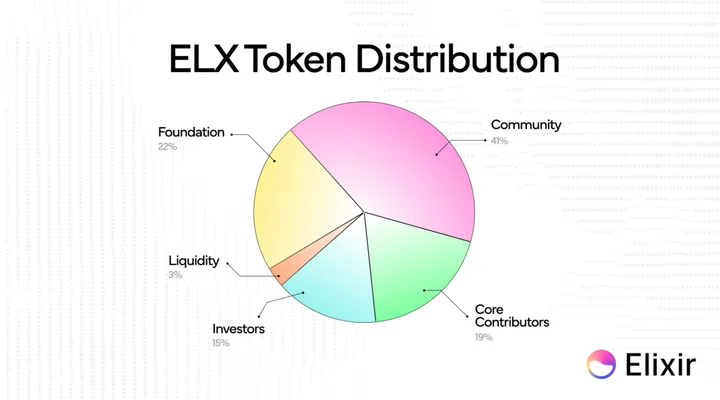
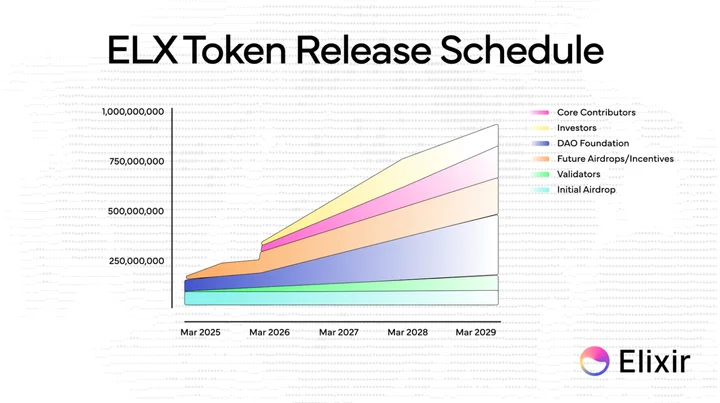
The allocation of genesis ELX supply and respective vesting parameters are as follows:
Community: 41%
- Airdrops: 19%
-
-
- Season 1 airdrop: 8%
- Initial airdrop allocation unlocked at TGE
- Future airdrops: 11%
- Half of future airdrop allocation unlocked at 6 months
- Full future airdrop allocation fully unlocked at 1 year
- Season 1 airdrop: 8%
-
- LP incentives: 10%
-
- Linearly unlocking over 4 years
- Validator Emissions: 12%.
- Unlocks over 20 years via logarithmically decreasing function
DAO Foundation: 22%
- These tokens will be allocated for grants, future ecosystem rewards, etc.
- 25% unlocked at TGE, 1-year cliff, followed by 4 years of linear vesting
Liquidity: 3%
- This represents the allocation of the network set aside for market makers and other liquidity providers across both centralized and decentralized exchanges
- Fully unlocked at TGE
Investors: 15%
- This is distributed to early investors of Elixir. These parties have provided crucial financial support during the 3+ years of Elixir’s development
- 1-year lockup, followed by 2 years of linear vesting
Core Contributors: 19%
- This allocation is set aside for the core contributors of the Elixir ecosystem: both past and future employees of Elixir Labs Ltd.
- 1-year lockup, followed by 3 years of linear vesting
The following graph illustrates the cumulative release schedule:
Risks
There are several key risks underpinning deUSD’s design:
- deUSD Redemption and Liquidation Cascade Risk: In the event that users look to redeem their deUSD en masse, this could cause a rapid unwinding of the basis trade. While slippage would actually be positive when closing the short perp position, it could be meaningfully negative if the basis trade at that time was “flipped” and Elixir was to close out their long perp positions. A possible way around this risk would be to implement a redemption queue, however, users would likely try to circumvent this queue by selling their deUSD into the market which could cause deUSD to depeg and thus trigger a potential liquidation cascade. This would especially hurt (1) those looping their deUSD exposure through money markets (2) those using deUSD as margin on perps exchanges and (3) LPs providing liquidity on pairs potentially quoted in deUSD. While there seems to be less of an incentive to mass redeem deUSD, it could make sense to hold more vanilla ETH during times when funding rates are more positive. ETH is inherently more liquid than stETH.
- LST Depeg: Similarly, in the event that stETH was to depeg, this could cause a liquidation cascade. Consequently, this could undermine the delta-neutrality of the basis trade. This could then cause users to redeem their deUSD en masse which would then segway into the aforementioned redemption and liquidity risk. This is yet another reason to be overweight ETH over stETH when possible.
- Rolling Average Risk: Given that Elixir changes the deUSD composition according to a 30 day rolling average, there is a risk that the OCF could get drained completely before Elixir changes the deUSD composition according to the rolling average. This risk will be exacerbated as deUSD supply scales relative to the size of the OCF. Elixir would likely step in and allocate 100% to sDAI before the OCF went negative under this scenario.
- Insufficient stETH/sDAI Liquidity: Given Elixir takes in stETH, the deUSD mechanism relies on sufficient liquidity to swap stETH to sDAI on the back-end. Similarly, to facilitate redemptions, Elixir must swap back from sDAI into stETH. Importantly, this will be outsourced to APs through a RFQ system. The risk with this approach is that during times when liquidity dries up, APs may have no means of facilitating these swaps without taking on meaningful slippage. While APs can hedge this price risk, the inherently obfuscated nature of RFQ-based systems nonetheless comes with embedded risk. Once again, given the OCF covers any trade execution costs, this could impact the integrity of both the OCF and deUSD more broadly.
- Insufficient sDAI capacity: If Elixir is able to successfully scale deUSD, there is a risk that they will hit a ceiling in terms of sDAI capacity. For starters, more sDAI in circulation will push down the yield paid out on sDAI. This could erode deUSD’s profitability causing Elixir to look to other assets for yield. Additionally, if Maker was to implement a hard ceiling on the amount of DAI that can be staked into the DSR, this would inherently constrain sDAI supply, making it impossible to swap from stETH to sDAI. This is another reason that Elixir will have to look to other yield bearing stables (e.g. AUSD, M^0) at scale.
- Counterparty Risk: Given that Elixir will initially rely on Centralized Exchanges (CEXs) to execute the perps positions and off-exchange settlement providers (OES providers) to custody the collateral assets, Elixir will be subject to the same counterparty risks as Ethena. One of these risks includes auto-deleveraging (ADL) risk, which despite being decentralized in nature, DEXs are also subject to.
- Smart Contract and General On-Chain Risks: While the eventual migration to running the basis trade fully on-chain is certainly more decentralized than relying on CEXs, it is not necessarily more secure. Over the years we have seen numerous smart contract exploits, oracle failures, scam wicks, liveness failures and other technical issues that have proven that trading on-chain may actually come with more risk than simply trusting a battle-tested CEX. Given that deUSD will likely be integrating with some newer DEXs that may not be as “lindy”, these risks could be magnified. To circumvent the aforementioned risks, Elixir is working on possibly integrating a similar model whereby Elixir is able to hold collateral off-exchange for DEXs as well.
- Conflicts of Interest – Elixir will use deUSD as collateral to perform its market making operations for perp DEXs. This meaningfully exacerbates the aforementioned risks. Moreover, in the event that deUSD was to depeg, this could result in drawdowns for Elixir LPs. While Elixir won’t market make the assets backing deUSD, there is certainly still some systemic risk associated with using deUSD as collateral. Additionally, given that Elixir will eventually be running the basis trade on the same DEXs that Elixir will be powering with their order-book liquidity, this could constitute an additional conflict of interest for the protocol. In the event that Elixir’s market making functionalities are interrupted for whatever reason, this could subsequently undermine the integrity of deUSD given that deUSD is reliant on Elixir’s market making to function. In other words, deUSD could be exposed to some of the same risks as Elixir’s core protocol given their inherent interdependence.
Therefore, while deUSD may appear more resilient, this model is not without tail-risks. By adding an additional layer in using deUSD as collateral to provide perps liquidity, Elixir seems to magnify some of the risks inherent to all synthetic dollars.
0 Comments