Ceteris
There was a weird aura in Brussels. First off, the main event was a ghost town. While side events always get a lot of traction at conferences this year it was quite extreme as the main events would only have 10 or so people in the crowd. Instead, people gathered around Brussels for what seemed like a never ending supply of side events, some being topic themed (eg. MEV, FHE, TEE, DePIN, DeAI events) and other more ecosystem focused (Arbitrum day, Starknet day, Optimism, zkSync, Monad, Berachain, etc). You could say the week was very… fragmented.
I’m not going to be overly pessimistic here and try and win the “most jaded” take of the week but it did feel like a year had gone by without much progression, just another year of research and data under our belts. With that being said, these are hard problems to solve and they do take time. If I had to sum up the most important topics from the week they’d be:
- LVR, sequencing and Intents will define the future of DEXs; can AMMs Survive?
- TEEs have real momentum
- Privacy still topical with shielded pools and other practical use cases
- Preconfs, based rollups and block times are the most contentious topics within Ethereum
- Chain Abstraction is a sexy buzzword with various proposed solutions
In this report we’ll go deep into these topics plus hit on a few notable projects.
Three Paths For DEX Design
Robbie
DEX design is approaching a fork in the road. Throughout ETHCC, there was heated discourse among three primary paths for on-chain trading: (1) AMMs (2) Order-Books and (3) Intents.
While each path is building towards maximally efficient trade execution, the road to get there looks different for each — at the heart of these respective differences lies liquidity and how it is ultimately provisioned. Importantly, each of these paths have their inherent tradeoffs, both technical as well as philosophical.
AMMs
More than anything, the AMM camp seems to come from a place of ideology — If we don’t preserve the ability for anyone to provide liquidity, what are we doing here? For these individuals, a path that leads us towards a future whereby a handful of off-chain entities end up filling the majority of orders (e.g. order-books or intents) feels antithetical to the ethos of crypto. Without democratic liquidity provisioning, DeFi feels a lot more like TradFi.
While a compelling proposition, the AMM camp unfortunately continues to face some meaningful headwinds. AMMs are subject to two main symptoms of MEV: (1) Slippage and (2) Loss Versus Rebalancing (LVR). The latter was the principal focus at ETHCC.
For those less familiar, LVR is very simply the value extracted from LPs on AMMs. Intuitively, downstream of price discovery happening off-chain (usually on Binance), there exists an opportunity for sophisticated actors to execute CEX/DEX arbitrage by rebalancing pools. After CEX/DEX arb is executed, LPs lose money versus if they had rebalanced the pools themselves — hence, loss versus rebalancing.
While the LVR problem may sound trivial, it is estimated that LVR is responsible for well over $500M in LP losses every year — more MEV than sandwiching and front-running combined. Moreover, less profitable LPs means less AMM liquidity. Downstream of less liquidity is worse execution for traders and thus less volume which makes LPs even less profitable. Put simply, LVR is a huge issue for AMMs.
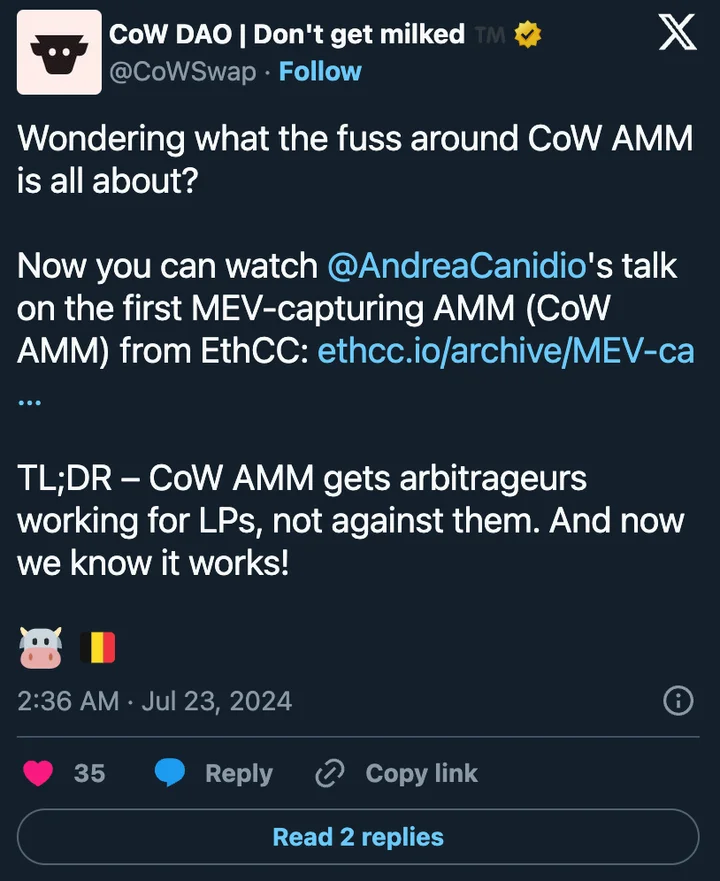 Despite the aforementioned headwinds, the AMM camp is making strong progress on LVR mitigation. CoW Swap’s CoW AMM (f.k.a. function-maximizing AMM) stood out at ETHCC as a clever LVR-aware AMM design that aims to return LVR back to LPs through an auction design. Moreover, by enabling solvers to bid to rebalance CoW AMM pools whenever there is an arbitrage opportunity, this model theoretically should make passive LPs meaningfully more profitable.
Additionally, there was a great talk given by Ken Ng at Uniswap labs that highlighted a handful of pending LVR-aware AMM designs set to release as “hooks” under Univ4. We should hear more from developing teams such as Sorella Labs on what exactly these designs will look like leading up to the official launch of Univ4 in November.
Therefore, despite the difficulties of LVR, it seems the AMM camp could be on the precipice of some breakthrough designs that enable efficient on-chain trading while importantly preserving passive liquidity provisioning.
Order-Books
The second path for on-chain trading is the order-book path. These individuals would make the case that instead of trying to preserve democratic and passive liquidity provisioning (and the technical hurdles — i.e., LVR — that come with it), we should instead embrace the oligopolistic natural resting state of market making. In other words, instead of executing trades through public and deterministic models, we should instead outsource this to the handful of centralized market makers running sophisticated and private proprietary strategies. After all, this is how things are run in TradFi which is optimized for best execution above all else.
While most order-book DEXs today are perp DEXs, we have slowly begun to see more spot DEXs emerge. Phoenix, built by the Ellipsis Labs team, currently has about 5% Solana spot volume market share. Additionally, we should see more order-book spot DEXs emerge on other high performance chains such as Monad in the near-future.
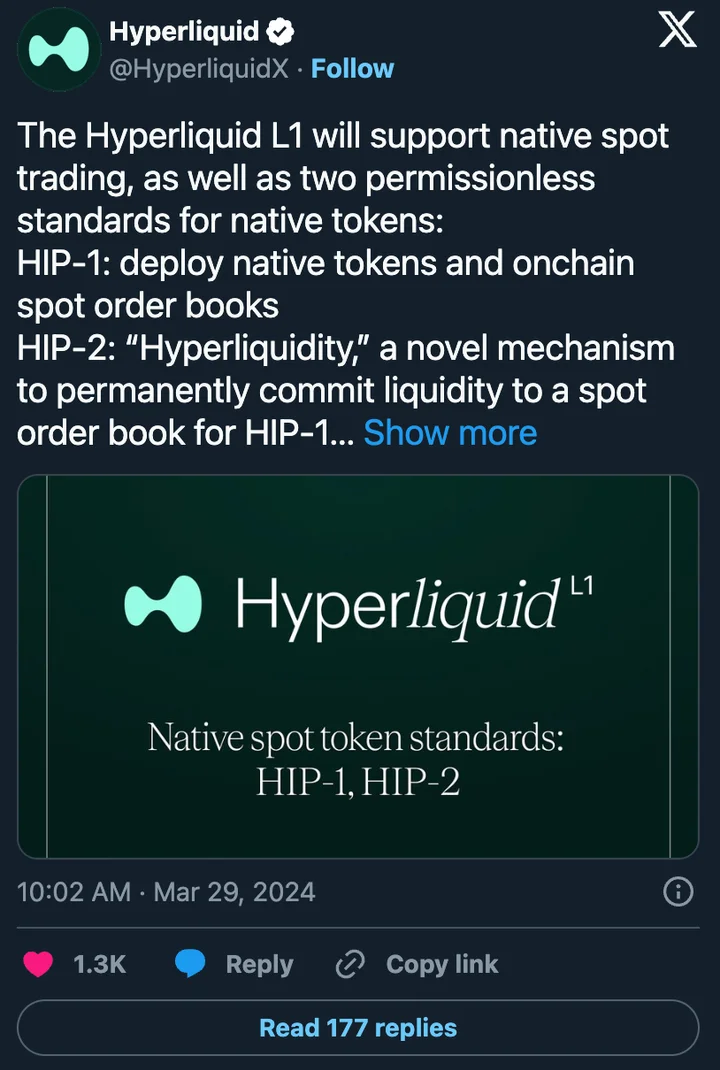 While an oligopolistic market structure for market making does feel antithetical to the ethos of DeFi, it is worth noting some attempts to solve this. Hyperliquid, who recently announced they will be offering spot trading, also announced that they
Read the full report
This report is part of Delphi Pro.
- 800+ Pro reports across every major sector
- Talk directly with our analysts
- Private community of funds and builders
Already a Pro member? Log in


0 Comments