Exploring Web3's Implications for Multi-Billion Dollar In-Game Item Economies
JUN 02, 2023 • 25 Min Read

Intro
As mobile gaming grew its share of the global games industry, representing roughly half of total revenue, the free-to-play (F2P) business was booming. Following a model of onboarding first and monetization later via in-app purchases (IAPs), F2P quickly carried the industry to new all-time highs. To put things into perspective, in 2022, Game of The Year winner Elden Ring, which followed a classic premium pricing model, amassed approximately $790.6M in primary sales revenue (not including deluxe editions, IAPs, and discounts). Genshin Impact, on the other hand, a completely F2P game, made roughly $1.8B during the same period.
It is for this reason that the number of F2P games released each year is increasing. Not only are the days when disgruntled gamers protested the release of horse skins far behind us, but today’s players have embraced certain IAPs, such as in-game cosmetics, to such an extent that they generate more revenue per month than some of the highest-rated games make in a year. NewZoo states that 85% of US gamers between the ages of 13 and 45 are aware of in-game cosmetics, with just under half claiming they use them. Their findings also showed the use of skins skewed toward a younger male demographic. However, on average, older gamers tend to spend more (roughly $15 per month).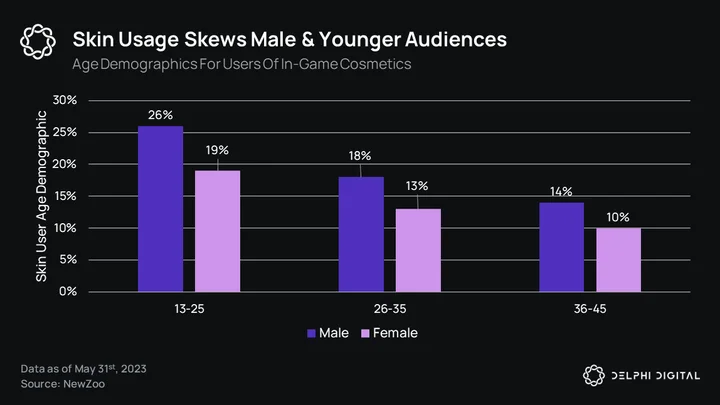
There is relatively little professional data on the total size of the skins market. However, consumers spent an estimated $67.9B on digital in-game purchases in 2022. DMarket, a blockchain-based skins marketplace acquired by Mythical Games in 2023, estimates the cosmetics market to generate $40B annually. 81% of US gamers want to get real-world money for their cosmetic items, and 75% of those interested in real money trade (RMT) stated that they would spend more on skins if they had real-world monetary value.
This report will analyze the current market trends, explore the potential for future growth, and pose the question: Are NFTs needed to drive increased value back to both players and developers?
Not as Easy as It Sounds
It is important to note that 10x-ing a game’s revenue via IAPs is not as simple as adding downloadable content (DLC) into an otherwise free game. Many have tried since Bethesda controversially experimented with the sales mechanic in 2006, but not all have succeeded. H1Z1, for example, was a third-person battle royale that showed early signs of promise when it sold 1M copies in the first two months after release in early 2015. The game featured loot crates containing cosmetic items that were randomly dropped during the game and could be traded between Steam’s Community Marketplace users. Due to the game’s initial popularity, some of these crates were highly sought after, such as the 2015 Invitational Crate, which could fetch as much as $15. However, after a series of lackluster game updates, player interest died down, and the game ultimately shut down not long after, with prices for the once-coveted crates crashing to zero.
PUBG is another third-person battle royale shooter that sold 1M copies in only two weeks. As tends to be the case, the combination of random item loot drops, an active player base, and the ability to engage in peer-to-peer asset trading quickly led to certain cosmetic items significantly increasing in price (in 2017, the right trench coat or skirt could cost several hundred US dollars). In fact, a specific type of loot box that contained many of the most sought-after items, the Pre-Order Crate, which was originally free with the $40 pre-order of the game, grew to $1,500. This rapid appreciation in price did two things — it caused many to speculate on the legitimacy of such market dynamics and it attracted a number of bad actors to these markets. As the number of scams, suspected incidents of money laundering, and underaged skin gambling (something we will touch on again later in the report) increased, PUBG Corp eventually decided to put a stop to it all by suddenly and indefinitely halting item trading.
Open vs. Closed Models
Broadly speaking, there are two main monetization models currently implemented by the most popular gaming titles that include some form of in-game purchasable items. The first are those that utilize a closed economic structure where players can use fiat currency to buy in-game assets, but these assets are then (according to the terms of service) stuck within the game. For the vast majority of games that fall within this category, not only are players unable to withdraw th
Read the full report
This report is part of Delphi Pro.
- 800+ Pro reports across every major sector
- Talk directly with our analysts
- Private community of funds and builders
Already a Pro member? Log in
0 Comments