FEI Supply Drop, Vesta Finance Liquidity Mining, Gamer's Review of Pegaxy
JUL 13, 2022 • 7 Min Read



Attention: Get Access to Delphi PRO For Just $1
In case you haven’t heard, we’re having a fire sale and your first month’s subscription to Delphi Pro is available for just $1. If you weren’t able to lock in your discount yesterday, we’re extending the offer period. Click here to sign-up in less than the next 24 hours!
Chart of The Day: FEI Supply Drops as TRIBE Hits All-Time Low
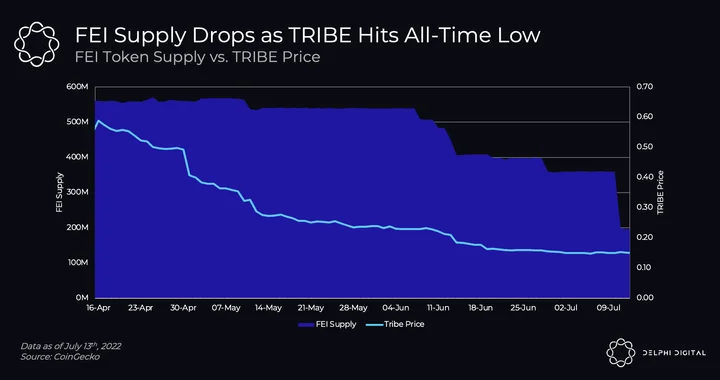
- On 10th July, FEI token supply dropped by 45% as the project burned 159M of protocol-owned FEI tokens. The protocol continues to hold $83M in FEI. See the burn transaction on Etherscan here.
- This follows an all-time low price for TRIBE, which touched $0.148 per token on 6th July. TRIBE is down 72% over the previous quarter, while ETH is down by 65%.
- The Fei Protocol is a stablecoin issuer that owns and manages a reserve pool of tokens, termed protocol-controlled value, to support direct minting and redemption of FEI at $1 per token. Users can mint or redeem FEI using a variety of assets, depending on market conditions.
- Currently, $117 million of user-owned FEI is backed with a 156% collateralization ratio, consisting primarily of DAI (44%), ETH (40%), LUSD (10%) and VOLT (6%).
- Recent governance actions taken by TRIBE holders include the deprecation of ETH, LUSD and RAI as acceptable collateral for minting or redeeming FEI. Currently, the only accepted collateral is DAI.
- Additionally, TRIBE holders have voted to stop emissions and remove all incentives across Curve, Uniswap, Aave and Rari Capital.
- For more on stablecoins, you can read a previous Delphi Daily report here.
Arbitrum Liquidity Mining, Bridge Farms, NFT Yield and Retroactive Airdrops
[Excerpt from a Delphi Insights report]

- Vesta Finance is a Layer 2-first lending protocol that allows users to obtain maximum liquidity against their collateral without paying interest. Vesta’s V1 is based on Liquity, a collateralized debt platform. Users can lock up collateral and issue Vesta’s stablecoin VST to their own Ethereum address, and subsequently transfer those tokens to any other Ethereum address. Learn more about it here.
- Yield Calculations are provided here. To access Vesta, you’ll need to configure your MetaMask to run Arbitrum One using this guide.
- Bridge: You can deposit and withdraw assets onto Arbitrum One using the Synapse Bridge.
- Emissions:
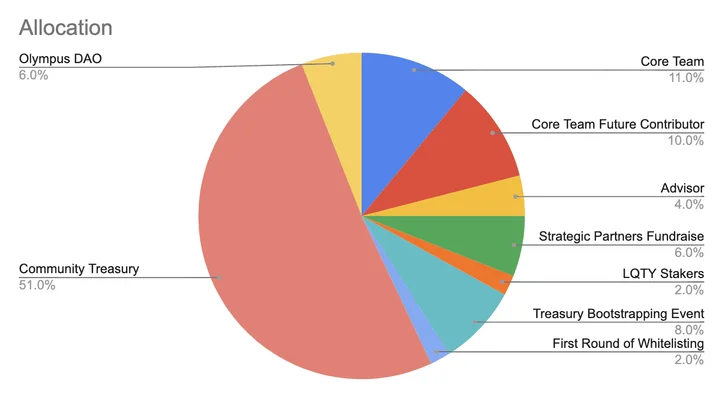
- Total Supply: 100M VSTA
- The Community Treasury (47% out of the 51% total supply) will be used to bolster growth, notably through yield farming programs
- Notable Unlocks:
- 25% (25M VSTA) of the total supply is allocated to Core Contributors and Advisors, vested linearly over two years with a six-month cliff
- 14% (15M VSTA) of the total supply is allocated to Partners and Angels, vested linearly over two years with a six-month cliff (read more about this round here)
- Stability Pool: Vesta primarily uses the VST tokens in its Stability Pool to absorb under-collateralized debt, i.e. to repay the liquidated borrower’s liability. Any user may deposit VST tokens to the Stability Pool. This allows them to earn the collateral from the liquidated vault. When a liquidation occurs, the liquidated debt is cancelled with the same amount of VST in the Pool (which is burned as a result), and the liquidated Ether is proportionally distributed to depositors.
- Stability Pool depositors can expect to earn net gains from liquidations, as in most cases, the value of the liquidated Ether will be greater than the value of the cancelled debt (since a liquidated vault will likely have an Individual Collateral Ratio slightly below 110%).
- Stability Pool Rewards: Stability pool providers earn VSTA tokens continuously over time, in proportion to the size of their deposit. The issuance rate is determined by the core team on a bi-weekly basis to ensure that there is enough liquidity in the stability pool.
- Liquidity Mining: To allow the VST stablecoin to reach critical mass quickly, the core contributors are allocating a fair amount of VSTA rewards to the initial farming program across five pools: VSTA-ETH, a VST-FRAX Curve Factory pool, and stability pools for the three launch collateral types. Learn more about Vesta’s tokenomics here.
- For more information, Delphi members can see the full Delphi Insights report here.
A Gamer’s Review of P2E Titles
[Excerpt from a Delphi Pro Report]

- Elevator Pitch: Pegaxy is a game where you can compete, breed, rent, and earn by racing mythological horses. It has a governance token (PGX), and an earn token (VIS). At its core, Pegaxy is a game of numbers. You combine the best stats with the best elements and then find a lobby complementary to your stat distribution.
- Accessibility: From a user acquisition perspective, the initial experience for someone freshly landing onto the site needs work. A game like Roblox has fantastic UI/UX. You enter the site, receive a quick sign-up message, click on a game, and then get the prompt to download. Roblox has 50+ million DAU (daily active users). The experience is designed to be as simple as possible.
- In contrast, this is what you need to do to play Pegaxy:
- Have a MetaMask wallet with ETH for gas
- Polygon Network with MATIC for gas
- If you don’t have funds on Polygon, you need to use a bridge which incurs 2 gas transactions
- There is no link to a Polygon bridge on the Pegaxy website
- You can use a credit card (minimum $2.50 fee) to buy MATIC or USDC but you still need to have the wallet
- Once funded, you can head to the marketplace, which is awash with different unexplained stats and Pega. There is an FAQ tucked away in the top menu bar, but it is not obvious. Once that is sorted, you can choose to buy or rent.
- Gameplay: The objective is to race your Pega to earn VIS, the utility token. Each Pega has a variety of stats, some of which complement each other and some of which don’t. The goal is to put the right Pega, with the right stats, in the right lobby. Each horse has 25 energy, which equates to 25 races per day. This is essentially just gambling software with the skin of a game. You pick your Pega and choose a lobby, and the rest is automated. You can watch the race in 2D or 3D. Outside of the actual “gameplay”, there are various breeding mechanics (which I factored into the narrative score) and items, but at the end of the day, this is truly just a numbers game — where the size of your wallet produces the greatest chances of winning.
- For more information, Delphi members can see the full Delphi Pro report here.
Notable Tweets
The Solution to Impermanent Loss
IL is never going away, but most users shouldn’t have to deal with it. Let them park their assets in a lending market, and have borrowers do the market-making (on margin). Lenders get yield and MMs get up to 40x capital efficiency.
More here:
— Hayden Shively (@hayden_shively) July 13, 2022
Trading Fees Across Centralized Exchanges
A summary of Trading fees analysis across spot exchanges// A Thread
https://theblockresearch.com/a-comprehensive-look-at-trading-fees-across-spot-exchanges-156694
Exchanges generate revenue by charging fees to their users for accessing various services like spot trading, margin trading, token listing, Initial Exchange Offering, and OTC deals.
— Atharv Deshpande (@deshpande_A96 ) July 11, 2022
The Source of Yield in DeFi
1/ The Source of Yield 🫙
A lot of focus is put on yield. People are willing to go to great lengths to get that sweet double- or triple-digit APR on their tokens.
There is nothing wrong with chasing yield, but it’s important to remember that not all of it is made equal…
— Trader Joe🔺 | We are Hiring! (@traderjoe_xyz) July 12, 2022
0 Comments